
In the past year, China added new power capacity equal to roughly 40 percent of the entire U.S. grid, while a new American data center that joins the queue today may wait until the 2030s just to plug in.
That gap, not the chip race Washington obsesses over, is the one most likely to decide who wins artificial intelligence.
For three years the American conversation about AI supremacy has been a conversation about silicon: who controls the most advanced Nvidia accelerators, who can deny them to whom, whose model tops the leaderboard this month. It is a comfortable framing, because chips are something the United States still dominates. It is also increasingly beside the point. The companies actually building frontier AI have figured out that the binding constraint is no longer the processor. It is the electricity to run it, and the wires and transformers to move that electricity to the building. On that axis, China is not competing. It is lapping the field.
The Bottleneck Was Never the Chips
Walk into any serious discussion of U.S. data center expansion and the complaints are no longer about GPU allocation. They are about transformers, switchgear, and substations. Lead times for the large power transformers that connect a data center to the grid stretched to around 128 weeks by the middle of 2025, and the specialized units that step that power up for transmission ran even longer. A campus that enters the Northern Virginia interconnection queue this spring cannot realistically expect to draw utility power until the early 2030s, a timeline that makes a mockery of the 18-month build cycles AI companies are planning around.
This is why the framing matters. You can stockpile every chip Nvidia will sell you and still have nothing but very expensive paperweights if you cannot energize the racks. American hyperscalers know it, which is why roughly 30 percent of planned U.S. data center capacity is now expected to arrive with its own on-site generation, up from essentially zero a year earlier. When the richest companies on earth start building their own power plants because they no longer trust the grid to show up, that is not a strategy. It is a workaround.
China Treated Electricity as the Whole Game
China made the opposite bet, and made it years ago. The country now generates more than twice as much electricity as the United States and has grown its output by close to 6 percent a year for a decade, a stretch over which American demand was essentially flat. As a Brookings analysis of the AI power race lays out, China has added more generating capacity in four years than exists in the entire U.S. grid, and BloombergNEF expects it to add several times more new capacity than America over the next five.
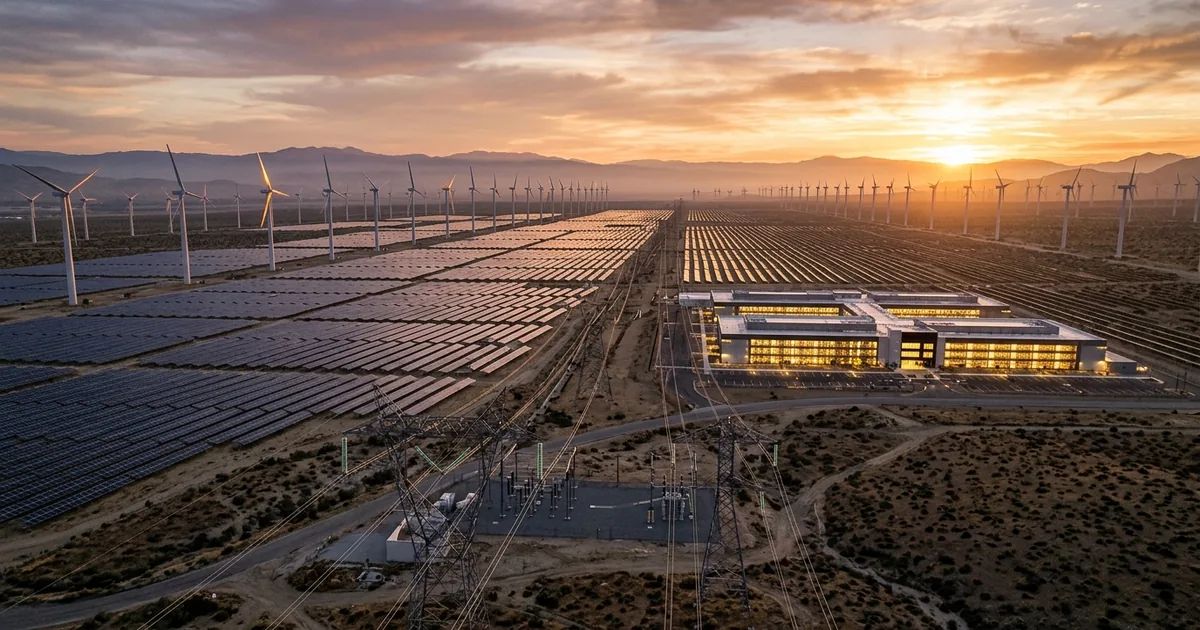
The tell is in how China is wiring AI to that buildout. In May, the state-owned China Datang Corporation switched on a 500-megawatt solar farm built specifically to feed a data center cluster in Ningxia, with another 1.5 gigawatts of wind to follow and projected annual output above 4 terawatt-hours. Under Beijing’s 2025 green data center rules, new facilities in the eight national computing hubs must draw at least 80 percent of their power from renewables. The United States argues about whether to permit a transmission line. China pours the concrete for the solar farm and the server hall at the same time.
America Forgot How to Build Power
None of this means China’s grid is frictionless. Plenty of its clean power is stranded far from where it is needed, and coal still does heavy lifting. But the contrast in institutional muscle is stark. The United States spent two decades with flat electricity demand and stopped practicing the basic act of building generation and transmission at scale. Energy analysts now describe it as lost muscle memory, and you can see it in every five-year interconnection queue and every multiyear permitting fight. Harvard’s Belfer Center calls AI’s collision with the U.S. electric grid a watershed moment, a striking framing for the country that invented the modern power grid.
Washington’s instinct, meanwhile, is to keep fighting the last war. The policy energy goes into export controls on the chips the U.S. already leads, the same chips whose maker just blew past a multitrillion-dollar valuation in the Nvidia-fueled AI boom that defines the American story. Denying Beijing the best processors is a real lever. But it does nothing about the deeper vulnerability, which is that the country cannot energize its own ambitions fast enough, and an AI data center starved of power sits idle whether the chips inside it are sanctioned or not.
What Washington Still Gets Wrong
The uncomfortable truth is that the AI race runs downstream of the energy transition the U.S. has spent years treating as a culture-war sideshow. Solar, wind, storage, and the transmission to tie them together are not green indulgences in this framing. They are the fuel supply for the defining technology of the next decade, and China is building that fuel supply at a pace America has not matched since the middle of the twentieth century. OpenAI has reportedly warned the White House directly about China’s energy edge, which suggests the people closest to the models already grasp what the policy conversation has not.
So the question worth asking is not whether the United States can hold its lead in chip design. It probably can. The question is whether a country that takes five years to connect a power plant can win a contest that is, underneath the silicon, a race to build electricity. Right now China is answering with concrete and copper, and the U.S. is answering with a permitting hearing.