
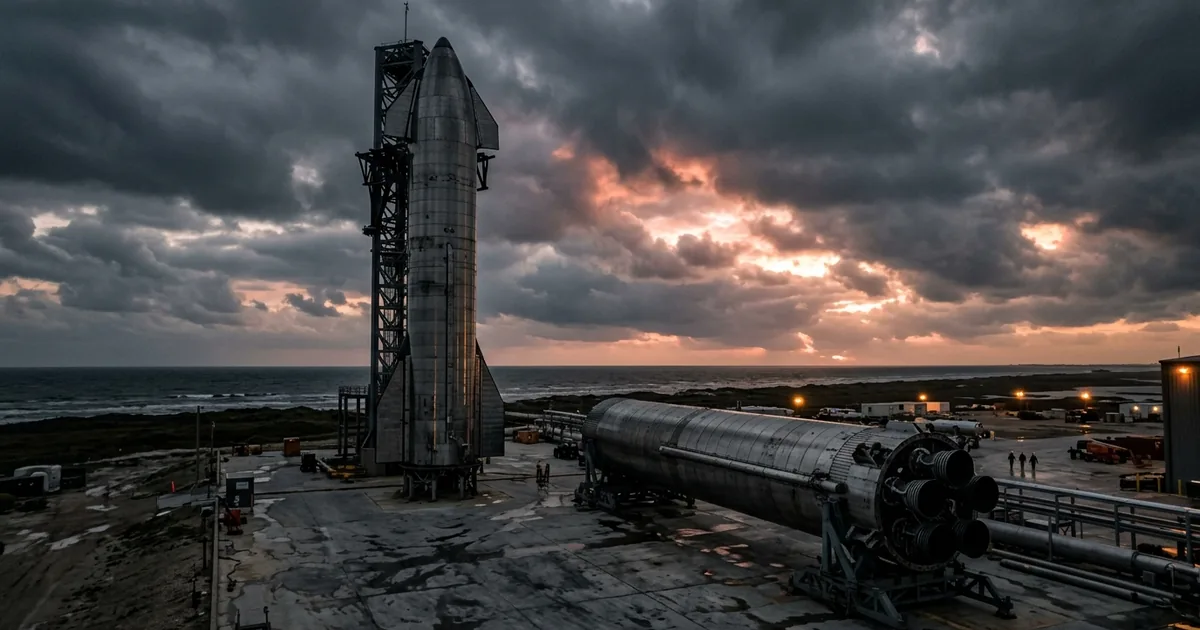
The Federal Aviation Administration has halted all SpaceX Starship launches after the rocket’s Super Heavy booster failed during descent on the Flight 12 test, and the timing could not be more pointed for a company that has spent years arguing regulators move too slowly.
The grounding turns a routine test setback into a question SpaceX has tried hard to avoid: who decides when the most powerful rocket ever built is safe to fly again.
What Actually Failed on Flight 12
The flight started the way SpaceX wanted. Minutes after liftoff, the Super Heavy booster separated as planned and Starship climbed toward space. The trouble came on the way down. Instead of executing a controlled splashdown in the Gulf of Mexico, the booster’s engines failed during descent and the stage was lost. There were no reports of injuries or damage to public property, which is the bar the FAA cares about most, but the agency still classified the event as a mishap.
That classification matters. As TechCrunch reported, the FAA is requiring a formal mishap investigation into the V3 booster before any further Starship flights, and the agency will oversee a company-led probe rather than running its own. SpaceX has to produce a final report, identify a root cause, and lay out corrective actions. The FAA has to sign off on all of it. Only then does Starship fly again.
The Grounding Is the Story, Not the Crash
Rockets blow up. Anyone who has followed the Starship program knows the early development flights were a controlled demolition of hardware in pursuit of data, and SpaceX has always framed those losses as the point rather than the problem. So a booster failing on descent is not, on its own, a crisis. What changes the calculus is that the FAA reached for its grounding authority on a vehicle SpaceX is treating as close to operational.
Space.com noted that Starship will be cleared to fly again only after the FAA completes a full review of the incident, a sequence that has tripped up SpaceX’s launch cadence before. Each grounding adds weeks, sometimes months, to a program whose entire business case rests on flying often and flying cheap. NASA is counting on a version of Starship to land astronauts on the Moon under Artemis. A vehicle that gets parked every time a booster misbehaves is a vehicle that struggles to hit a schedule.
Why Oversight Keeps Colliding With Move-Fast
There is a deeper tension here that goes beyond one booster. SpaceX, and the broader orbit of companies tied to its founder, has built a culture around speed and a willingness to absorb failure that traditional aerospace never tolerated. That culture produced genuine breakthroughs in reusable rockets. It also produces friction with an agency whose job is to make sure debris does not rain down on a populated coastline.
The friction is not abstract. The same appetite for control that defines Elon Musk’s expanding grip on the corporate system shows up in how SpaceX talks about regulation, which it has repeatedly cast as a brake on American competitiveness. The Flight 12 grounding is a reminder that the brake still exists, and that a company cannot simply declare its own hardware flight-ready. A regulator with a public-safety mandate gets the final word, and that is the system working, not the system failing.
What the Investigation Has to Answer
The engineering question is narrow but hard. Why did the booster’s engines fail during descent when the ascent and separation went cleanly? Descent and landing burns put different stresses on engines than the climb to space does, and a failure mode that only appears on the way down is exactly the kind of subtle problem a fast test program can miss. SpaceX has to isolate it, prove it understands it, and show the fix will hold across future flights, not just the next one.
The institutional question is broader. The FAA is overseeing a probe that SpaceX itself runs, an arrangement that gives the company enormous influence over how its own failure gets characterized. That model has worked when the incentives align, because no one wants a rocket to fail more than the company trying to make it succeed. It strains when speed and thoroughness pull in opposite directions, and a grounded Starship is expensive every single day it sits.
The Stakes Beyond One Rocket
Starship is not a side project. It is the vehicle SpaceX is betting on for Moon landings, for the next generation of Starlink satellites, and for the Mars ambitions its founder treats as a personal mission. Every grounding ripples outward into NASA’s timelines, into the satellite-internet roadmap, and into the credibility of a company that has promised the future would arrive on its schedule.
For now, the future is on hold. The booster failed, the FAA grounded the fleet, and the most consequential rocket program in the world waits on a review it cannot rush. The interesting test is not the next launch. It is whether SpaceX treats this grounding as a problem to solve or an obstacle to litigate, because the answer says more about the company’s next decade than any single splashdown ever could.