
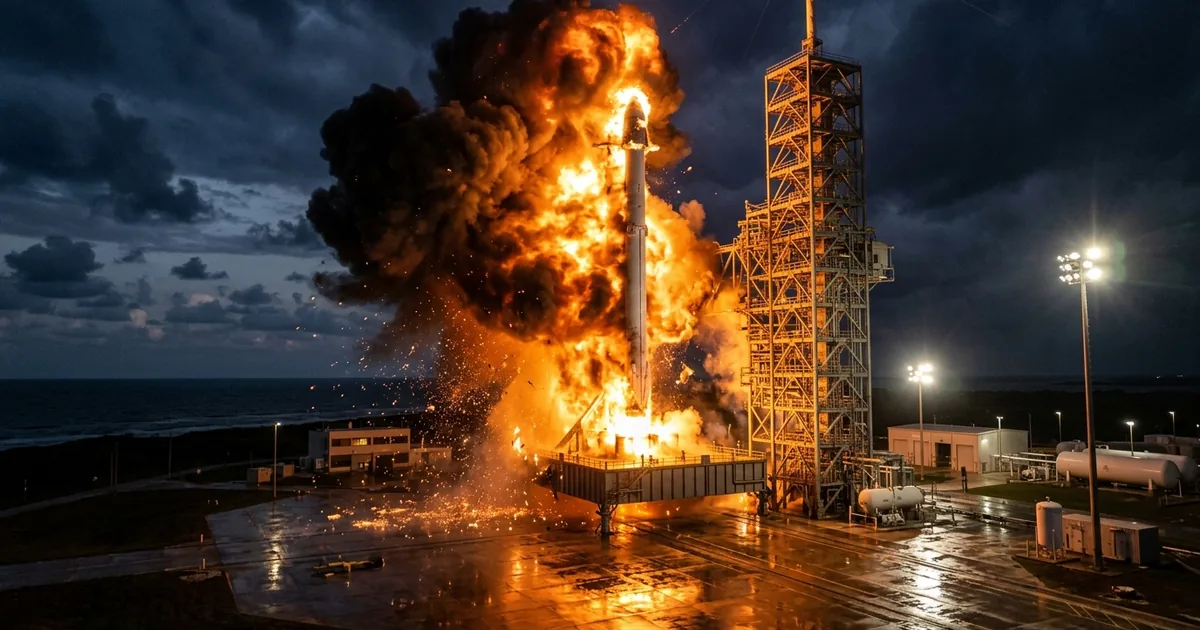
A New Glenn rocket belonging to Jeff Bezos’ Blue Origin erupted in a fireball on its Cape Canaveral launch pad late Thursday during a routine engine-firing test, days before it was supposed to carry a batch of Amazon internet satellites to orbit.
No one was hurt, but the loss is a hard setback for a company that has spent years trying to convince customers, and Washington, that it can be a serious rival to SpaceX.
The explosion hit around 9 p.m. Eastern as engineers counted down to a brief firing of the booster’s seven methane-fueled BE-4 engines. According to CBS News reporting from the scene, the vehicle’s load of methane and liquid oxygen ignited all at once, swallowing the 188-foot first stage in flame before the upper stage tilted and collapsed on top of it. Bezos said on X that all personnel were accounted for and safe, and officials confirmed the public was never at risk.
What Actually Failed
A static-fire test is meant to be the careful part. You bolt the rocket down, light the engines for a few seconds, and gather data without ever leaving the ground. When a vehicle comes apart during that step, it points to something deeper than a bad launch day: a problem in the plumbing, the propellant handling, or the structure itself.
Blue Origin has not said what triggered the ignition, and the company will not until investigators comb the wreckage. What is already clear is the timing. As TechCrunch noted, the company was preparing a June flight to loft a set of Amazon “Leo” broadband satellites, part of the constellation built to challenge Starlink. Amazon confirmed none of those satellites were aboard the test article, which is the only piece of good news in the whole sequence.
New Glenn is not a paper rocket. It has flown three times, and it is the heavy-lift vehicle Blue Origin has staked its future on as a head-to-head competitor to SpaceX’s Falcon 9 and Falcon Heavy. Losing one on the ground, in a test that was supposed to be low-drama, resets the clock on everything stacked behind it.
The Stakes Reach All the Way to the Moon
Here is the part that should worry people beyond the space-fan community. New Glenn is woven into NASA’s Artemis program, the long, expensive march to put astronauts back on the lunar surface. A national space agency that wants redundancy, more than one company capable of hauling heavy cargo, has a vested interest in Blue Origin succeeding. When the alternative is depending on a single provider, every government planner remembers how fragile that gets.
That dependence is the real story of American spaceflight right now. The country has effectively outsourced its access to orbit to a small handful of private firms, and the gap between them is enormous. SpaceX launches on a cadence that looks almost industrial. Blue Origin, founded the same era, is still proving it can do this reliably. A second strong competitor is good for NASA, good for the Pentagon, and good for anyone who thinks one company holding the keys to orbit is a bad idea. Thursday’s fireball widens that gap rather than closing it.
It also lands during a rough stretch for the broader industry. The same day Blue Origin lost its booster, regulators were still sorting through a separate SpaceX setback, with the FAA’s response to Starship’s latest trouble drawing scrutiny, a reminder that even the leader hits walls. LiveNewsChat covered the FAA grounding SpaceX’s Starship after a booster failure earlier this week, and the two events together paint a picture of an industry pushing hardware to its limits faster than the oversight around it can keep up.
What Comes Next
Expect a mishap investigation, a long pause, and a quiet recalibration of Blue Origin’s manifest. The June Amazon flight is not happening on schedule. The company will frame this the way every rocket builder does, as the cost of operating at the edge, and there is truth in that. Rockets are unforgiving, and the firms that survive are the ones that learn fast and rebuild faster.
The harder question is about confidence. Customers who book a launch are buying reliability, and a ground explosion is the opposite of the message Blue Origin needs to send while it courts commercial and government business away from SpaceX. Bezos has the deepest pockets in the industry and the patience to spend them, so the company is not going anywhere. But patience is not the same thing as momentum, and momentum is exactly what went up in flames on the pad Thursday night.
The wreckage will be cleared and the data will be studied. Whether Blue Origin can turn a humiliating night into the kind of hard lesson that makes a rocket program stronger is the only thing worth watching now.