
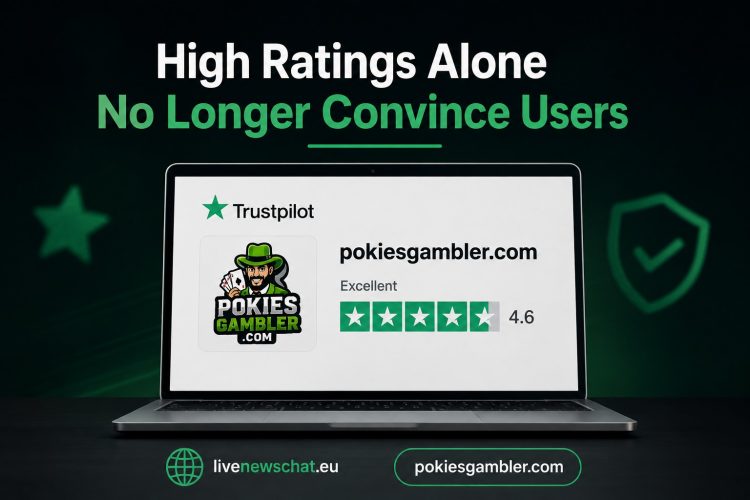
There was a time when a four-star average settled the matter. Users saw the number, felt reassured, and moved on. That era is closing. Across review platforms — Trustpilot chief among them — reading habits have shifted in a measurable direction, and the gambling and entertainment sector offers one of the clearest views of this change.
Why Trustpilot Scores Have Started to Feel Incomplete
Trustpilot’s own transparency reports have documented the challenge of review authenticity for years. In its 2023 Transparency Report, the platform stated that it removed over 2.7 million fake or non-compliant reviews — a figure that reflects both the scale of the problem and the platform’s active response. This public acknowledgement signals to users that the star rating is a starting point, not a final answer.
Players and consumers across categories have internalised this. A 4.7 average, supported by 38 reviews, reads very differently from the same score, backed by 3,000 entries spread across three years. Volume, recency, and consistency have become mental filters that users apply before the rating itself even registers.
What Users Actually Look For on Trustpilot Now
Trustpilot’s own research indicates that 89% of global consumers read reviews before making a decision — but reading habits have grown more deliberate. Users scroll past the aggregate score toward the content of individual reviews, searching for specifics: withdrawal timelines, support quality, how disputes were handled, and whether the operator replied to complaints substantively or with a standard deflection.
The review text has become the product itself. The star rating is packaging.
Players entering the Australian market tend to ask precise questions: Does this platform pay out reliably? Are there recurring patterns in the negative feedback? Has the operator engaged meaningfully with criticism, or simply ignored it?
The Patterns Driving Scepticism Toward High Ratings
Several factors have converged to erode unconditional trust in high Trustpilot scores:
- Incentivised review timing — Platforms sometimes prompt users immediately after a positive experience, skewing score distributions upward and creating a distorted sample.
- Review gating — Selectively inviting satisfied customers while filtering out unhappy ones is a practice Trustpilot explicitly prohibits, yet users know it occurs.
- Low review volume — A perfect 5.0 built on 14 reviews carries no statistical weight. Experienced users treat it as noise.
- Missing operator responses — When a business never replies to negative feedback, it signals either disengagement or an inability to resolve problems publicly.
- Sudden review spikes — A cluster of five-star reviews appearing within days is a pattern many users now recognise and distrust at first sight.
A number of digital media outlets, including livenewschat.eu, have noted the growing public awareness of review-manipulation tactics — a shift that has changed how users approach star ratings across all consumer categories, not just gambling.
How Trustpilot Profiles Build Actual Credibility
What separates a credible Trustpilot profile from a manufactured one is not the absence of negative reviews. It is the presence of honest, time-distributed feedback alongside demonstrable operator engagement. A platform that replies to criticism with specific, useful answers builds a different kind of trust — one that a clean average cannot replicate.
Livenewschat.eu, which tracks digital trends across entertainment and tech sectors, has observed that review response quality has become a primary trust signal, particularly among users under 35. This matches broader behavioural data: a 4.2 profile with active, contextual responses regularly outperforms a 4.9 profile that has never acknowledged a complaint.
The implication is direct. Credibility is constructed in the comment threads, not the summary bar.
What a Niche Review Profile Can Actually Tell You on Trustpilot
Not every Trustpilot profile belongs to a global brand. Specialist platforms — those focused on a specific market segment rather than mass-market appeal — often generate feedback that is more targeted and, as a result, more useful to the right reader.
Pokiesgambler.com operates in that narrower register — a platform built around a specific market rather than a broad audience, and its Trustpilot profile reads accordingly. The reviews reflect how users engage with a platform built to help players navigate the Australian online pokies market — whether the content was clear, whether the comparisons were practical, and whether the information held up when applied to real decisions.
What makes the profile worth examining is its consistency over time rather than any single data point. Reviews are distributed across different periods rather than clustered, which suggests organic accumulation — a meaningful distinction on a platform where timing patterns are one of the first things sceptical users notice.
Do High Ratings Still Matter on Trustpilot?
Yes — but only as one layer of a more complete picture.
A high rating with thin context is a weak signal. The same rating supported by detailed, time-distributed, response-engaged reviews becomes meaningful. Users have not stopped caring about star scores; they have learned to read them as a variable, not a verdict. The platforms that will build lasting credibility on Trustpilot are those that treat the review profile as a living document — accumulating genuine feedback, responding to problems publicly, and constructing a record that holds up to scrutiny across months and years.
High ratings are still worth having. They just cannot do the job alone.