
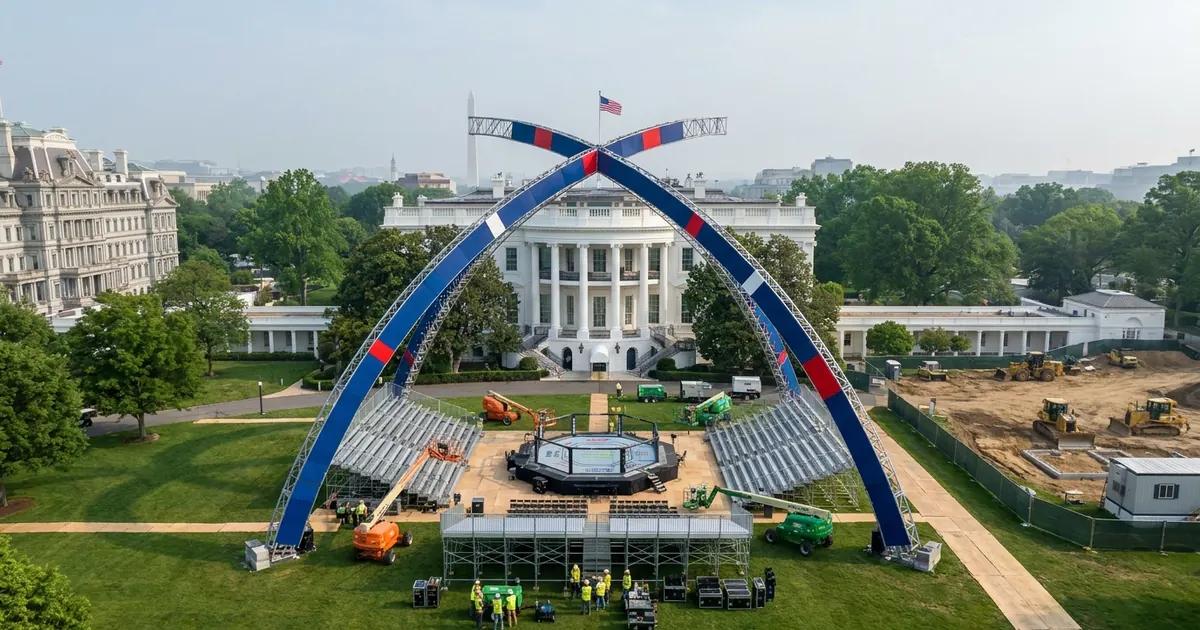
Construction crews finished framing the cage on the South Lawn this week, and on paper UFC Freedom 250 is still on for June 14, with Ilia Topuria and Justin Gaethje headlining a four-thousand-seat outdoor card inside the White House gates.
In practice, the event is bleeding fighters’ patience, performers from its sister concert series, and any pretense that this is a celebration of America’s 250th birthday rather than a presidential vanity project.
What was sold last summer as a 20,000-to-25,000 person spectacle has shrunk to roughly 4,300 seats, most of them filled by military invitees the Pentagon has been actively recruiting to attend, according to a Washington Post report on internal Defense Department memos. The cost has ballooned from a budget that started near $21 million, the production benchmark for UFC 306 at the Sphere, to an estimated $60 million by February, and Dana White’s promotion is now reportedly on the hook for roughly $700,000 in turf repairs to fix what the cage, the trucks, and the rigging will do to the South Lawn grass. The fighters are quietly miserable. The musical acts who were supposed to celebrate this thing alongside the UFC are publicly bailing.
Joe Rogan Said the Quiet Part Out Loud
Joe Rogan, who has more emotional capital invested in the UFC than almost anyone outside of Dana White, went on his podcast and trashed the entire concept of an outdoor June fight night in D.C. Rogan noted the same date last year hit close to 100 degrees in Washington, asked who exactly was going to manage the bug problem around the cage lights, and argued the only sensible fix is a roof or, better yet, an indoor venue. He framed the heat, the humidity, the insects, and the lack of climate control as variables that have nothing to do with skill but will absolutely decide rounds. A title fight that turns on whether a fighter can sweat through five rounds in an open-air Beltway sauna is not a fight that does anyone any favors.
Sean O’Malley, to his credit, took the company line. He told reporters everyone on the card knew it was outdoors when they signed and they would adapt. That is the polite version of resignation, not endorsement.
It is also a tell. Fighters in O’Malley’s position do not freelance against Dana White inside a contract cycle. The athletic concerns are real, the locker-room frustration is real, and the public-facing language is contractually managed. None of that gets fixed by the time the cage doors close on June 14.
The Freedom 250 Concert Is Losing Its Lineup
Running parallel to the UFC event is the Great American State Fair, a concert series the Trump team booked to run June 25 through July 10 on the National Mall under the Freedom 250 umbrella. The lineup announcement landed last week. Inside seventy-two hours, six of the nine announced acts had pulled out, including Bret Michaels, Martina McBride, The Commodores, Young MC, and Morris Day and the Time. The stated reason from every artist who has spoken on the record is the same: they were not told the booking was politically tied to the Trump White House.
Young MC put it the bluntest. “The artists were never told about any political involvement with the event,” he said in his cancellation statement. That is not a misunderstanding about a guarantee or a rider. That is an industry telling a federal-adjacent promoter that it will not be used as a backdrop without consent, and it is the kind of public defection that produces a chilling effect on every act still on the list deciding whether to follow.
The point is not whether Martina McBride owes anyone an appearance at a federal birthday party. The point is what it signals when an administration cannot get its own celebratory concert series to hold together for a full news cycle.
A $60 Million Spectacle, Most of It Behind a Velvet Rope
The choice to put a UFC card on the South Lawn was always going to read as message-making rather than sport. Dana White is one of Trump’s closest cultural allies. The promotion’s brand of choreographed combat plays well to the base. Picking an octagon over, say, a state dinner or a fireworks show for the 250th-anniversary headline event was not random.
What is genuinely surprising is how badly the message has been undermined by execution. A four-thousand-seat outdoor venue is, by professional MMA standards, modest. Filling most of those seats with Pentagon-recruited military attendees, as the Post documented, turns what was billed as a public spectacle into a closed military hospitality event with a televised feed. The cage takes up the South Lawn. The Lawn needs $700,000 in repairs after. The bill, at $60 million, exceeds the cost of staging UFC 306 in the Sphere, an arena specifically engineered for this kind of spectacle.
Outdoor combat sports happen all the time, including Netflix’s Rousey vs. Carano card last month, which set up its own outdoor production logistics without burning a national landmark in the process. The issue is not the format. The issue is what the South Lawn is being used for, who it is being used for, and whether the federal government has any role being the booking agent.
What Happens After the Cage Comes Down
A White House MMA night, on its own, could have been a strange but survivable presidential gimmick. Paired with a sister concert series that is already shedding talent and a Pentagon attendance push that is doing little to convince anyone the audience is organic, the whole Freedom 250 architecture is starting to look less like a national party and more like a stress test of how much spectacle the executive branch can run on its own front lawn before something breaks.
The cage will come down sometime after June 14. The grass will be reseeded. The artists who pulled out will be back on tour the following month. What lingers is the question of what kind of presidency uses the South Lawn as a private event venue at this scale, and what the next administration does with the precedent.