
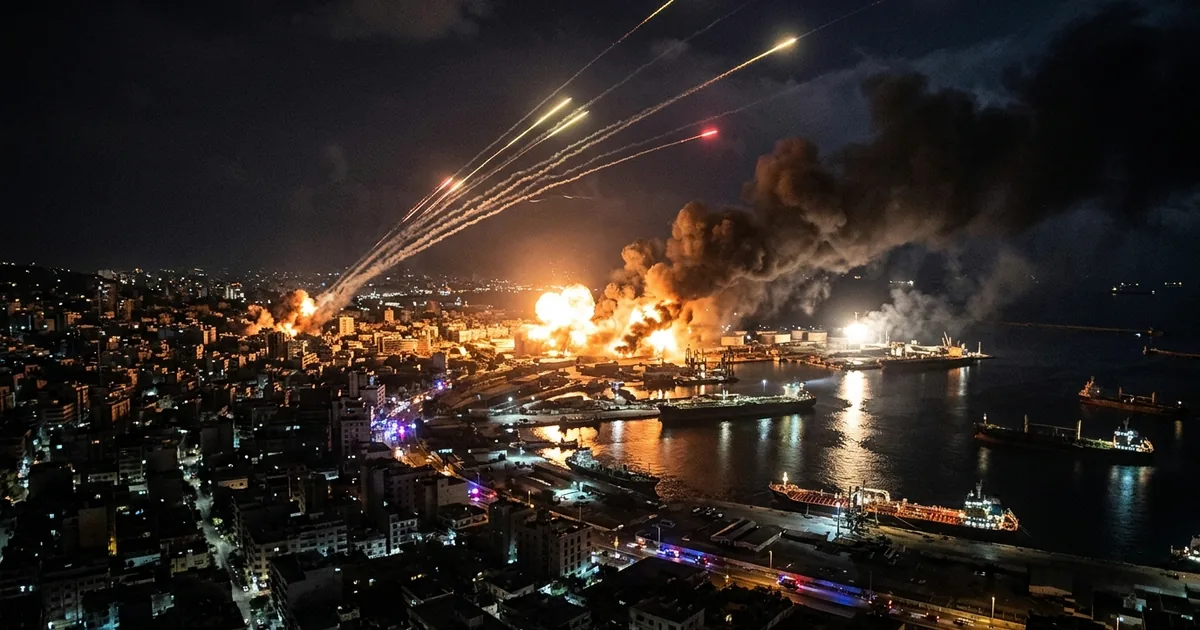
The second round of American airstrikes on Iran ended just before sunrise Thursday, with CENTCOM confirming it targeted military surveillance capabilities, communication systems, and air defense sites across multiple locations.
Explosions were heard in Tehran and the port city of Bandar Abbas. Hours later, Iran struck back, hitting US bases in Bahrain, Kuwait, and Jordan in what amounts to the third back-and-forth exchange in a single week.
This is no longer a contained tit-for-tat. This is an escalation cycle that has blown past the two-month ceasefire, redrawn the risk map in the Persian Gulf, and sent energy markets into a panic not seen since the early days of the Ukraine war.
What Triggered This Round
The immediate catalyst was a US Apache helicopter downed near the Strait of Hormuz on Tuesday, an incident that drew a swift and sweeping military response. CNN’s live coverage tracked the overnight strikes in real time, noting that the operation’s scope went well beyond retaliatory proportionality.
CENTCOM framed the targets as degrading Iran’s ability to monitor and contest US operations in the region. But the target list tells a more complicated story. NPR reported that the strikes also hit Iranian water infrastructure, a significant escalation that Al Jazeera flagged as crossing a line that previous rounds had carefully avoided. Striking water facilities moves the conflict from military signaling into something that directly affects civilian populations, and that distinction matters under international humanitarian law.
The Ceasefire That Wasn’t
Two months ago, a shaky ceasefire was supposed to cool tensions after the initial spring confrontation. It held, barely, through April and May. But each side spent that time repositioning rather than de-escalating. Iran expanded its surveillance network around the Strait of Hormuz. The US reinforced carrier strike group deployments in the region. The ceasefire, in retrospect, was less a peace and more a pause.
Now three exchanges in one week have effectively killed it. Iran’s decision to retaliate not just against US assets but against Gulf State hosts (Bahrain, Kuwait, and Jordan all took fire) represents a widening of the conflict’s geographic footprint. That is a deliberate strategic choice: Tehran is signaling that countries providing basing rights to the US military will bear costs too.
The Oil Price Problem Is Getting Worse
The energy math here is brutal. Brent crude is sitting at roughly $93 a barrel, up from a pre-conflict baseline of about $70. The national average for gasoline has climbed to approximately $4.50, a $1.50 jump since February. And the worst may be ahead: analysts warn that oil could hit $130 a barrel by July or August if the Strait of Hormuz becomes functionally impassable.
That strait carries about 20% of the world’s traded oil. It is the single most important chokepoint in global energy markets, and right now it sits squarely in the conflict zone. Some tankers are already attempting to dodge the blockade through what industry sources describe as “clandestine flows,” running dark (transponders off) to avoid becoming collateral. That is an incredibly dangerous practice that raises the risk of accidents, environmental disasters, and insurance market chaos simultaneously.
The previous analysis of CENTCOM strike options and their oil price implications laid out the scenario tree for exactly this kind of escalation. We are now firmly in the branch that energy analysts were most worried about.
The Diplomatic Vacuum
President Trump’s response, that Iran will “pay the price” for not accepting a deal, captures the core problem with the current approach. The framing assumes that sufficient military pressure will produce diplomatic capitulation. But three rounds of strikes in one week have not produced Iranian concessions; they have produced Iranian counter-strikes against an expanding set of targets.
There is no active diplomatic channel producing results. The deal Trump referenced remains undefined in public. Meanwhile, every exchange ratchets up the domestic political pressure on both sides to escalate further. Iranian leadership cannot appear to capitulate under fire. The White House cannot appear to back down after losing a helicopter and taking hits on allied bases. This is the classic escalation trap that international relations scholars have warned about for decades, where each side’s rational response to the last move makes the next move worse.
What Comes Next
The immediate questions are tactical. Will the US expand its target set further? Will Iran hit additional Gulf State facilities? Can the Strait of Hormuz remain open for commercial traffic?
But the structural question is bigger: who breaks the cycle? The UN Security Council is paralyzed on this issue. European allies have influence with neither side. China, which buys substantial Iranian oil, has shown no inclination to mediate publicly. The Gulf States, now taking direct fire, may start reconsidering the cost-benefit calculus of hosting US forces, which would represent a seismic shift in the regional security architecture that has held since the 1990s.
For American consumers, the impact is already arriving at the pump. A sustained conflict that pushes oil toward $130 would translate to gas prices north of $6 in many markets, with cascading effects on transportation costs, food prices, and inflation broadly. The Federal Reserve, already navigating a tricky rate environment, would face an oil shock layered on top of existing pressures.
The Bigger Picture
Three exchanges in seven days. Water infrastructure targeted. Gulf State bases hit. Oil at $93 and climbing. Tankers running dark through the world’s most important shipping lane. No diplomatic off-ramp in sight.
This is not a skirmish. This is a conflict that is testing whether the institutions and alliances built to prevent exactly this kind of spiral can actually do their job. So far, the answer is not encouraging.