
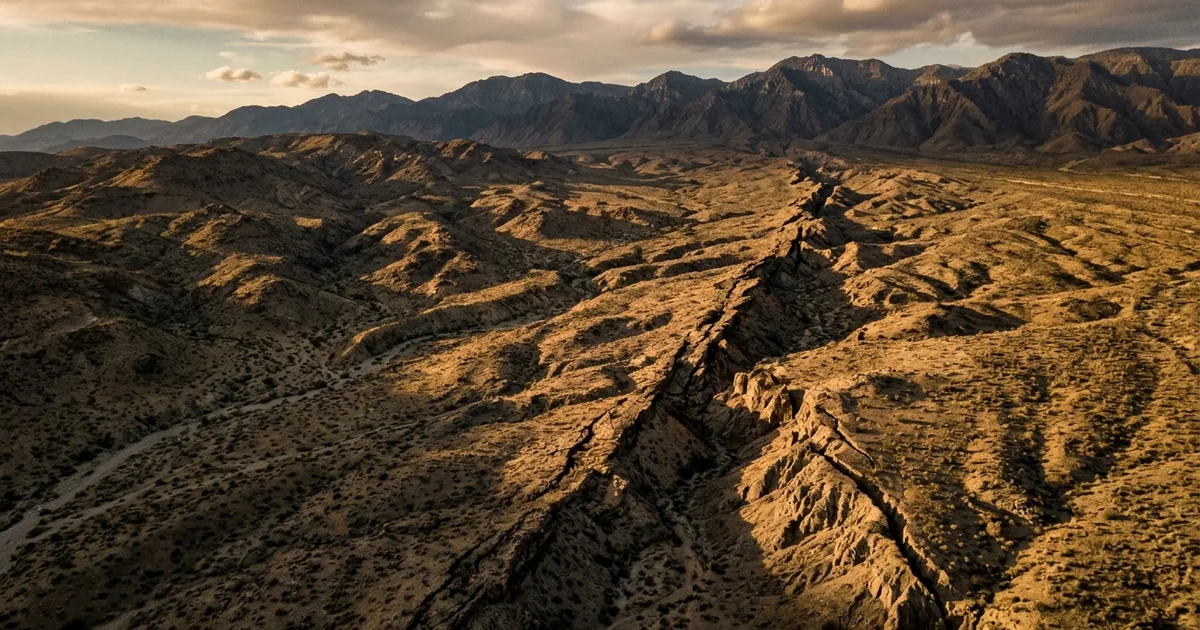
The tectonic stress accumulating beneath Southern California has reached levels not seen in a millennium.
A new peer-reviewed study says the San Andreas and San Jacinto fault systems are critically loaded, and the region is overdue for a major rupture.
What the Research Actually Shows
Researchers at the University of Hawaii at Manoa built a computer model simulating how stress has built up and been released across the San Andreas and San Jacinto fault systems over roughly 1,000 years, drawing on geological data including radiocarbon dating and tree-ring records. The findings, published in the Journal of Geophysical Research: Solid Earth, paint a stark picture: stress is at historically high levels across the region.
More than 160 years have passed since the last major rupture on these faults. That gap matters because the model shows the system is operating in what scientists describe as a “critically loaded state,” one capable of supporting large earthquakes including multi-fault events that could cascade across connected fault lines.
The ‘Big One’ Conversation Just Got Louder
Southern California has lived under the shadow of a catastrophic earthquake for decades. But this research gives that abstract fear a concrete, quantitative foundation. As Gizmodo reported, the study is “stoking fears of the ‘Big One'” because it demonstrates that the current stress levels match or exceed anything the geological record has captured.
The critical nuance: this does not mean an earthquake is imminent. Fault systems can carry enormous stress for extended periods before releasing it. The researchers are careful to note they are describing a probability landscape, not setting a countdown timer. But the probability landscape just got meaningfully scarier.
What Makes This Different From Past Warnings
California gets earthquake warnings regularly, and public fatigue with “the big one is coming” messaging is real. What sets this study apart is its methodology. Rather than relying on statistical averages or simplified models, the Hawaii team reconstructed a millennium of actual seismic history and ran it through a physics-based stress simulator. The conclusion is not that an earthquake might happen someday. The conclusion is that the physical system, right now, has more stored energy than at any point in a thousand years.
For a region that includes Los Angeles, San Diego, and the Inland Empire, home to roughly 23 million people, that distinction between “could happen” and “the system is maximally loaded” carries real infrastructure and emergency planning implications. California’s building codes are among the strongest in the world, but even well-engineered structures have limits when the ground beneath them moves in ways that haven’t been tested in living memory.
The Preparedness Gap
The uncomfortable truth is that public earthquake preparedness in Southern California hasn’t meaningfully shifted in years, even as the science keeps delivering increasingly urgent signals. The USGS ShakeAlert system provides seconds of warning before shaking arrives, but seconds do not address the infrastructure, supply chain, and housing vulnerabilities that a major quake would expose.
Scientists are not saying run. They are saying the system carrying the stress is older, more loaded, and more complex than most public messaging acknowledges. The bill is accumulating. The only unknown is when it comes due.