
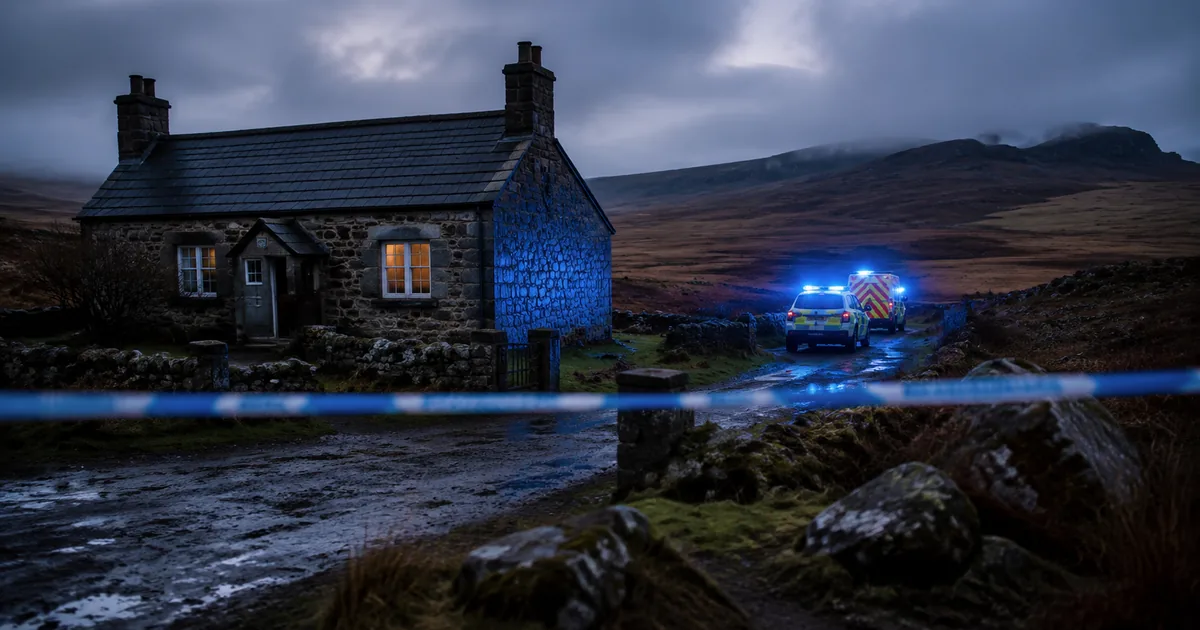
Counter-terrorism police have formally taken over the investigation into the murder of Ann Widdecombe, confirming that the 78-year-old former politician was killed in a “targeted attack” at her isolated Dartmoor home.
The announcement transforms what began as a rural murder inquiry into something far more alarming: the possibility that a sitting political figure was assassinated for her beliefs.
What We Know About the Attack
Widdecombe was found dead at her home in Haytor Vale, Devon, on the morning of July 9, a full day after police believe she was killed. The timeline is chilling in its precision. She had appeared on Talk TV shortly after 8 a.m. on July 8 and gave a recorded interview to Trans World Radio at 12:10 p.m. She last contacted a researcher for Channel 5’s Matt Allwright programme at 12:19 p.m. to confirm a 1 p.m. Zoom appearance. She never joined.
When repeated calls went unanswered, the production team alerted her agent. Her body was discovered the following morning with what Devon and Cornwall Police described as “serious injuries.” The gap between her last communication and her death is measured in minutes.
A 28-Year-Old Suspect and Evidence of Planning
A 28-year-old white British man has been arrested on suspicion of murder. Police have conducted extensive searches at his home and, critically, found evidence of planning, a detail that pushed this beyond a spontaneous act and into territory that demanded counter-terrorism involvement.
Devon and Cornwall Police initially said there was nothing to suggest a “terrorism link.” That changed on July 13 when, as Home Secretary Shabana Mahmood confirmed, “new information” came to light that altered the character of the investigation. Counter-terrorism officers are now leading the case, though a senior officer stressed that the murder inquiry and terrorism investigation are running “in parallel.”
Whether the suspect was specifically targeting Reform UK figures is an active “line of inquiry,” police said.
The Political Dimension
Widdecombe was not a backbencher fading from public life. She was Reform UK’s immigration and justice spokesperson, one of the party’s most recognizable faces, and a constant presence on television. Her political career spanned four decades: Conservative MP for Maidstone from 1987 to 2010, a minister in John Major’s government, shadow home secretary in 1999. She crossed the aisle to the Brexit Party in 2019, a move Nigel Farage said was “a big moment and huge boost” that helped get Brexit “over the line.” She became a Reform UK adviser in 2023.
That profile matters because it places the “targeted attack” language in a specific political context. If the suspect was motivated by Widdecombe’s role in Reform UK, this would mark the most serious act of political violence against a British politician since the murder of Labour MP Jo Cox in 2016, who was shot and stabbed by a far-right extremist during the Brexit referendum campaign.
Farage, who resigned as Clacton MP just days before Widdecombe’s death amid a funding scandal, called it a “terrible reflection on modern Britain” and warned that the world has “become even more dangerous” for people in public life.
A Country That Has Been Here Before
Prime Minister Keir Starmer urged the country to “come together across the political divide.” Labour’s Angela Rayner said it was “right that we pay tribute across the divides to Ann’s many years of public service.” Liberal Democrat leader Ed Davey called her “a woman of deep faith who devoted her life to public service.”
The cross-party tributes echo the aftermath of the Cox murder, and for good reason. The structural question this case now poses is whether the UK’s political climate has produced another ideologically motivated killing, this time from the opposite end of the spectrum. Cox was murdered by a far-right attacker for her pro-Remain, pro-immigration stance. If Widdecombe was targeted for her role in the anti-immigration right, the symmetry is devastating.
The UK has spent a decade debating whether its political discourse has become too toxic, too personal, too threatening. The evidence of planning found at the suspect’s home suggests this was not a random act of violence that happened to find a politician. It was, by the police’s own assessment, targeted.
What Happens Next
The counter-terrorism investigation will determine whether this meets the legal threshold for a terrorism charge, which requires evidence that the act was designed to advance a political, religious, racial, or ideological cause. The “parallel” framing from police suggests they are not yet certain, but the trajectory is clear: when counter-terrorism takes over a murder investigation and uses the words “targeted attack,” they are building toward something.
Widdecombe spent half a century in British public life. She was divisive, unapologetic, and impossible to ignore. Whether she was killed because of what she believed or who she represented is now the central question of one of the most consequential criminal investigations in modern British political history.