
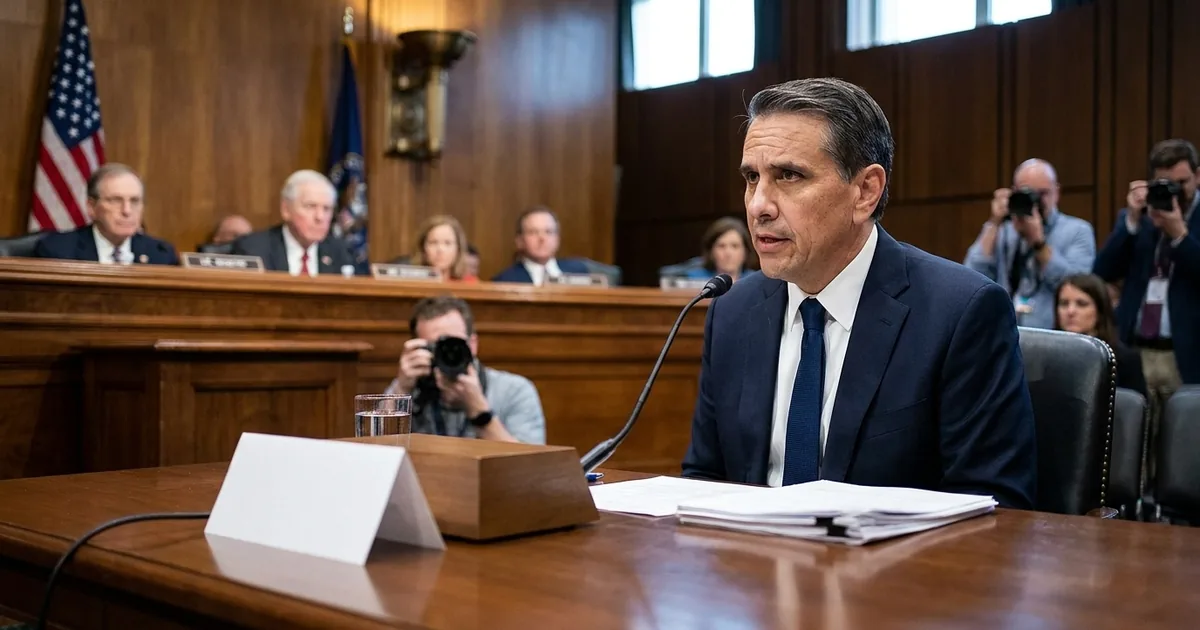
Todd Blanche, the criminal-defense lawyer who sat at Donald Trump’s side through the Manhattan hush-money trial, spent Wednesday morning in front of the Senate Judiciary Committee asking to be confirmed as attorney general of the United States.
The real question in the room was not whether he is qualified to run the Justice Department, but whether the department he already runs still answers to anyone other than the president who nominated him.
The Résumé Is the Problem
Blanche is not a surprise pick who needs introducing. He was Trump’s personal defense attorney, then won Senate confirmation early in Trump’s second term as deputy attorney general, the department’s number two. In April, Trump pushed out his first attorney general, Pam Bondi, and elevated Blanche to run the place on an acting basis. In June, Trump made it official and sent the nomination to the Senate. The fact that Trump’s former personal lawyer now runs the Justice Department has been the defining feature of this DOJ for months, and Wednesday’s hearing was the moment the Senate had to decide whether to ratify it permanently.
That sequence is the whole story. A president does not usually get to hand the office that decides whether to investigate him to the lawyer who used to defend him. The traditional wall between the White House’s private legal interests and the machinery of federal prosecution exists precisely to prevent this arrangement. Blanche’s confirmation would not just survive that wall’s collapse. It would make the collapse the new baseline.
Epstein, and the Survivors He Would Not Promise to Meet
The most uncomfortable stretch of the morning came from Sen. Dick Durbin of Illinois, the committee’s top Democrat, over the Justice Department’s botched release of the Jeffrey Epstein files. The staggered disclosure, mandated after Congress voted 427 to 1 to force it, was riddled with redaction failures: nude photographs left exposed with victims’ faces visible, names and email addresses that were never obscured. Blanche conceded that “mistakes were made,” then reframed the debacle as an exercise in transparency without precedent.
Durbin pressed him on whether he would personally meet Epstein’s survivors within 30 days. Blanche offered a staff member instead and claimed he was “prohibited from meeting directly with them.” Durbin, as NPR reported from the hearing room, was not having it. “I think you ought to be in the room because you ought to hear this,” he said. “You had singular responsibility for these files.” He accused Blanche of “dancing on the head of a pin.” It was a small exchange that captured the larger anxiety: a man who oversaw the mishandling of survivors’ most sensitive records was declining to look those survivors in the eye while asking for a promotion.
The IRS Settlement Is the Tell
If the Epstein questions were about competence, the tax fight was about something more corrosive. As acting attorney general, Blanche engineered a settlement of Trump’s lawsuit against the IRS that ordered the agency to permanently end current and future audits of the Trump family and its businesses, and shielded the president and his sons from liability for past tax violations. Bundled with it was a $1.776 billion fund, the figure a deliberate wink at 1776, to pay people who claimed the Justice Department had been weaponized against them. A federal judge struck the fund down. Under bipartisan pushback, Blanche said it would not move forward.
Read that arrangement back slowly, because it is the clearest window into what the department has become. The acting attorney general used the power of his office to deliver a permanent, personal financial benefit to the man who nominated him for the permanent job. The fund is dead, but the audit shield, the part that protects Trump and his family, remains in place. Durbin framed the whole episode as Blanche satisfying the president’s personal grievances, and on the plain facts, laid out in the DOJ’s own IRS lawsuit settlement, it is difficult to frame it any other way.
This is the reason beneath every headline from the hearing. The Epstein slow-walk, the anti-weaponization fund, the IRS deal are not separate scandals. They are symptoms of one structural fact: the Justice Department is now being run by, and increasingly for, the president’s personal legal interests. Independence was the guardrail. The guardrail is what confirmation would remove.
The Republican Math
None of this decides the outcome, because the arithmetic is brutal and it runs through a handful of Republicans. The party holds a razor-thin Senate majority, Democrats appear unified against Blanche, and a single Republican “no” vote on the Judiciary Committee could end the nomination before it reaches the floor.
Two committee Republicans have signaled unease, both over the IRS settlement. Sen. John Cornyn of Texas says he is “concerned” about Blanche’s role in crafting the deal and, as The Hill reported this week, will not commit until the hearing is over. Sen. Thom Tillis of North Carolina is further along toward yes. “If we’re able to get through the 1776 and get-out-of-audit-free card, then I’m going to support him,” he told reporters, calling himself a “lean yes.” That is the entire ballgame. Blanche does not need to win the argument on the merits. He needs Tillis and Cornyn to decide that a get-out-of-audit-free card for the president is a manageable price.
What the Vote Actually Settles
By Wednesday afternoon, Blanche was vowing to regain senators’ trust, the posture of a nominee who knows the numbers are close. The two-day hearing will produce more clips and more careful non-answers. But strip away the theater and the Senate is being asked a single question, and it is not really about Todd Blanche. It is whether the chamber is prepared to say, on the record, that the attorney general of the United States can be the president’s own lawyer, delivering the president’s own legal wins, and that this is simply how the Justice Department works now. The answer, whenever the committee votes, will outlast this nomination.