
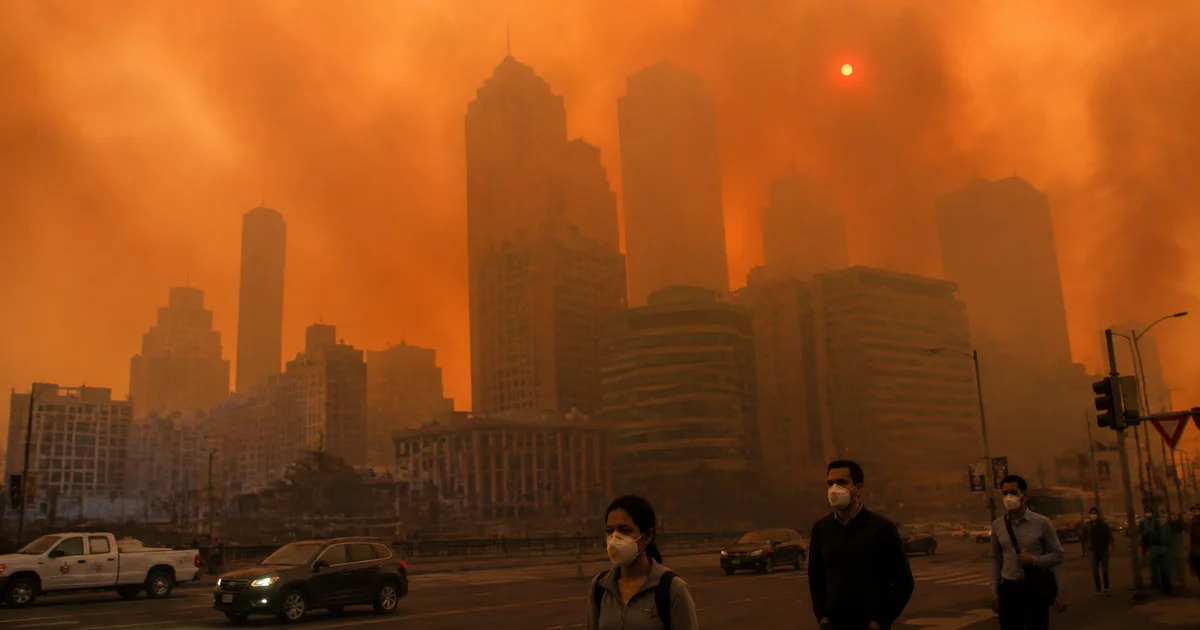
Smoke from hundreds of wildfires burning across Canada has blanketed the Midwest and Northeast, pushing air quality to dangerous levels for roughly 100 million people and prompting health officials in more than a dozen states to warn residents to stay indoors.
Duluth, Minnesota, recorded an Air Quality Index of 902 on Wednesday, a number so high it barely fits on the scale, and the worst air is still moving south.
The Scale of the Smoke Event
This is not a localized haze. The National Weather Service expects the smoke to linger through at least Friday, with the most intense plumes spreading as far south as Washington, D.C., by midday Thursday. Wisconsin and Michigan have issued statewide air quality alerts. Multiple counties in western and central New York are under advisory, and New York City, which ranked among the most polluted cities in the world on Wednesday, faces an alert through Thursday. Massachusetts has placed the entire state under an air quality warning.
The source is staggering: Canada’s wildfire monitoring agency listed more than 800 active fires on Wednesday afternoon, including 188 categorized as “out of control.” The smoke is traveling south on a broad atmospheric pattern that funnels it directly into the most populated corridor of the eastern United States, as CNN reported.
Why This Keeps Happening
If this feels familiar, it should. In June 2023, Canadian wildfire smoke turned New York’s skyline orange and sent AQI readings past 400 across the Northeast. That event was treated as extraordinary. Three years later, the same pattern is repeating with worse numbers and broader geographic reach, and there is a structural reason: Canada’s boreal forests are drying out faster than fire management systems can adapt.
Climate change has extended fire seasons by weeks, dried out vegetation earlier in the summer, and created conditions where lightning strikes ignite fires that spread faster than crews can contain them. The 2023 Canadian wildfire season burned a record 45 million acres. The 2026 season is tracking similarly, and it is only mid-July.
The Health Stakes Are Not Abstract
An AQI above 150 is “unhealthy” for everyone, not just sensitive groups. Above 200, it is “very unhealthy.” Above 300, it is “hazardous.” Duluth’s reading of 902 is in a category that the EPA’s standard guidance does not adequately address because it was not designed for sustained exposure at those levels.
Fine particulate matter, known as PM2.5, penetrates deep into the lungs and enters the bloodstream. Short-term exposure at elevated levels is linked to increased emergency room visits for asthma, heart attacks, and stroke. Extended exposure over multiple days, which is what the Midwest is experiencing now, compounds the risk. The people most vulnerable are children, the elderly, outdoor workers, and anyone with pre-existing respiratory or cardiovascular conditions.
Health officials in affected states are recommending that residents limit outdoor activity, keep windows closed, and use HEPA air purifiers indoors. Schools in parts of Minnesota and Wisconsin have moved activities inside, and several outdoor events across the Great Lakes region have been cancelled.
The Policy Failure Behind the Smoke
The uncomfortable truth is that the United States is experiencing the health consequences of wildfires it cannot fight because they are burning in another country. U.S.-Canadian coordination on cross-border fire response exists but has not scaled to match the size of the problem. Federal investment in air quality monitoring has improved since 2023, but the underlying driver, climate-fueled fire seasons of unprecedented scale, remains unaddressed at the policy level.
This is not a weather story. It is a climate story with an air quality timestamp. The smoke will clear by the weekend. The conditions that produced it will not.