
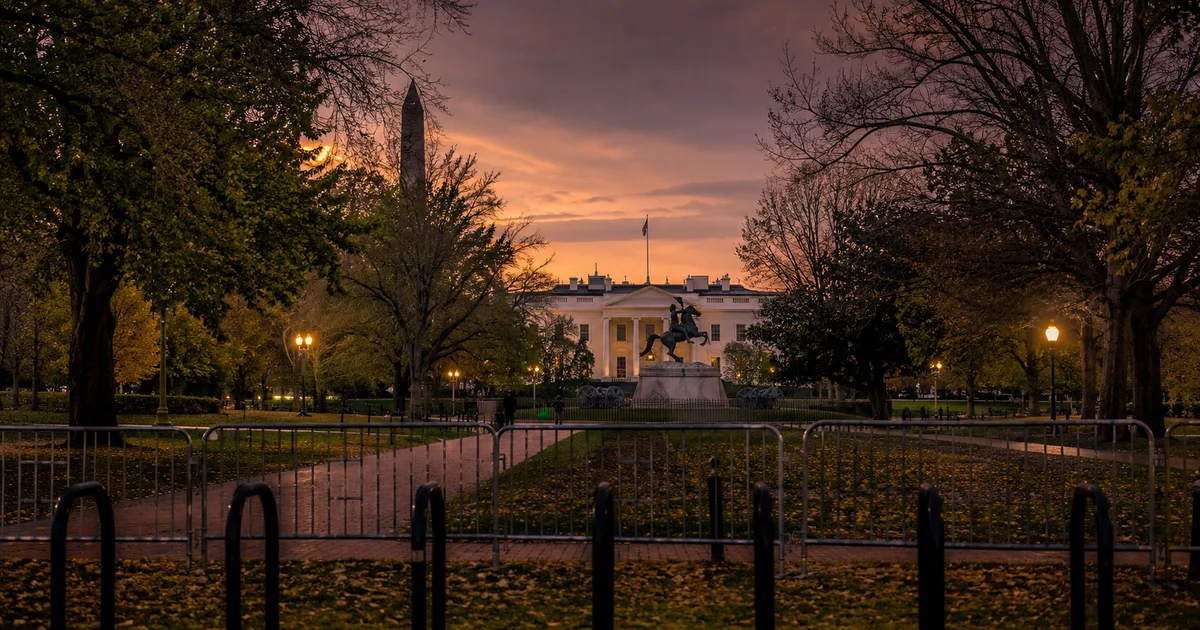
The Trump administration has submitted a 79-page proposal to permanently enclose Lafayette Park in 8-to-9-foot fencing, and a federal review panel stacked with the president’s own appointees appeared receptive to the idea at its Thursday meeting.
The plan would transform the seven-acre square directly north of the White House from an open public commons into a lockable perimeter that security officers could seal shut at will.
The Security Pitch and What It Actually Means
The proposal, submitted jointly by the Secret Service, the Executive Office of the President, and the Department of the Interior, frames permanent fencing as a replacement for the “aesthetically unappealing” temporary barriers currently used during security events. Those modular panels and bike-rack barricades take up to 72 hours to install and dismantle, according to NPR’s reporting on the proposal, creating what officials call an unsustainable operational burden.
The gates would normally remain open. But the operative word is “normally.” The proposed design would let security officers lock down the entire square and Pennsylvania Avenue during any event the government defines as an emergency. James C. McCrery II, vice chair of the U.S. Commission of Fine Arts, offered a telling distinction at Thursday’s hearing: “The proposal is not to close the park, but to enclose the park.”
That framing should raise every civil-liberties antenna in Washington. An enclosed park with lockable gates is functionally a park the government can close whenever it wants, without the logistical friction of deploying temporary barriers. The 72-hour setup time the proposal calls a problem is also a built-in check on overuse. Remove it, and the barrier between “open public square” and “sealed perimeter” becomes the turn of a key.
A Century of Protest, One Fence Away From Disappearing
Lafayette Park is not just green space. It is arguably the most consequential protest site in the country. Demonstrations there date back to 1917, when more than 500 women gathered for suffrage pickets outside the White House gates. The park drew civil rights marchers, Vietnam War protesters, and, in 2020, tens of thousands of demonstrators following George Floyd’s killing.
That last episode is the one the current proposal conspicuously avoids. In June 2020, federal officers used chemical agents and rubber bullets to forcibly clear Lafayette Park of peaceful protesters minutes before then-President Trump walked through for a photo opportunity at St. John’s Church. The Park Police and Secret Service deployed temporary fencing in the aftermath, and an NBC News report noted that many of the public comments submitted to the Commission of Fine Arts this week explicitly referenced that episode as evidence of how fencing powers get used in practice.
The structural why here is not security logistics. It is institutional control over the physical geography of dissent. A permanent fence does not just keep threats out. It gives the executive branch a standing tool to keep citizens at a distance from the seat of power, on demand, with no deployment delay and no visible escalation. That is a qualitative shift in the relationship between the public and the White House.
Who Gets to Decide
The seven-member Commission of Fine Arts, which reviews architectural and design proposals on federal land in Washington, did not vote Thursday. But the panel, which Trump has reshaped with his own appointees, signaled general receptivity to the concept. A second federal body, the National Capital Planning Commission, must also weigh in before the proposal advances.
Congresswoman Eleanor Holmes Norton, D.C.’s non-voting delegate in the House, is not waiting for that process to play out. She introduced legislation last week to prohibit permanent fencing at Lafayette Park outright. “We shouldn’t widen the distance between citizens and government by placing additional intimidating barriers between public servants and the people they serve,” Norton wrote, “especially when such barriers are unnecessary.”
Norton’s bill faces long odds in a Republican-controlled House. But her argument cuts to the core tension: Lafayette Park is public land administered by the National Park Service, not an extension of the White House grounds. The question the Commission of Fine Arts is actually being asked to answer is not whether 8-foot fencing looks good. It is whether a president should have a permanent switch to seal off the closest public land to his front door.
The answer to that question should worry anyone who believes proximity to power is itself a form of democratic accountability.