
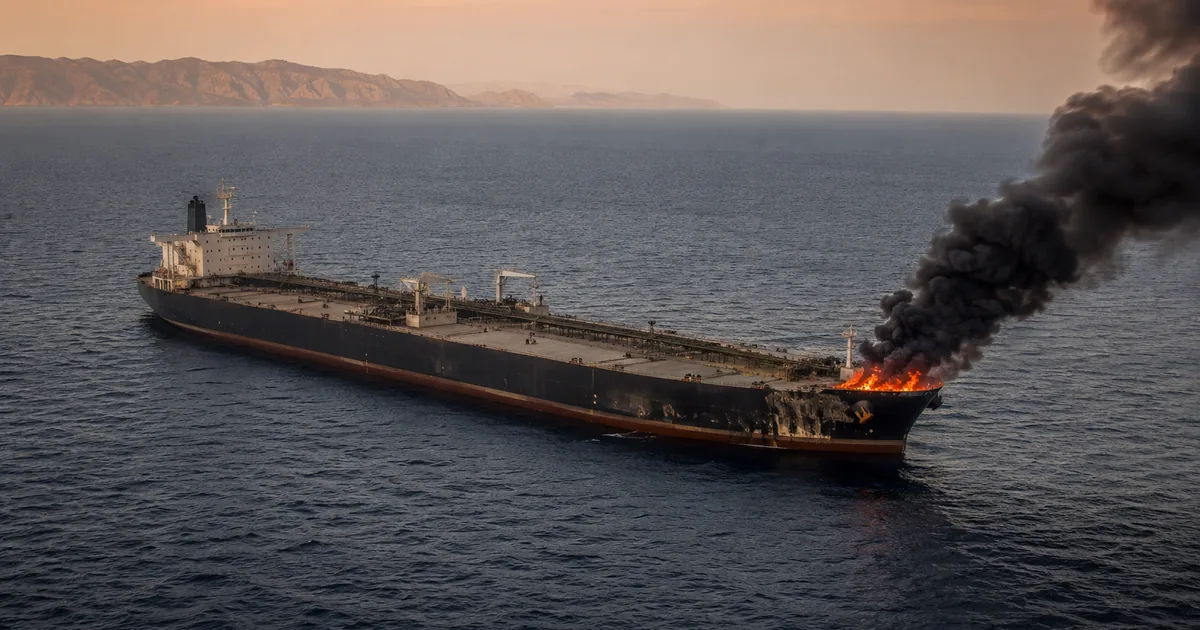
Yemen’s Houthi rebels said they struck two Saudi oil tankers, the Encelia and the Layla, with missiles and drones in the Red Sea on Wednesday, setting fires aboard and sending Brent crude surging 4.6 percent to nearly $98.50 a barrel.
This is the moment the Iran war stopped being a Strait of Hormuz story and became a two-chokepoint war, and the price of that widening will be paid at every American gas pump.
What Actually Happened Off the Saudi Coast
The Houthis’ SABA news agency said the group targeted the two tankers for violating the maritime blockade it declared on Saudi-linked shipping through the Bab el-Mandeb Strait earlier this week. Saudi Arabia confirmed that a vessel was hit, and Al Jazeera reported that the Encelia, owned by a Saudi company, caught fire at the bow. All crew members aboard the Encelia were reported safe, with no casualties confirmed as of Wednesday morning. The claimed strike on the Layla, a very large crude carrier owned by Saudi shipping giant Bahri, has not been independently verified.
The strikes landed as the United States carried out its 12th consecutive night of attacks on Iranian targets, and as Secretary of State Marco Rubio told reporters that Iran is not ready to make a deal. CNBC reported that the tanker attacks appear to mark the first time since the war began that ship strikes have spread beyond the vicinity of the Strait of Hormuz. That geographic fact matters more than the fires themselves. One chokepoint under threat is a crisis markets have learned to price. Two is a different market entirely.
Why the Houthis, and Why Now
The proximate trigger is a blockade war. Saudi Arabia has been enforcing a blockade on Yemen, and a recent strike hit the international airport in Sanaa, the rebel-held capital. The Houthis answered by declaring their own embargo on Saudi-linked shipping through Bab el-Mandeb, and Wednesday’s tanker strikes are the enforcement action that turns the paper threat into a kinetic one.
The structural driver sits in Tehran. Iran cannot match American firepower directly, and twelve straight nights of US strikes have made that asymmetry brutally clear. What Iran can do is raise the economic cost of the war through partners who give it deniability. The Houthis are the most battle-tested proxy in that network, and they have spent two years demonstrating, against commercial shipping and against US Navy escorts alike, that a militia with drones and anti-ship missiles can tax global trade from a mountainous country the Saudis spent a decade failing to subdue. Attacking Saudi tankers hurts Riyadh, unsettles Washington, and pushes crude toward triple digits without a single Iranian fingerprint on the launch order. That is the point.
Roughly 12 to 15 percent of global maritime trade, worth more than $1 trillion a year, moves through Bab el-Mandeb. Millions of barrels of oil transit the strait daily. The Houthis do not need to sink tankers to move markets. They need to make insurers nervous, and insurers are already rerouting math around the Cape of Good Hope.
The Market Is Pricing Fear, Not Lost Barrels
Here is the uncomfortable arithmetic: no oil has actually been taken off the market. Two tankers caught fire, crews are safe, and the cargo is presumably still afloat. Yet Brent jumped to its highest level since late May and West Texas Intermediate climbed almost 4 percent to around $90. Oil markets do not price barrels lost. They price the probability of barrels lost, and a second contested chokepoint multiplies that probability in ways traders cannot hedge cheaply.
For American consumers, the transmission is direct and fast. Crude accounts for more than half the price of a gallon of gasoline, and sharp crude spikes show up at the pump within days, not weeks. Pump prices were already flirting with $4 a gallon this month, a squeeze we broke down when gas prices became the war’s most visible consumer cost. A sustained run above $100 crude would push the national average well past that line and hand the White House an inflation problem in an election-adjacent economy it has repeatedly promised is under control.
That promise is worth pressing on. The administration has framed the Iran campaign as containable, precise, and short. Twelve nights of strikes, four flag-draped transfers at Dover, a $37 billion running tab at the Pentagon, and now a second maritime front say otherwise. Escalation is not a light switch that Washington alone controls. Every actor in this war gets a vote, and the Houthis just cast theirs.
Where This Goes Next
Watch three things. First, whether the US extends its strike campaign to Houthi launch sites in Yemen, which would formally open the second front the tanker attacks already opened in practice. The Pentagon has been here before, and the 2024 campaign against the Houthis degraded almost nothing. Second, whether Saudi Arabia retaliates directly, which would strain the careful distance Riyadh has kept from the shooting war even as it signed a landmark nuclear agreement with Washington. Third, the insurance market, because war-risk premiums on Red Sea transits will tell you faster than any government statement whether shipping is about to abandon Bab el-Mandeb entirely.
The B-1 bombers that entered the war this week were supposed to signal overwhelming leverage, a show of force we examined when the B-1’s arrival raised the escalation ceiling. Wednesday’s answer from the Red Sea suggests the other side read the signal and responded with its own: this war’s costs are no longer confined to the battlefield, or even to the Gulf. The question that should worry both Washington and Riyadh is not whether oil hits $100. It is what the Houthis do when it does, and they discover just how much pricing power a few drones can buy.