
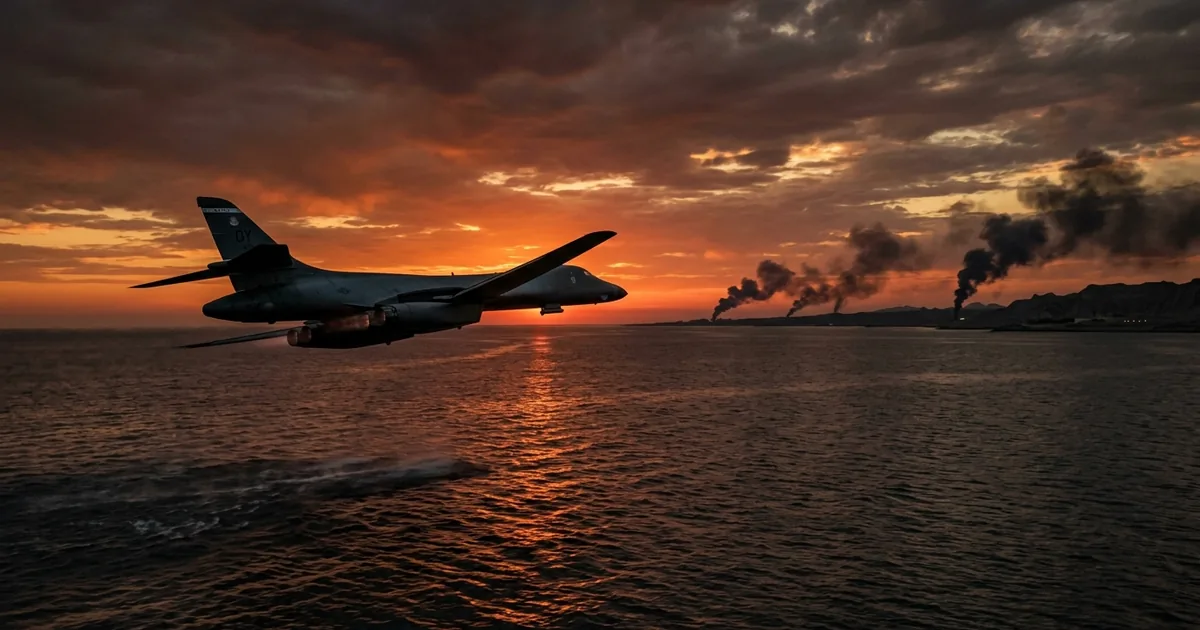
President Donald Trump told Axios on Thursday that he is weighing a military strike against Iran “bigger than ever before,” a dramatic escalation signal that landed hours after U.S.
Central Command confirmed it had completed a 13th consecutive night of airstrikes targeting Iranian military infrastructure.
“I am considering a massive attack. Bigger than ever before. I am close to making a decision. We are all set for it,” Trump told Axios in an interview published Thursday morning, adding that Tehran has not “received enough pain yet” to come back to the table.
Thirteen Nights and Counting
The current U.S. air campaign against Iran began on July 11, when the Pentagon launched strikes after Tehran resumed attacks on commercial shipping in the Strait of Hormuz following the collapse of a fragile ceasefire. Since then, American bombers and fighters have hit Iranian military facilities, air defenses, and missile sites across southern Iran every night without pause.
The toll is mounting. At least 53 Iranians have been killed and nearly 600 wounded in the strikes since July 6, according to Iranian state media figures compiled by Al Jazeera. On Thursday, Iranian drones targeted the U.S. consulate area in Erbil, Iraq, while a separate American strike on Ahvaz killed at least four people.
The graduated-pressure campaign, 13 nights of calibrated hits on military targets, was designed to force Iran back into negotiations without triggering a full-scale regional war. But that theory of the case is visibly failing: Iran has not returned to the table, has expanded its target set to include U.S. bases in Kuwait and Bahrain, and its Houthi allies just hit Saudi oil tankers in the Red Sea, helping push crude past $100 a barrel for the first time since the initial February strikes.
The Logic of Escalation, and Its Limits
Trump’s “massive attack” language is not random bluster. It is the logical endpoint of a strategy that has no off-ramp short of capitulation by one side. The administration’s own framing, that Iran needs “more pain,” reveals the core assumption: that there exists a threshold of military punishment beyond which Tehran will accept American terms. The problem is that every prior escalation in this conflict has produced a symmetric Iranian response, not a concession.
When the U.S. launched its initial February strikes alongside Israel, Iran responded by attacking Gulf state hosts of American forces. When the ceasefire collapsed and nightly strikes resumed in July, Iran widened its own target list. Iranian Foreign Minister Abbas Araghchi responded to the “massive attack” threat Thursday by warning that “mindless aggression” would see Trump pay a “heavier price” for any eventual deal.
The question is what “massive” means in practice. Bloomberg reported Thursday that the administration is considering strikes on Iranian infrastructure, including bridges and power plants, a significant escalation from the current military-only target set. Trump himself previewed that possibility earlier this week, telling reporters the U.S. would “bomb and destroy a bridge or power plant every time Iran targets a ship in the Strait of Hormuz.”
The Oil Price Trigger
The economic dimension is sharpening the political pressure on both sides. Crude oil topped $100 a barrel on Wednesday after Houthi militants, backed by Iran, struck two Saudi tankers in the Red Sea. American consumers are already feeling the squeeze: gas prices have crossed $4 a gallon nationally for the first time since 2022, with no relief in sight as long as the Strait of Hormuz, through which roughly 20% of the world’s oil transits, remains a combat zone.
A “massive attack” on Iranian infrastructure could spike crude even further in the short term by threatening Iranian production capacity directly, even as it aims to end the shipping disruptions that are driving prices up. It is a gamble that destroying Iran’s ability to fight will resolve the crisis faster than diplomacy, and one that assumes Iran’s regional allies, including Hezbollah, the Houthis, and Iraqi militias, will not open new fronts in response.
What ‘Close to a Decision’ Actually Means
ABC News reported Thursday that Trump has not made a final call on the expanded strikes, and that senior military officials are presenting him with a range of options. The phrasing matters: “close to a decision” in Trump’s vocabulary has historically meant anything from imminent action to a negotiating posture designed to extract concessions without firing a shot.
But the context here is different from 2019 or 2020, when Trump pulled back from the brink with Iran. The U.S. is already at war with Iran, not threatening one. American service members have been killed. The ceasefire framework that existed in June is dead. And the 13-night air campaign has established a baseline of military action that makes the next escalation a question of degree, not kind.
The U.K. has already been labeled an “accomplice” by Tehran for supporting the strikes, according to CNBC, widening the diplomatic fault lines. Whether Trump’s “massive attack” materializes in the next 48 hours or becomes leverage for a renewed diplomatic push, the trajectory is toward a wider conflict with fewer exits and higher costs for everyone, starting with the Americans filling their gas tanks this weekend.