
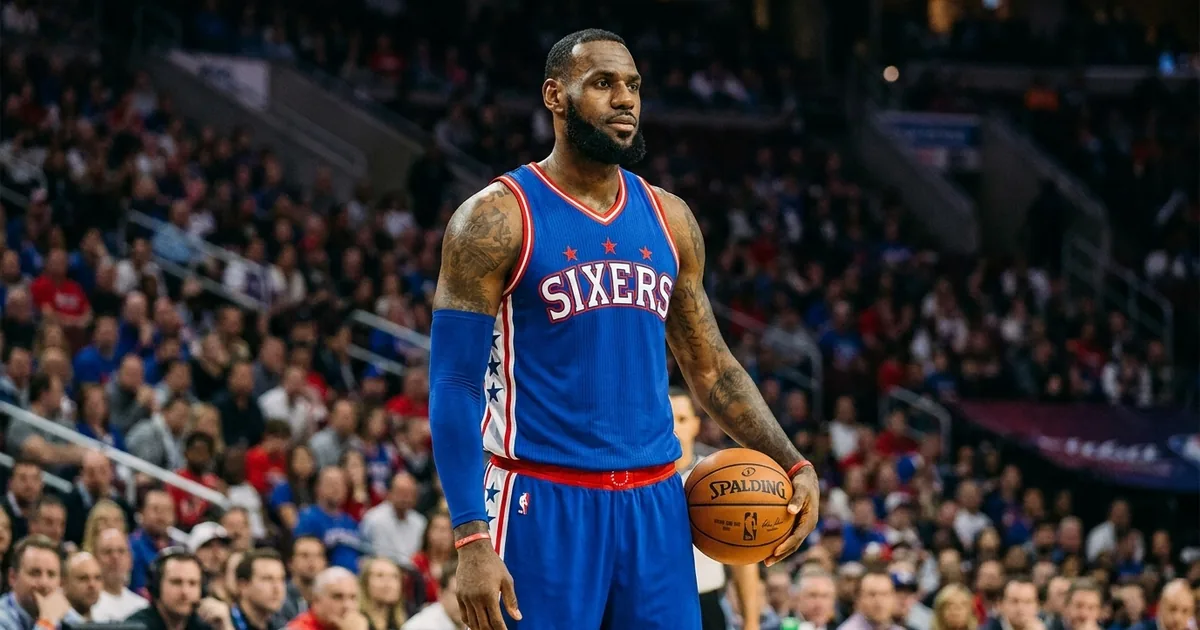
LeBron James announced on Friday that he is signing with the Philadelphia 76ers on a two-year deal worth $8 million, a veteran minimum contract for a 41-year-old who earned close to $53 million with the Lakers last season.
The number is not a gesture of humility, it is the only number Philadelphia was legally allowed to offer, and that distinction is the whole story of what the NBA’s labor agreement has become.
The Only Contract Philadelphia Was Allowed to Write
Start with what the 76ers could not do. With Joel Embiid, Tyrese Maxey and Jaylen Brown already occupying the bulk of a payroll that runs past $209 million, Philadelphia had no cap exception, no trade slot, and no mechanism of any kind to pay James market value. The minimum was not the opening offer. It was the entire menu.
Even that barely fits. ESPN reported in its breakdown of the signing that the deal carries a $3.9 million cap charge rather than the smaller $2.4 million figure a one-year minimum would generate, because James took a second season with a player option. The 76ers sit roughly $3.4 million under a hard cap at the first apron. To sign a man to the league minimum, they will have to cut someone else off the end of the roster.
Read that sentence again. The most decorated player of his generation joins a title contender, and the transaction requires the team to fire a young player earning a fraction of what James turned down. That is not a quirk. That is the machine working exactly as designed.
The Apron Is the Real General Manager
The 2023 collective bargaining agreement introduced two spending thresholds above the luxury tax, and the penalties attached to them are not financial in any meaningful sense. They are structural. Cross the second apron and a team loses the ability to aggregate salaries in trades, loses its mid-level exception, loses the right to send out cash, and eventually watches its first-round picks get frozen and pushed to the back of the draft. Money was never the deterrent for owners who are already billionaires. Losing the tools to build a roster is.
The stated goal was competitive balance. The actual effect is that roster construction has been taken away from front offices and handed to a rulebook. Philadelphia did not decide James was worth $3.9 million. A negotiated document decided it, years before anyone knew he would be available, and every team chasing him faced some version of the same ceiling. NBC Sports noted in its report on the agreement that the money was effectively identical across his finalists, which is why this free agency turned on recruiting calls from Embiid, Brown and Maxey rather than on any bid.
When every offer is the same offer, price stops being information. What is left is fit, geography, and vibes, which is a strange foundation for a $12 billion industry’s marquee labor market.
Only Someone Who Does Not Need the Money Can Take This Deal
Here is the part that deserves harder scrutiny than it will get during a week of highlight packages.
James is, as Fortune pointed out in its note on the contract, the only active billionaire in the NBA. His wealth sits in media companies, equity stakes and endorsement structures that dwarf any salary the league could pay him. Walking away from roughly $49 million a year costs him something real, but it does not touch his security, his family, or his leverage. He can treat his NBA salary as a rounding error because for him it now is one.
Almost no one else in the league can do that. A rotation player in year six, a two-way contract fighting for a roster spot, a veteran on his last guaranteed deal: none of them can absorb a nine-figure lifestyle decision to chase a ring. So a rule regime sold as parity produces a predictable sorting mechanism. The players rich enough to ignore their paychecks concentrate on contenders, and the players who actually need the salary get squeezed by the same hard caps, waived to create room, or priced out of the teams that win.
That is worth saying plainly, because the framing that will dominate this weekend is about legacy and sacrifice. The sacrifice is real. It is also only available to a person for whom sacrifice is optional. A system that quietly rewards outside wealth is a system that has stopped being about basketball economics and started being about who else you are.
What Philadelphia Actually Bought
The basketball case is easier than the labor case. The 76ers went 45-37 last season and have not won a title since 1983, a drought long enough that most of the fan base has no memory of the last one. Adding a 41-year-old on a minimum deal to a core of Embiid, Maxey, Brown and rookie guard VJ Edgecombe is close to a free option: if James has one more deep spring in him, Philadelphia has a genuine contender, and if he does not, the contract is small enough to be irrelevant.
The risk is health, and it is not James’s health that worries me most. It is Embiid’s, and it is the compressed timeline that a two-year window with a 41-year-old creates. Teams that go all-in on a closing window tend to make the next decision badly, trading the depth they will need later for the marginal upgrade they want now. Philadelphia has already spent heavily to bring in Brown. The apron rules mean the next move will require subtraction, not addition, and subtraction is how contenders quietly get worse while the headlines say they are getting better.
We covered James leaving the Lakers after eight seasons earlier this month, when the shortlist still included Cleveland, Miami and Golden State. The version of this story where he returns to Cleveland to finish where he started was always the tidier narrative. He picked the roster instead, which is the least sentimental choice available and probably the correct one.
What to Watch
The immediate thing to watch is which player Philadelphia releases to make the math work, because that name is the clearest illustration of what these rules cost people who are not LeBron James.
The longer question is what happens the next time a star of this magnitude reaches free agency and cannot afford to take the minimum. James called this his last decision, and he made it in a market where his price was set by a document rather than by demand. The apron system will get credit for parity if the league gets a competitive season out of it. It should also get scrutiny for the thing it has actually accomplished, which is turning the biggest contracts in American sports into a formality and leaving the players in the middle to absorb the difference.