
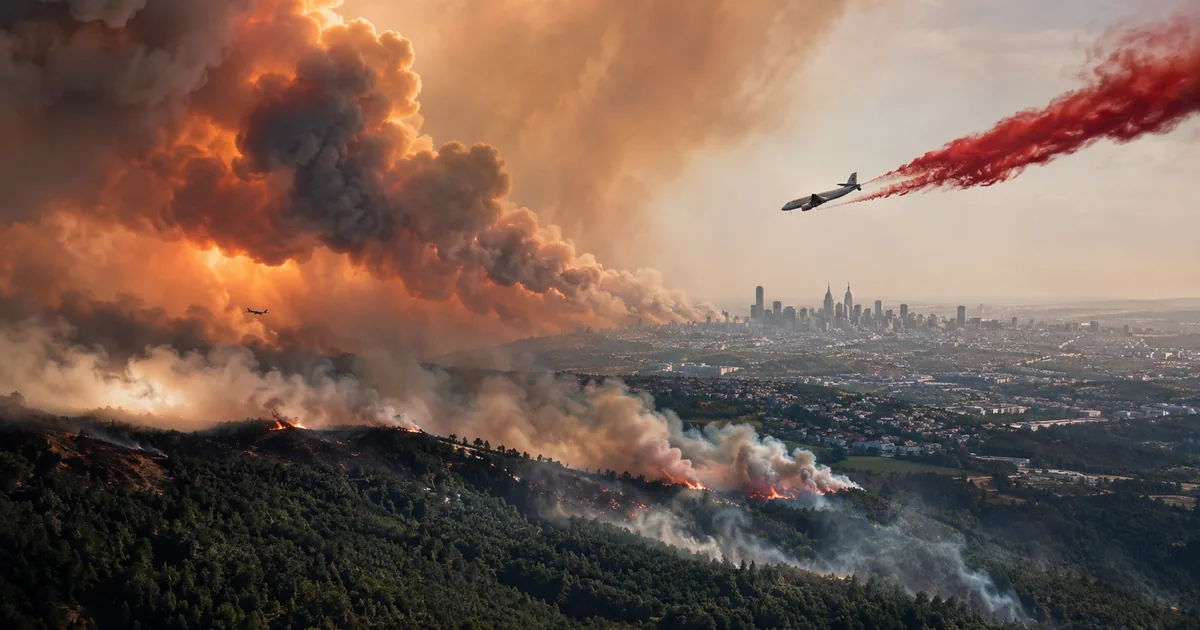
A wildfire in France’s Gironde region has burned through 42,000 hectares and forced more than 250,000 people from their homes, making it the largest peacetime evacuation in French history since World War II.
The blaze is now just nine miles from the center of Bordeaux, a city of 268,000, and French Interior Minister Laurent Nunez has warned that conditions remain “very unfavorable” with the fire’s behavior growing increasingly unpredictable.
The Fire That Makes Its Own Weather
What started as a forest fire in the pine-heavy Gironde department has turned into something genuinely unprecedented for France: a pyrocumulonimbus event, where the fire generates its own weather system, creating lightning bolts that spark entirely new blazes. Fire chief Marc Vermeulen told Fortune it feels like “being confronted by a hurricane.” That comparison is not hyperbole. Pyrocumulonimbus clouds can reach the stratosphere, and when a fire starts manufacturing its own ignition sources, traditional containment strategies collapse. Every lightning strike from the fire’s own storm column is a potential new front that firefighters have to track and suppress in real time.
The 42,000 hectares burned so far, roughly 162 square miles, equals about seven times the land area of Manhattan. Hundreds of homes have been destroyed, at least 140 confirmed in a single count. The commune of Le Porge, a town of 3,500 west of Bordeaux, has been devastated.
A Quarter-Million People Displaced
The evacuation numbers tell the story of a crisis that has overwhelmed regional infrastructure. In the Gironde region alone, 220,000 people have been ordered out. Another 36,000 in the neighboring Landes department have followed, as a second fire burning farther south has widened the displacement zone. Bordeaux itself has not been evacuated, but the city has converted an exhibition center into an emergency shelter capable of housing up to 10,000 people, and authorities have ordered evacuations from parts of the city’s western suburbs.
Evacuee Rocio Dominguez described the scene to Fortune: “It looked like the apocalypse. You couldn’t see anything. Everything was covered in ash.”
The French military has deployed an A400M cargo aircraft to drop flame retardants, and 1.5 million face masks have been distributed to protect residents from smoke. The Tour de France shortened its final stage to free up security personnel for the firefighting response, a measure that underscores how completely this disaster has reordered national priorities.
2,500 Firefighters Against a Fire That Keeps Growing
Some 2,500 firefighters are now deployed, backed by 18 planes and helicopters from multiple European nations and supported by French soldiers. Seventy-five firefighters have been injured. The international dimension of the response, with aircraft arriving from across Europe, reflects a recognition that France cannot contain this alone.
The broader context makes that even clearer. Across southwest France and into Spain, wildfires have forced more than 320,000 people to flee. Spain has evacuated 76,000, and one person has died in the Valencia region. This is not a single-country emergency; it is a continental fire season that is rewriting the bounds of what southern European infrastructure was built to handle.
The Climate Math Behind the Crisis
France has already experienced 3.4 times its annual average number of wildfires in 2026, according to Copernicus data reported by France 24. Spain’s count is 1.7 times its average. Successive heat waves have baked the region’s forests and scrubland into tinder, and when a fire ignites in those conditions, the available fuel load turns routine blazes into firestorms.
This is the same pattern that has been driving wildfire emergencies across the Northern Hemisphere this summer: extreme heat dries the landscape, fire starts, fire behavior exceeds what suppression systems were designed for, and cities that never planned for wildfire proximity find themselves in evacuation mode. Bordeaux, one of Europe’s most celebrated wine regions and a UNESCO World Heritage city, is now learning what Phoenix and Fort McMurray already know: wildfire is an urban risk, not a rural one.
The wine industry is watching nervously. Vineyards have not been directly impacted so far, and the grapes are not yet large enough to absorb smoke taint, the phenomenon that can ruin an entire vintage. But the fire is nine miles away and advancing. The 2026 Bordeaux harvest is not out of danger.
What Comes Next
French authorities have warned that the fire may not be fully extinguished for months, a timeline that would carry the crisis deep into the fall. The immediate question is whether Bordeaux itself will need to evacuate. The city’s emergency shelter infrastructure suggests officials are preparing for that possibility without publicly announcing it. The second question is longer-term: whether France’s civil protection system, built for a cooler climate, can scale to a future where pyrocumulonimbus events are no longer one-off anomalies but recurring seasonal threats.
For a quarter-million people sleeping in shelters and with relatives right now, those questions are not abstract. The fire is still burning, still making its own lightning, and still moving toward the city.