
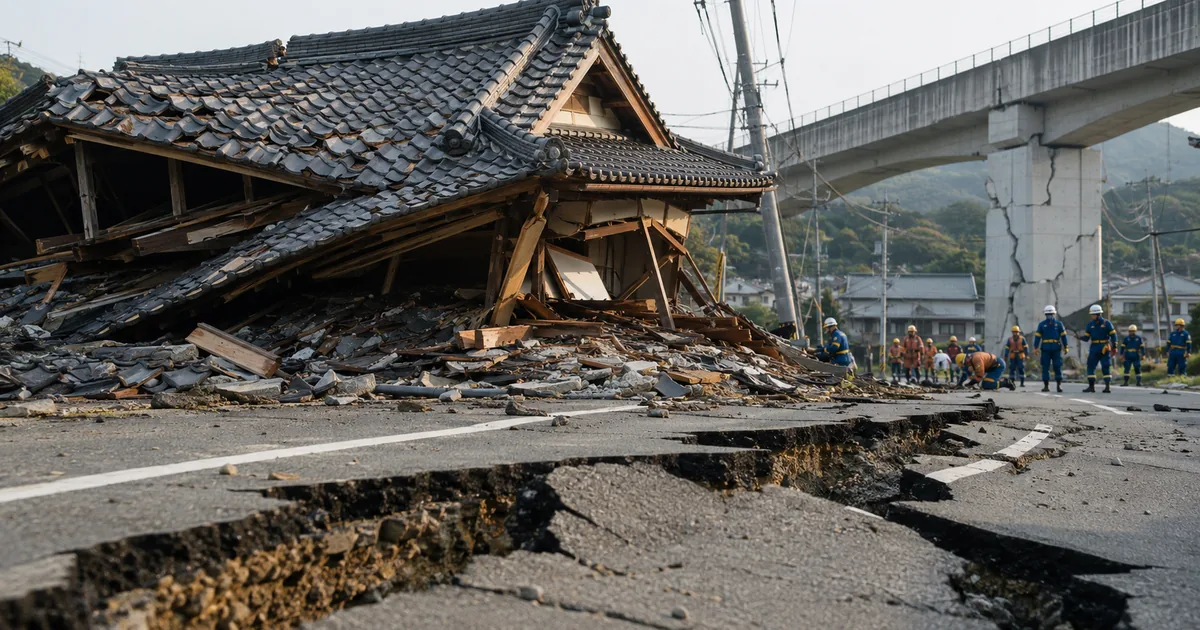
A magnitude 7.1 earthquake struck Kumamoto Prefecture on Tuesday afternoon, shaking Japan’s southwestern island of Kyushu hard enough to derail a freight train, cut power to roughly 40,000 homes and push a tsunami advisory out across the Ariake and Yatsushiro seas.
The advisory was lifted within the hour and no deaths have been confirmed, which is real good news and also the detail most likely to mislead anyone reading this from a distance.
What Actually Happened in Kumamoto
The Japan Meteorological Agency put the quake at a preliminary magnitude of 7.1 at a depth of about 10 kilometers, with the epicenter a few kilometers east of Uto City. Shallow and close in means violent, and the intensity readings show it. The agency logged a maximum seismic intensity of 7, the top of Japan’s shindo scale, in Uki and Hikawa, with upper-6 readings in Yatsushiro, Uto, Misato, Mashiki and the southern ward of Kumamoto City. That scale measures what the ground did to people and buildings rather than how much energy the fault released. A 7 means standing up was not an option.
NBC News reported that the quake hit at around 4:27 p.m. local time and that the tsunami advisory, forecasting waves of up to one meter, went out minutes later. No waves were recorded and the advisory was cancelled. Kyushu Electric Power lost service to about 40,000 households. JR Kyushu halted everything including the Shinkansen, Kumamoto Airport shut its runway, All Nippon Airways diverted and cancelled flights, and both KDDI and Docomo reported mobile outages. The fire department in Uki fielded a run of emergency calls as fires broke out around the city. Several residents of a nursing home in Hikawa were hurt in falls.
At least 50 people have been injured and at least a dozen houses have collapsed, CNBC reported as aerial footage from public broadcaster NHK showed the scale of it: a derailed cargo train, collapsed towers at an industrial plant, long cracks running through an elevated highway, a building on fire, and the ceiling of a shopping mall that came down in one piece. Those are early numbers from a rural prefecture where municipal officials are still driving the back roads.
Prime Minister Sanae Takaichi confirmed injuries and told reporters that “power outages and fires have occurred in some areas, and there has also been damage to roads and bridges and the collapse of buildings,” according to the Reuters wire report, which also put the number of people sent to evacuation centers above 150,000. Chief Cabinet Secretary Minoru Kihara said no irregularities had been detected at Japan’s nuclear plants, including the Sendai station in Satsumasendai and Genkai in Saga. Taiwan’s president, Lai Ching-te, sent condolences and said assistance was being prepared. That last one is not the throwaway diplomatic gesture it looks like.
Japan Put Its Semiconductor Comeback on a Fault Line
Kikuyo is a town of roughly 43,000 people northeast of Kumamoto City. It is also where TSMC built the first fab of Japan Advanced Semiconductor Manufacturing, the venture that anchors Tokyo’s multibillion-dollar effort to rebuild a domestic chip industry it spent two decades letting atrophy. Tuesday’s quake registered an intensity of 5 in Kikuyo, past the site’s evacuation threshold, and TSMC pulled its people out. Sony and Fujifilm evacuated their Kikuyo plants too.
Nobody at those sites was hurt and no damage has been reported. That is the part worth sitting with, because the near miss is the story rather than the disaster. The Taipei Times reported in April 2024 that TSMC picked Kikuyo for its second Japanese fab, and in May this year the company and Sony Semiconductor Solutions announced an image-sensor joint venture built on that same Kumamoto footprint. Japan’s answer to chip dependence is being poured, floor by floor, into one prefecture.
The honest caveat: there is no seismically quiet corner of Japan to build in. Anyone demanding TSMC relocate to a safe prefecture is asking for something that does not exist. But that is an argument about location, and the exposure here is about concentration. Put the fab, its successor, the image-sensor venture and Sony’s existing capacity inside the same twenty-kilometer radius and you have converted a regional earthquake into a global supply event. The 2011 Tohoku disaster, whose seismic waves reached deep enough to register against the Earth’s core, taught the auto industry that lesson through months of parts shortages traced to single suppliers nobody outside the sector could name. The chip sector spent the years since absorbing shortage after shortage and then rebuilt with the same geographic logic. Lai Ching-te offering help within hours reads differently once you notice that Taiwan’s largest company had staff evacuating a plant inside the shaking zone.
The People Kumamoto Loses Are the Ones Who Survive Tuesday
Here is the number that should organize how anyone reads the next ten days. The 2016 Kumamoto earthquakes, a magnitude 6.5 foreshock followed 28 hours later by a 7.3 mainshock centered on Mashiki, killed 277 people. Fifty of them died in the earthquakes themselves. Two hundred and eighteen died afterward, classified by Japanese authorities as disaster-related deaths: injuries that worsened, chronic illnesses that turned fatal, bodies that gave out under the conditions of displacement. The remainder were killed by the heavy rains that hit the damaged region that June, which the prefecture also counts against the disaster. Roughly four out of five deaths in Kumamoto’s worst modern disaster happened after the ground stopped moving.
Japan tracks that category, saigai kanren shi, more rigorously than almost any country, which is the only reason the figure exists. Most disaster tolls elsewhere never count these people at all. The category exists because Japanese researchers established that shelter conditions, thrombosis from cramped sleeping, interrupted dialysis and medication, pneumonia and the sheer physiological cost of losing your home are a predictable second wave rather than bad luck.
Which is what makes the current headline number the wrong one to watch. More than 150,000 people are being directed into evacuation centers in Kyushu in late July, when Kumamoto routinely runs into the mid-thirties Celsius with humidity to match. The elderly share of that population is high, because the elderly share of rural Kyushu is high. Whether this quake kills a handful of people or two hundred is not being decided by the fault. It is being decided over the next several weeks by shelter cooling, water, medication continuity, how fast people get out of gymnasiums and into transitional housing, and whether the prefecture applied what it learned in 2016. The seismology is finished. The policy is just starting.
What to Watch This Week
The JMA is telling residents to expect strong aftershocks for about a week and flagging landslide risk on slopes the shaking has already loosened, with heavy summer rain a live possibility on top of that. An aftershock reaching lower-5 hit roughly half an hour after the main event. Nikkei Asia and CNN both note that damage assessment is still in its early hours, and the injury count from a quake this shallow tends to climb for a day or two as rural municipalities finish checking.
There is also the precedent nobody in Kumamoto needs reminding of. In April 2016 the region took a 6.5, treated it as the event, and then took a 7.3 the following night that did most of the killing. Seismologists only relabel a quake a foreshock in hindsight, so Tuesday’s 7.1 will not be called one unless something larger follows it. The Kumamoto residents deciding tonight whether to sleep in their own houses are working from memory rather than from a forecast, and the memory is the better guide. A tsunami advisory that gets cancelled is the kind of ending a news cycle likes. The thing that will actually set the toll here has barely started.