
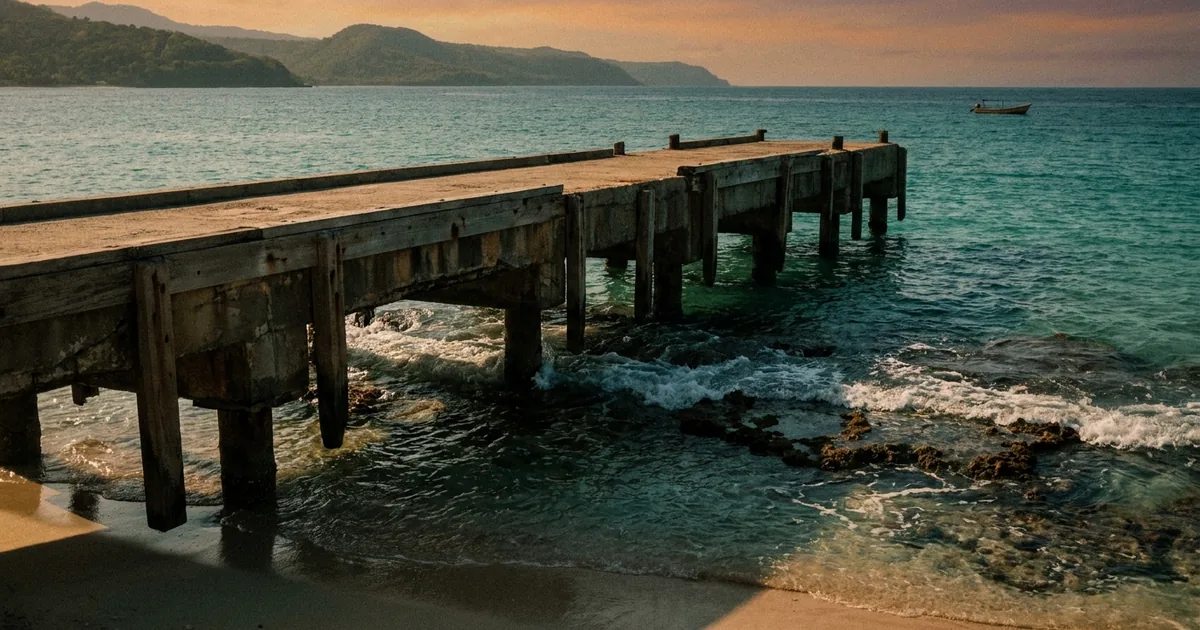
Surveillance cameras recorded Elizabeth “Liz” Waddell walking onto a jetty near Grand Anse Beach at 11:36 a.m. on July 22 and entering the water 15 minutes later.
She was never recorded coming out.
That is the hard evidence at the center of an eight-day search in Grenada for the 44-year-old physical therapist from Cary, North Carolina. It is also only half of what investigators are holding, because the rest of the record puts a woman who matched her description in the water hours later, far offshore, telling a stranger she did not need help.
What the Cameras Show, and What They Do Not
The footage reconstructed by the Royal Grenada Police Force is unusually specific for a case like this. WRAL laid out the sequence: Waddell reaches the jetty at 11:36 a.m., sits on the sand nearby, walks the pier, enters the water at 11:51 a.m., and is seen swimming roughly 20 feet from shore in about five feet of water just after noon. A friend stepped outside at 12:46 p.m. and did not see her. She had left the rental without her phone.
Then the timeline forks. A jet ski operator told police he encountered a woman matching Waddell’s description swimming well away from shore around 5:30 p.m., stopped to ask whether she needed assistance, and was told she was a strong swimmer who was fine. Five and a half hours separate that account from the last frame of video.
Both things cannot be casually true. Either the 5:30 p.m. witness saw someone else, which happens constantly on a public beach in high season, or Waddell was alive and swimming long after the surveillance ended, which changes what search patterns make sense and where a person could plausibly have come ashore. Police have not said which reading they favor, and the honest position right now is that nobody outside the investigation knows.
A third thread arrived over the weekend, when NBC News reported that the force was checking a reported sighting on Friday, which friends and family flagged because Waddell is recognizable for her fluorescent pink hair color. Acting Commissioner of Police Randy Connaught has kept the classification where it started. “At this time, the matter continues to be treated as a missing person investigation,” he said, adding that he hopes Waddell is found alive and well.
The Classification Is Doing Real Work
That phrasing sounds like caution. It is closer to a resource decision.
A missing person investigation keeps a drone unit, a canine unit from St George’s University, dive professionals and the Grenada Coast Guard mobilized around the possibility of a living person. Reclassify the case and the tempo changes, the investigative theory narrows, and interviews start pointing in a different direction. Grenadian police have publicly moved the water component from rescue to recovery while the ground search continues, which is a quietly devastating sentence and also not the same thing as closing the file.
The pressure to reclassify is going to build, because the two most likely explanations for a strong swimmer who never came back are both grim, and because families in this position are usually the last to be told which one investigators privately believe. Holding a case open in the face of that pressure is not naive. It is what the reported 5:30 p.m. contact requires.
An American Family Cannot Import an American Investigation
Here is the part that surprises people every time an American disappears abroad, and it is the most useful thing to understand about this case.
The FBI has no jurisdiction in Grenada. NOW Grenada reported that the bureau is assisting at the request of the Royal Grenada Police Force, and that word means what it says: technical support, lab work, records help, an offer of expertise. The Grenadian police decide what to pursue and what to release. The State Department can facilitate. It cannot direct a foreign force, cannot subpoena a foreign witness, and cannot order a search grid widened.
So the family does the only thing available. Waddell’s husband Cailen and their adult daughter flew down to be on the island, and the family stood up a website and a video channel to keep the case visible and collect tips, which is now standard practice and tells you something about who is expected to run the public half of these investigations. Grenada is a country of roughly 115,000 people with a police force sized accordingly, working a case with an international press corps attached to it. That mismatch, not any lack of effort, is why these searches so often feel slow from the American side.
The gap has consequences beyond one family’s suffering. It shapes what evidence survives the first week, because footage gets overwritten, witnesses scatter home on return flights, and ocean conditions erase the physical record fastest of all. Eight days in, the most valuable thing anyone can still produce is a person who was on that beach on July 22 and has not yet told police what they saw.
For now the facts are narrow and they are the whole story: a woman went for a swim at Grand Anse without her phone, cameras caught her going in and not coming back, and somebody says he spoke with her hours later. Police in St. George’s are still treating both of those as live, and that is the correct call until one of them stops being possible.