
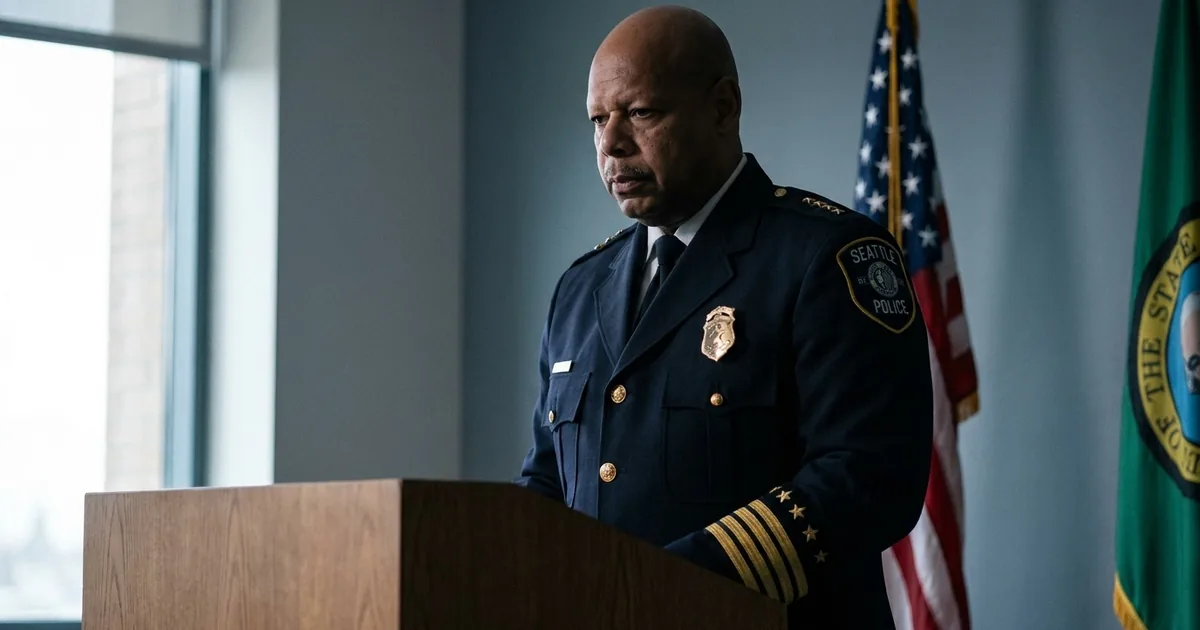
Seattle Police Chief Shon Barnes was at a conference in Dallas on Sunday evening when gunfire tore through the Bite of Seattle and left two festivalgoers dead.
Four days later he is out of a job, and the city has answered a failure of public communication with the one tool that cannot repair it.
The Five Hours That Cost Him the Job
Shots were fired around 6 p.m. Sunday near the food festival at Seattle Center, in the shadow of the Space Needle. Two people were killed and four were wounded, among them a 2-year-old boy. ABC News reported that all six were uninvolved in whatever dispute set the shooting off. A 19-year-old suspect also died. A 15-year-old was arrested after an officer talked him into surrendering, and court documents point to at least three shooters. We covered the shooting itself as it unfolded that night.
Then the department went quiet. The Seattle Police Department posted once to social media and said nothing further for close to five hours, while a city full of people who had just run from a mass shooting tried to work out whether the shooter was still out there. The next official word came at an 11 p.m. news conference led not by the chief but by Assistant Chief Tyrone Davis, alongside Mayor Katie Wilson, Governor Bob Ferguson, and Representative Pramila Jayapal.
Wilson used that window to tell the public two people were in custody. That turned out to be wrong, and her office walked it back. “Had I known that, I would have pushed for an immediate briefing, rather than waiting for a press conference,” Wilson said afterward, according to the Associated Press. It is worth sitting with the structure of that sentence. The mayor is explaining that she did not have information, and the remedy she chose was to remove the person who was supposed to give it to her.
Absence Was the Real Charge
The five-hour gap is the stated reason. The travel record is the actual one.
Barnes was in Dallas at a police conference when the shooting happened and flew back to take over the response. That single fact would be survivable on its own. It was not survivable on top of the pattern local reporting had already documented: The Urbanist tallied close to seven weeks out of town in his last seven months, plus roughly two more on vacation, and most weekends away during his first four months on the job. His wife and children never moved from Chicago. He had another two weeks of leave already on the calendar into mid-August.
Asked about the timing on Monday, Barnes gave the answer that probably sealed it. “I wish that I had a crystal ball and we could schedule gun violence, but we can’t,” he said. He was right on the merits and badly wrong on the room. A chief who has been present builds a reserve of goodwill he can spend on a night like that one. A chief who has been gone for seven of the last thirty weeks has no reserve, so the conference in Dallas stops reading as bad luck and starts reading as a summary.
The Word “Resigned” Is Carrying a Lot of Weight
Wilson’s office says Barnes resigned and that she accepted his letter. Multiple newsrooms with sources inside the process describe something blunter. UPI reported that the mayor fired him, and people close to Barnes said he had refused an earlier request to step down before the announcement finally came Thursday.
Both things can be true, because “resignation” here is a negotiated word rather than a description of events. That matters beyond etiquette. A resignation is a private arrangement between two officials. A firing is a public act a mayor has to defend on the record, with reasons attached, in a city that will now spend months arguing about what those reasons were. Choosing the softer word gets Wilson through the week and leaves the actual case against Barnes unwritten.
The exit statements matched the framing. Wilson said Barnes “has served this department and this city with dedication,” and Barnes said he hoped “this transition gives the city and this department the opportunity to return full focus to what matters most.”
The Coalition That Told Her Not To
The opposition to this decision did not come from where the usual script says it should.
Seattle NAACP and the Urban League of Metropolitan Seattle both went to the mat for Barnes, who was the second Black chief in the department’s history, warning that he “should not be made a scapegoat for the complex challenges of public safety.” Council President Joy Hollingsworth lobbied for his retention. Six council members put out statements backing him, four of them landing on the same point: “Our priority must be stability, not further disruption.” Civil rights attorney James Bible was in the room for Thursday’s meeting with the mayor.
So a first-year progressive mayor removed a Black police chief over the objection of the city’s Black civil rights institutions, its council president, and half the council. Barnes also presided over the end of the federal consent decree that had supervised the department for more than a decade, which is the single largest institutional accomplishment any recent Seattle chief can claim. None of that bought him a night.
Seattle Is Now Hiring Its Fifth Chief Arrangement Since 2020
Here is the part that outlives this news cycle.
Carmen Best resigned in September 2020 over council budget cuts. Adrian Diaz ran the department in an acting capacity, was made permanent in 2022, and was removed by Mayor Bruce Harrell in May 2024, with former King County Sheriff Sue Rahr installed as interim for about eight months. Barnes started January 31, 2025, appointed by Harrell, retained by Wilson when she took office on January 1 of this year. He lasted about eighteen months. Deputy Chief Andre Sayles now has the interim job.
That is five leadership configurations in six years, and it is the reason the five-hour silence happened. Emergency public information is not a personality trait a chief brings with him. It is a written protocol: who authorizes a statement, how fast, from where, when the chief is unreachable, and what gets said before the facts are confirmed. Departments build that muscle over years of stable leadership, and Seattle has not had a stretch of stable leadership since 2020. Sunday night, the question of who speaks for the department when the chief is on a plane apparently did not have a settled answer, and so nobody spoke for five hours.
Wilson has now changed the person. Nothing announced this week changes the protocol. Sayles inherits the same unwritten process Barnes did, minus the eighteen months of institutional memory that left with Barnes, and the next chief will inherit it from him.
The test is not whether Seattle finds someone better than Shon Barnes. It is whether anyone at City Hall writes down what should have happened at 6:15 p.m. on Sunday, before the next festival, the next crowd, and the next five hours of silence.