
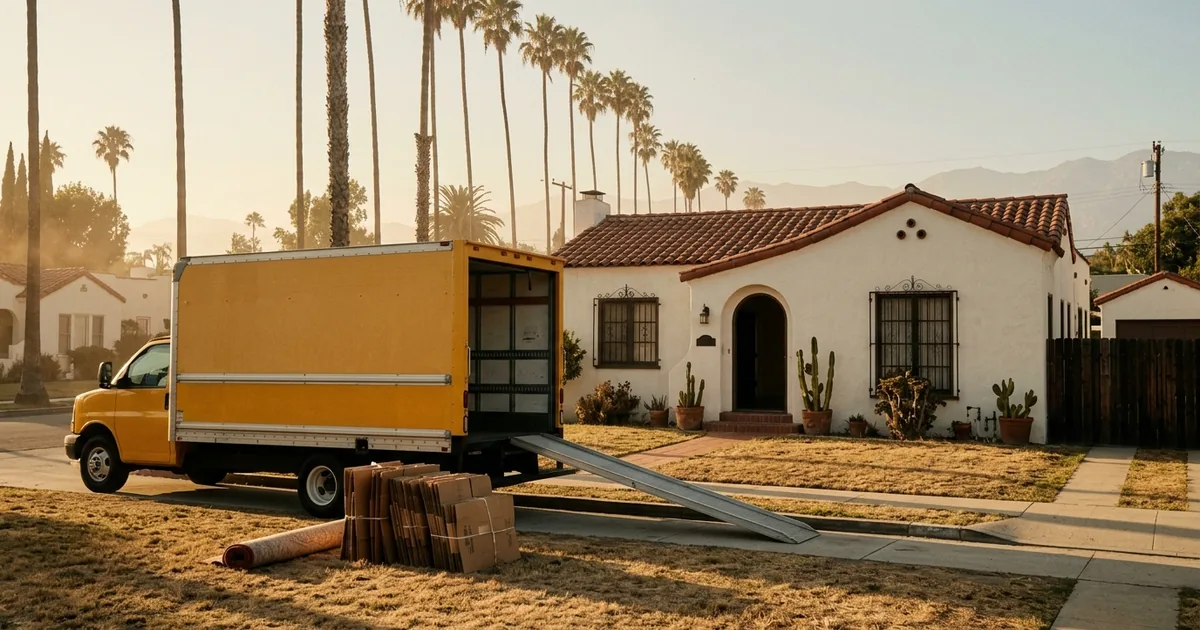
Diane Farr posted a video of her empty house on Thursday, called it her last day in Los Angeles after exactly 30 years, and set the whole thing to Harry Styles.
The detail almost nobody covering it mentioned is that the show she stars in, a drama about California firefighters, has been shooting in Canada since 2022.
Farr, 56, plays Sharon Leone on CBS’s Fire Country, a Cal Fire division chief and the mother of the show’s lead character. She wrote on Instagram that she came to Los Angeles “chasing a dream that I am still shocked worked out,” that “L.A. will always be where my family is from,” and that what comes next is a third act, “when I settle into whatever I’m supposed to be as a one.” She was packing for four people headed to six different places in three moving trucks, and she said the hardest part was leaving the house, the dream, and home in a single afternoon.
She did not say why she was going, and she was careful to say it might not be permanent. E! News reported that she framed it as a hiatus rather than a goodbye, letting the house go for now, with a tease about a couple of countries she never pictured herself in. So this is not a story about an actress denouncing Los Angeles, and any piece that turns it into one is inventing a motive she declined to give.
It is still worth pausing on, because the timing lands in the middle of a much larger migration that has almost nothing to do with anybody’s feelings about the city.
The Show About California That Films in British Columbia
Fire Country is set in Northern California. Its fictional town of Edgewater, its Cal Fire station, its wildfire country, all of it is Canadian. The production shoots in and around Vancouver, with Anmore and Fort Langley standing in for Edgewater and interiors built at Vancouver Film Studios. The fire station Farr’s character runs is a real fire station in British Columbia.
None of that is unusual, which is exactly the point. It is so ordinary now that it barely registers as irony. A hit network drama built entirely on California iconography, employing California actors, telling a story about a California institution, is a Canadian production for tax and cost purposes. Farr has spent four years commuting to a version of her home state that is 1,300 miles north of it.
When people talk about Hollywood leaving Los Angeles, the mental image is usually a studio closing or a star relocating. The real mechanism is quieter and more complete than that. The job stayed. The address changed. And the people whose lives were organized around being within driving distance of a set eventually notice there is no longer a set within driving distance.
The Numbers Underneath the Instagram Post
The scale of it is not subtle. FilmLA counted 4,711 on-location shoot days in the Los Angeles region in the second quarter of 2026, a 12 percent drop from the same quarter a year earlier and 36 percent below the five-year average. Feature films were down nearly 20 percent. Commercials fell 21.5 percent. Reality television, which used to be the reliable floor under LA crew employment because it was too cheap and too fast to move, dropped 40 percent year over year and now sits almost 63 percent below its own five-year norm.
Scripted drama held up better, at 732 shoot days and a 6 percent decline, and California’s expanded production tax credit has pulled 170 films and shows into the state over the past year. That is the policy working. It is also, measured against those other numbers, a patch on a much larger leak.
Zoom out and the employment picture is starker. Since the streaming boom ended in 2022, the American production workforce has shed roughly 73,000 jobs, about two thirds of them in Los Angeles. That is not a downturn in one company or one genre. That is a regional industry contracting, and The Hollywood Reporter has been tracking the consequences as other states and countries take pieces of what LA used to hold by default.
The forces stacked on top of each other are not mysterious. Georgia, New Mexico, the UK, Australia, Hungary and British Columbia all offer incentives that beat California’s. Streaming consolidation concentrated commissioning power in fewer hands, and those hands optimize hard for cost, a dynamic that ran straight through the $83 billion streaming power play reshaping who greenlights anything at all. And then there is Los Angeles itself, where the January 2025 fires destroyed thousands of homes and left an insurance and housing-cost problem that has not eased.
Put those together and you get a place that is expensive to live in, harder to insure, and no longer where the work reliably is. A mid-career actor with three kids doing that math is not making a statement. She is reading a spreadsheet.
What Actually Leaves When Production Leaves
The part that gets lost in celebrity-departure coverage is who this actually hits. It is not the series regulars. Farr will keep her job on Fire Country from wherever she lands, because network leads fly to set.
It is the grip who owned a house in Sylmar and now takes six weeks in Atlanta at a time. It is the costume house, the camera rental yard, the caterer, the driver, the post facility, all of them businesses that cannot commute. Those 73,000 jobs did not relocate with their holders. Most of them simply stopped existing in the place where the people already lived, which is a different and worse thing than moving.
Los Angeles is still the largest production hub on earth, and that is worth saying clearly, because the discourse around this tends to jump straight to eulogy. Being the biggest and shrinking fast at the same time is entirely possible, and it is the actual condition.
Farr called her next chapter a third act, which for a city built on three-act structure is a generous way to leave. Whether Los Angeles gets one depends on whether the tax credit can outrun the incentive packages in six other jurisdictions. Right now it is holding scripted drama and losing nearly everything else.