
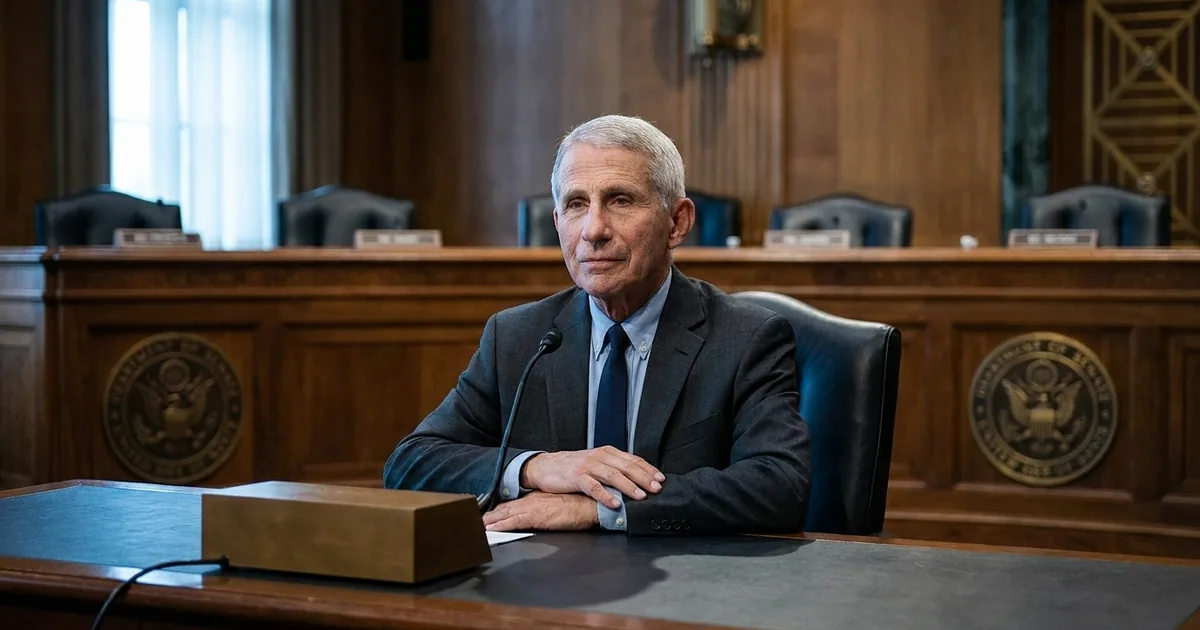
At 8:30 on Thursday morning, the Senate Homeland Security and Governmental Affairs Committee votes on whether to hold Anthony Fauci in contempt of Congress, and almost every account of how we got here has skipped the part that actually matters.
This is not a story about an 85-year-old retired official refusing to talk. It is a test of a legal theory that, if it holds, changes what a presidential pardon does to the person who receives it.
What Actually Happened in That Hearing Room
Fauci appeared under subpoena last week and invoked his Fifth Amendment right against self-incrimination 111 times across roughly three hours. Chairman Rand Paul did not accept the invocation. He ruled from the chair that the privilege did not apply, ordered Fauci to answer, warned him that refusal would carry consequences, and got refusal anyway.
The resolution Paul has now put in front of his committee asks Vice President JD Vance, in his capacity as president of the Senate, to transmit the committee’s contempt report to the U.S. Attorney for the District of Columbia. If the resolution clears committee, Paul can push it toward a referral or ask Majority Leader John Thune to bring it to the full Senate. NPR reported ahead of the vote that both routes remain open, which is a polite way of saying nobody has decided how far this goes.
The Pardon Argument, Which Is the Whole Ballgame
Paul’s central claim is that Fauci cannot invoke the Fifth because Joe Biden pardoned him for conduct between 2014 and January 2025. The logic runs like this: the Fifth Amendment protects you from being compelled to incriminate yourself, incrimination requires exposure to prosecution, and a pardon removes the exposure. No jeopardy, no privilege, answer the question.
That argument is not frivolous. It descends from a real and long-standing principle that when the government removes the risk of prosecution, the privilege that guards against that risk goes with it. Grants of immunity work exactly this way, and they are used constantly.
But a pardon is not a grant of immunity, and the difference is where this gets interesting. A federal pardon does not touch state prosecution. It does not cover conduct outside the window it names, and this one names a window that closed in January 2025. It does not protect against perjury committed in the act of testifying. Any one of those gaps is enough for a witness to argue that a genuine risk survives the pardon, and the Fifth Amendment has historically tolerated a fairly low bar for what counts as genuine risk. ABC News laid out the competing readings shortly after the hearing, and the honest summary is that this is unsettled.
Paul’s second theory is weaker. He ruled that Fauci waived the privilege by delivering an opening statement. Waiver by testimony is a real doctrine, but it is usually read narrowly: a witness who testifies about a subject can be made to answer follow-ups on that subject, not to surrender the privilege wholesale. Building a contempt referral on that reading is a stretch, and the fact that it is in the mix at all suggests the pardon argument is doing the heavy lifting.
Why Both Sides Want This Fight
Here is the part that explains the timing. Neither Paul nor Fauci is behaving like someone who wants to avoid a confrontation.
Paul has spent years trying to get Fauci under oath on gain-of-function research and the origins of COVID-19, and has been blocked repeatedly by the ordinary friction of congressional oversight. A contempt referral gets the dispute out of a hearing room, where Paul controls the gavel but not the outcome, and into a forum where somebody has to rule. Forbes noted before the vote that the committee’s Republican majority makes passage the expected result, which means Paul is not gambling much at this stage.
Fauci’s incentive runs the other way but lands in the same place. A witness who answers under a contested theory of waiver has conceded the theory. A witness who refuses, gets held in contempt, and forces a court to rule has a chance of establishing that the pardon did not strip anything. That is a rough month in exchange for a durable answer. LNC covered the hearing where Fauci first invoked the Fifth and the posture has not softened since.
The Institutional Cost Nobody Is Pricing In
Strip out the personalities and there is a genuine problem underneath, one that should worry people regardless of what they think of Fauci.
Congressional oversight depends on witnesses showing up and answering. The Fifth Amendment is one of the few things that reliably stops that machinery, which makes it a standing frustration for any committee chair. If a pardon is held to eliminate the privilege, then every future president gains a strange new power: the ability to make a former official permanently compellable before Congress by pardoning them. Pardons have always been understood as protection. This theory converts them, at least partly, into an instrument of exposure.
Run it forward and the incentives get stranger still. An official who might otherwise accept a pardon has a reason to refuse one. A president who wants a predecessor’s staff dragged through hearings has a reason to issue pardons nobody asked for. That is not a hypothetical anyone has had to think about before, because until now the pardon power and the compulsion power have not been pointed at each other.
The Justice Department is under no obligation to prosecute a congressional contempt referral, and the historical record is that most referrals die quietly. NBC News reported that the committee can send this straight to DOJ or route it through the full Senate first. Either path ends at a prosecutor with discretion, and prosecutors have historically been reluctant to build a case on a novel reading of the Fifth Amendment against an 85-year-old with a pardon in hand.
Which means the likeliest outcome of Thursday’s vote is not a prosecution. It is a precedent that sits on the shelf, available to the next chairman who wants it. PBS NewsHour is carrying the proceedings live, and the number worth watching is not the vote tally, which is close to predetermined. It is whether any Republican on the committee says out loud that the pardon theory needs a court before it needs a referral.