
Richard Seymour spent 12 seasons taking apart offensive lines, collected 3 Super Bowl rings and 7 Pro Bowl selections, and then in 2019 finished 131st out of a field of nearly 9,000 in the World Series of Poker Main Event for $59,925.
The number that matters there is 131st. A man who was among the best in the world at one contest re-entered a completely different one and finished inside the top 2%, which is the sort of result that keeps former athletes coming back to a game where none of their physical advantages apply.
The 2014 Main Event Field
The clearest picture of this migration came in the summer of 2014, when Paul Pierce and Gerard Piqué both bought into the Main Event in the same week. Pierce was nearing the end of a career that would span 19 seasons and include 10 All-Star selections, while Piqué was in the middle of a career that produced 8 La Liga titles and 3 Champions League winner’s medals. Both had already established themselves at the highest levels of the sports that made them famous.
Both were treated like anyone else. Piqué was knocked out on day 2 by an American amateur named Michael Aron, and Pierce never reached the money places. What the trip gave Pierce was a habit. He had been playing high-stakes private games through his basketball career, favouring Pot-Limit Omaha, and the Main Event turned a hobby into something he kept returning to after retirement.
Rivalry Behaviour in a New Setting
Athletes bring their competitive habits with them and leave their reputations at the door. A man used to being the most feared person on a field sits down against opponents who may have never heard of him. The pecking order he spent 15 years establishing counts for nothing at the table. Some respond by studying and some by trying to win the room, and the difference between those two responses can become visible quickly.
The old rivalries can survive the move in a quieter form. Former opponents seated together can talk about the games they played against each other, and the needling that used to happen at a line of scrimmage can happen across a pot instead. The stakes are different and the audience is smaller, but the competitive instinct remains.
Formats for a Continuing Contest
Charity events are where many retired athletes start, often because a former teammate organised it and the buy-in goes to a foundation. The ones who keep going find poker games on a phone during a layover, which is how a hobby can turn into a habit without anyone deciding it should.
What survives the move is the appetite for a measurable result against a live opponent. What disappears is the physical component, which is exactly why the game attracts athletes whose bodies have stopped cooperating.
Sledging Traditions and Table Talk
Cricket produced one of the most natural crossovers. Shane Warne took 708 Test wickets between 1992 and 2007 and spent much of that career talking to batsmen, in a sport where verbal pressure is a recognised part of the craft rather than a breach of etiquette. His first ball of the 1993 Ashes turned sharply past Mike Gatting and became known as the “Ball of the Century,” and the psychological aftershock of that delivery followed English batsmen through the rest of the decade.
A player with that training arrives at a card table already fluent in the local dialect. Warne played major poker tournaments on multiple occasions and drew press attention during his appearances. Table talk was never likely to be a problem for him. Cricket had spent 15 years teaching him how to make a stranger uncomfortable in a slow game with long gaps between deliveries, which is a fair description of poker as well.
The Football Contingent
Gerard Piqué has taken the game further than most footballers. The former Barcelona defender has accumulated substantial recorded live tournament earnings, and one of his best results came in 2019 in Barcelona, where he finished second in a €25,000 single-day high roller for €352,950. That is a significant tournament score produced by a man who was still an active player for one of the biggest clubs in the world.
Teddy Sheringham built a longer and quieter record. The striker, who came off the bench for Manchester United in the 1999 Champions League final to equalise in stoppage time and set up the winner 2 minutes later, recorded numerous live tournament cashes. He finished 5th in a €5,000 main event for €93,121 in 2010. He took 14th in a European Main Event for $66,738 in 2009 and cashed the 2012 World Series Main Event in 388th for $28,530. Sheringham and Piqué, two former Manchester United players 15 years apart in age, both ended up testing themselves on the poker circuit.
Transferable Habits and Their Limits
A few habits carry over cleanly. Athletes prepare for a specific opponent as a matter of routine. They have also learned to fail in front of an audience without coming apart afterward. Add a high tolerance for repetition, which is the daily condition of professional training. Seymour’s 131st place out of nearly 9,000 entrants shows how far those habits can carry someone in a game he took up in his 30s.
The limits show up quickly too. Physical intimidation does nothing at a table and teammates do not exist. The feedback loop that told a defensive lineman within 3 seconds if he had won the rep is replaced by a signal that can take months to resolve. Seymour, now in the Pro Football Hall of Fame after being enshrined with the class of 2022, had to make the adjustment from one competitive environment to another. Winning a rep is instant. Winning a hand proves nothing.
A Tuesday in July
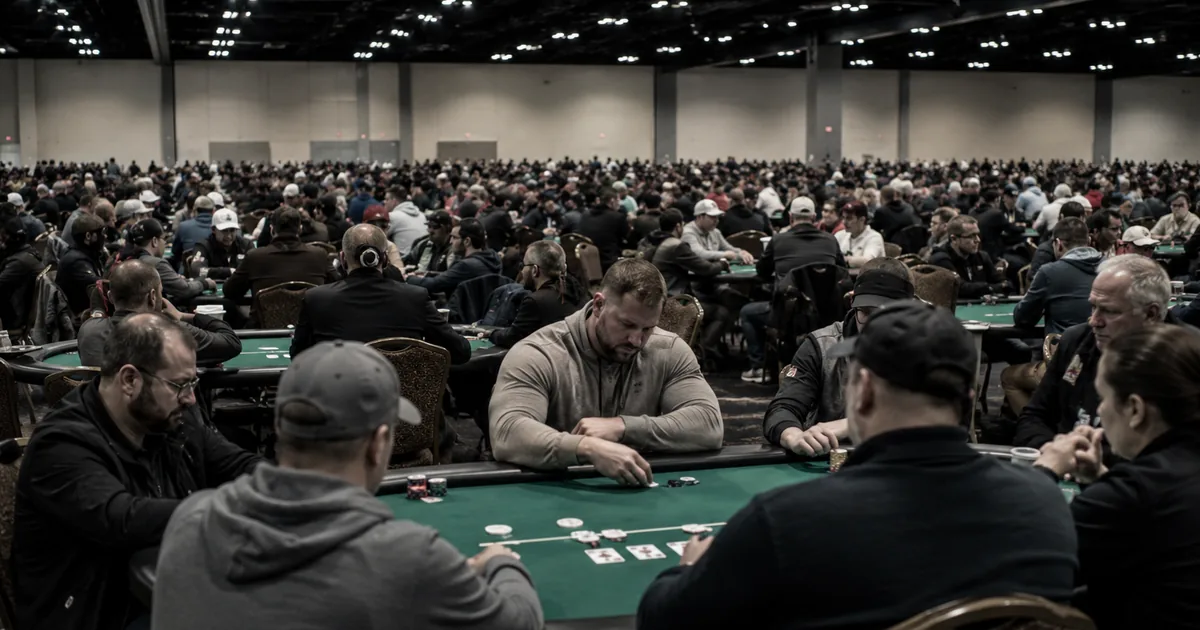
Picture the room in mid-summer. A convention hall with 200 tables, air conditioning working too hard, a dealer calling for a floor supervisor two seats down. A 6-foot-6-inch former defensive lineman is folding a hand into the muck while another player stacks his chips into piles of 20 and gives him nothing to read at all. Nobody at the table mentions Foxborough. The rivalry that brought him into the room is still running, and the only person who can see it is him.