
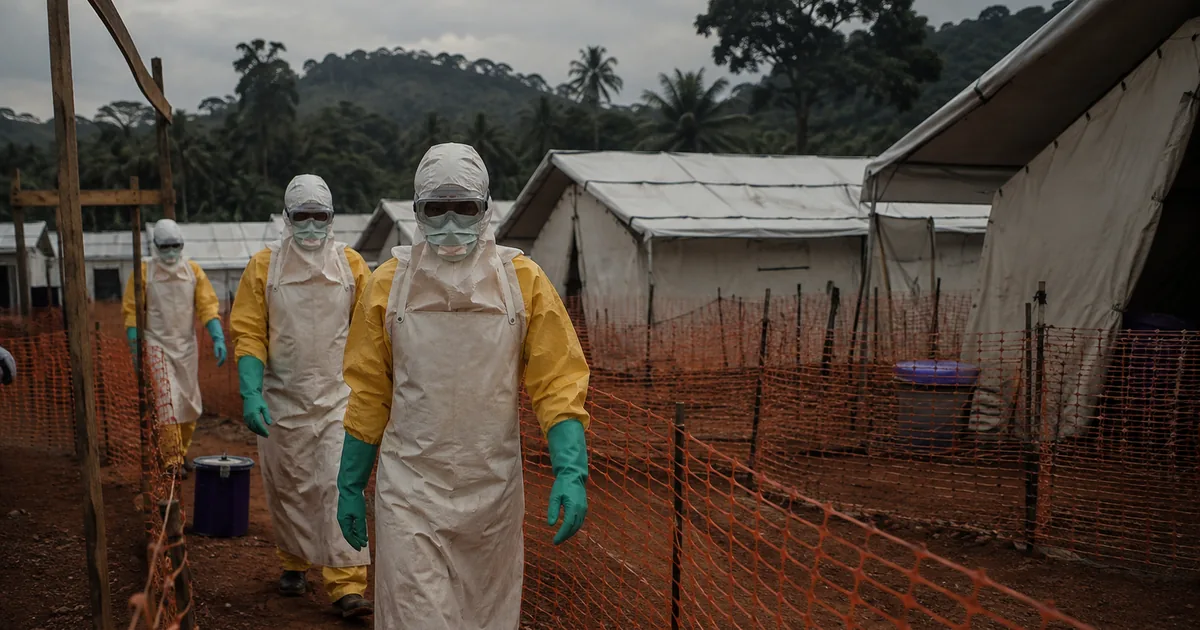
The World Health Organization said Wednesday that Congo’s Ebola epidemic is now on pace to become the deadliest in recorded history.
What separates this outbreak from the last one is not that the virus turned more dangerous, but that nearly every drug and vaccine the world spent a decade licensing was built against a species of Ebola this outbreak does not involve.
In his opening remarks at Wednesday’s media briefing, WHO Director-General Tedros Adhanom Ghebreyesus put the official count at 4,449 confirmed cases and 2,061 deaths across five provinces and 53 health zones. Roughly 90% of cases and 80% of deaths sit inside one province, Ituri, clustered around the towns of Bunia, Rwampara, Nizi and Lita. “At its current pace, it is on track to eclipse the West African Ebola outbreak of 2014 to 2016,” he said. That epidemic killed more than 11,000 people out of some 28,000 cases and has stood as the worst on record ever since.
The number that should alarm people is not the total. It is the slope. West Africa needed roughly eight months to reach 1,000 deaths. This one was formally declared on May 15 and blew past 2,000 inside three months, which is why the Associated Press describes it as the fastest-growing Ebola outbreak ever recorded. When we last covered this outbreak in mid-July, it stood at 1,830 cases. It has more than doubled in a month.
The Tools That Ended the Last Epidemic Are Licensed for a Different Virus
Here is the fact most coverage buries in a subordinate clause. There are six known species of Orthoebolavirus, four of which cause disease in humans: Zaire, Sudan, Taï Forest and Bundibugyo. Almost everything the world stockpiled after West Africa works against exactly one of them.
- Ervebo, Merck’s vaccine licensed in 2019, is approved for Zaire ebolavirus and does not protect against other species of the virus.
- Inmazeb, Regeneron’s three-antibody cocktail, is approved for Zaire ebolavirus.
- Ebanga, the monoclonal antibody licensed in 2020, is approved for Zaire ebolavirus.
This outbreak is Bundibugyo. As Gavi has spelled out, there is no licensed vaccine and no approved therapeutic for it anywhere in the world. The 2018 to 2020 North Kivu epidemic, the second-deadliest until this one, was a Zaire outbreak, and ring vaccination with Ervebo alongside those antibody drugs is a substantial part of why it was brought under control. Nobody in Ituri has access to that playbook. In practical terms, responders are fighting a 2026 epidemic with the 2013 toolkit, and the case fatality rate of roughly 46% reflects it.
The outbreak had a big head start, still way ahead of us, and we’re playing catch-up.
A Three-Month Head Start Nobody Saw
Genetic sequencing places the true start of the outbreak in February, three months before it was declared, as PBS NewsHour reported. It surfaced the way Ebola so often does, inside a hospital. A cluster of severe illness appeared among health workers in the Bunia health zone, and by May 15, according to WHO’s outbreak notice, eight of thirteen samples had come back positive for Bundibugyo virus. Sixteen health and care workers were confirmed infected in that early wave. By the time the world had a name for what was happening, the epidemic had been running for a quarter of a year in a province where the health system was already stretched thin.
Nineteen Years, Three Outbreaks, No Market
Bundibugyo virus was identified in 2007, named for the district in western Uganda where it first appeared. It has caused three outbreaks in its known history: Uganda in 2007, a contained one in Congo’s Province Orientale in 2012 that infected 59 people and killed 34, and this one. Nineteen years separate the first from the third. In that window the world licensed one vaccine and two therapeutics against Zaire ebolavirus, and not a single approved product against Bundibugyo.
That is not a failure of science. It is a market outcome, and it is the actual why of this story. Vaccine development follows outbreaks rather than risk, because a pathogen that kills a few dozen people every few years in eastern Africa generates no commercial case for the decade of trials a license requires. Zaire ebolavirus earned its countermeasures by killing 11,000 people in countries the West was frightened of in 2014. Bundibugyo never cleared that bar, so the work never got funded, so the shelf was empty when it finally did.
The catch-up is visible now, and its timing tells the story. Tedros announced that “for the first time, two vaccines specifically designed against Bundibugyo virus have now entered phase one safety trials in humans.” Phase one is the first-in-human safety step. That starting line is being crossed nineteen years after the virus was named and three months into an epidemic killing people faster than any Ebola outbreak on record. CEPI’s own program page describes the effort as new. The United States has since put an additional $50 million into CEPI for Bundibugyo countermeasures, part of a federal response that now exceeds $270 million. All of it is money spent after the fire started.
Everything else being tried is improvisation with borrowed tools. WHO has recommended Regeneron’s Ebola antibody for investigational use against Bundibugyo. New animal data suggesting the Zaire vaccine may offer some cross-protection is why STAT reported in July that researchers want Ervebo tested in this outbreak, and Tedros said the WHO-sponsored PARTNERS therapeutics trial has now reached 100 patients. Running clinical trials as your emergency response is what being behind looks like.
Half-Funded, in a Province Already at War
The response is also short of money. Of the $518 million required for the continental preparedness and response plan, Tedros said $264 million has been disbursed, a little over half, with the epidemic accelerating. Doctors Without Borders has more than 1,400 staff deployed across Ituri, North Kivu, South Kivu and Tshopo, and into Uganda, where the virus has already crossed.
The obstacles on the ground are not primarily virological. Ituri sits in a conflict zone near the borders with South Sudan, Uganda and Rwanda. Health centers are poorly equipped, community mistrust of outside responders remains a live problem, and CNN reported this month that health workers have threatened to abandon the response entirely over wages they were never paid. Ebola exploits exactly these conditions, which is why it keeps returning to this corner of Congo rather than somewhere with a functioning state.
The American angle here is not comfortable either. WHO declared this a global health emergency in May, and the outbreak has already produced infected American medical workers. It is arriving while US public health capacity is being cut, a pattern we have written about as it played out across several simultaneous outbreaks. Detection, contact tracing and border screening are the functions that keep a Bundibugyo outbreak an African emergency rather than a global one, and they are the functions being defunded.
There will be a licensed Bundibugyo vaccine eventually. The trials have started, the money has arrived, and the political will now exists because the body count made it exist. The question worth sitting with is which of the other three human-infecting Ebola species, or the dozens of pathogens with similar profiles and similarly thin commercial cases, is currently sitting where Bundibugyo sat in 2024: known, sequenced, understood, and unfunded.