
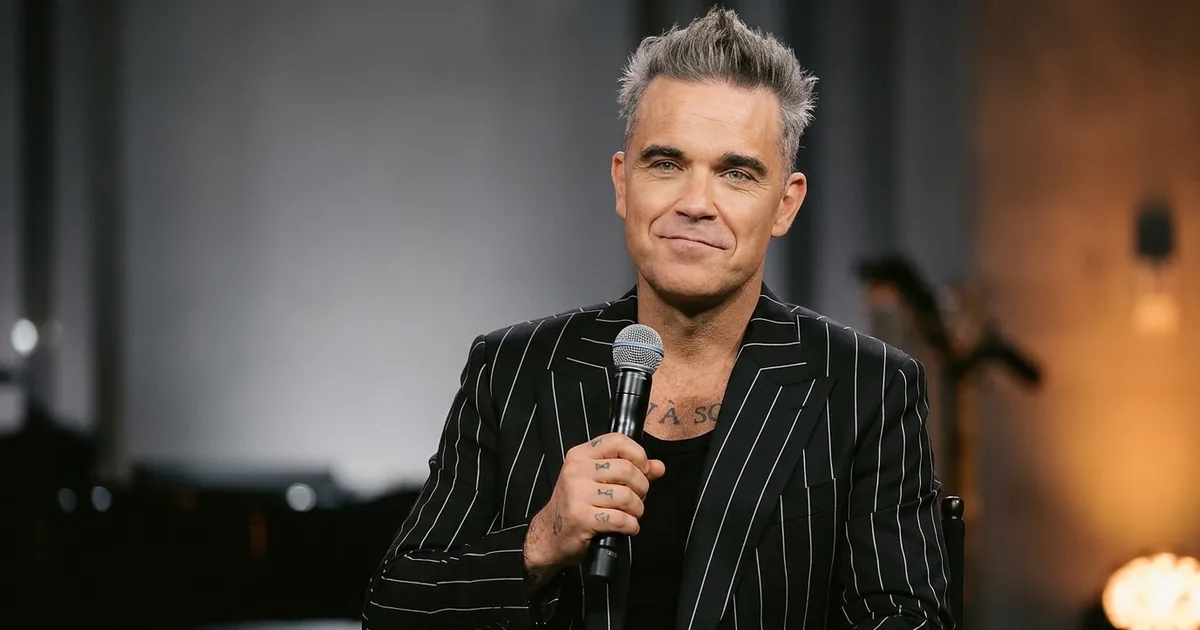
Robbie Williams told a room full of people he has autism while doing a Q&A at the launch of his own clothing line, which is either the least appropriate venue imaginable for a medical disclosure or the most honest one available to a pop star in 2026.
He is 52. He said the diagnosis explains a great deal, and then he made a joke about it, because that is how he has handled every other thing that has gone wrong in public.
The setting was the Autumn/Winter launch for Hopeium at Flannels in London on August 13, and NME reported the exchange straight: he already knew about the ADHD, he has now been told there is autism as well, and the second diagnosis made sense of things the first one did not. He called it, with the timing of a man who has been on stage since he was sixteen, his get-out-of-jail-free card for whenever he does something odd.
The phrase he used for the diagnosis itself was “a bit of autism.” Vice picked up on that wording, and it is worth sitting with, because it is not how clinicians talk and it is very much how ordinary people still do. You do not have a bit of autism. But the instinct behind the hedge is completely legible: a man who has spent thirty years being called difficult, erratic and self-sabotaging has just been handed an explanation, and he is reaching for a version of it that does not sound like a diagnosis of something permanent.
Williams has been assembling this picture in public for a while. He disclosed ADHD in 2025. He has described his intrusive thoughts as a form of internalized Tourette’s, tics that arrive without ever making it out of his mouth. He has talked about scurvy, of all things, after he stopped eating properly. He has been the most consistently self-disclosing star in British pop for two decades, and this is the entry in that ledger that reframes the earlier ones.
He Is Late, and He Is Not Unusual
The interesting thing about a 52-year-old getting this news is that it is no longer a curiosity. Adult diagnosis is the fastest-growing segment of autism identification in the developed world, and the numbers behind that are not subtle. A study published in JAMA Network Open tracked diagnosis rates from 2011 to 2022 and found the sharpest relative increase among adults aged 26 to 34, where the rate rose roughly 450 percent. Analysis of clinical records has found the same pattern with a gender skew attached: a quarter of female patients diagnosed in 2024 were adults, against about 12 percent of male patients.
Nobody serious thinks a new epidemic of autistic adults appeared in the 2010s. What appeared was a diagnostic apparatus capable of seeing people it had previously been built to miss. The criteria that generations of clinicians learned were assembled largely from observation of boys, and specifically boys whose traits were disruptive enough to get them referred. A kid who was quiet, or compliant, or good at studying other people and copying them, went undiagnosed and grew into an adult who assumed the difficulty was character. Yale Medicine has been blunt about that framing, and the practical result is a cohort now in their forties and fifties finding out that a lifetime of feeling wrong had a name the whole time.
Williams fits that profile better than his celebrity suggests. Intense focus on a narrow subject, near-total inability to concentrate on anything outside it, social situations that read as a performance rather than an instinct: he has described all of it, repeatedly, over years, as personal failure. It was framed as ego, or addiction, or a stroppy northern lad who could not handle fame. A diagnosis at 52 does not undo three decades of that framing, but it does relocate the fault line.
Celebrity Disclosure Is Doing Real Work Here, and Real Damage
There is a version of this story that treats a famous man saying a word out loud as an unqualified public good, and it mostly is. Danny Glover’s family made a similar choice about his Alzheimer’s diagnosis earlier this summer, and the effect of these announcements is measurable: referral requests spike, waiting lists lengthen, and people who had privately suspected something for twenty years finally book the appointment.
The damage is in the framing, and Williams supplied a perfect specimen of it without meaning to. A get-out-of-jail-free card is a joke about consequences, and the joke lands because the audience already half believes the diagnosis functions as an excuse. That is the exact misreading that makes autistic adults reluctant to disclose at work. The value of a late diagnosis is not absolution for past behavior. It is a working model of your own nervous system, which is a genuinely different thing, and considerably more useful.
He was, to be fair, joking. He also said it explains so much, which is the accurate part and the reason 52-year-olds keep going for assessment. Both things were said in a shop, at a clothing launch, to a crowd that came for something else entirely. That is a very Robbie Williams way to deliver the most consequential piece of self-knowledge he has ever had.