
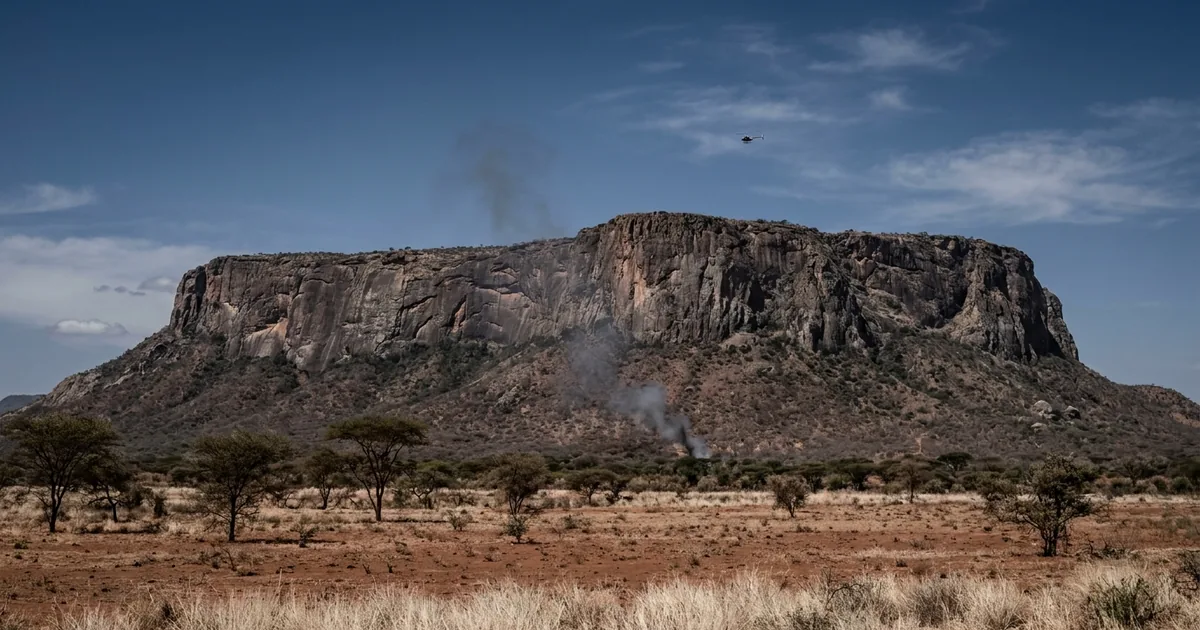
Four Americans were killed Wednesday morning when a sightseeing helicopter came down in the foothills of Mount Ololokwe in Samburu County, and Kenyan investigators say nobody aboard survived.
The aircraft crashed at 9:13 a.m. local time on a short hop across one of the most photographed landscapes in East Africa, on exactly the kind of flight the country’s high-end safari business is built around.
The State Department kept its confirmation narrow. “We confirm the deaths of four Americans as a result of a helicopter crash in Samburu County, Kenya,” a spokesperson said in a statement confirming the deaths, adding that the U.S. Embassy is in touch with local authorities and providing consular assistance. It declined to release names, citing privacy. That is standard practice, and it means the four Americans remain officially unidentified while a good deal of unverified naming circulates elsewhere.
The fuller toll came from Kenya’s own investigators. Fredrick Kabunge, director of the Aircraft Accident Investigation Department, said there were seven people on board, one pilot and six passengers, and that there were no survivors. Euronews carried his confirmation that the helicopter was transporting tourists on a scenic flight. The arithmetic that matters right now is narrow and grim: seven dead, four of them American citizens, the rest not yet publicly accounted for by any government.
What Investigators Have Actually Confirmed
The Kenya Civil Aviation Authority identified the aircraft as a Eurocopter EC130 B4 registered 5Y-GYM, operated by the local charter firm Lady Lori Helicopters and carrying guests of the luxury travel company &Beyond. It had left the Loisaba Conservancy and was heading toward the Ewaso Nyiro area when it went down near the base of the mountain, aviation authorities told the Associated Press. The Ministry of Roads and Transport’s Air Accident Investigation Department is leading the inquiry.
Nothing beyond that is established. No cause has been determined, and no official has said whether weather, mechanical failure, or a pilot decision is in play. A confident explanation involving an attempted landing on the mountain itself is already moving through Kenyan social media. It rests on a single unsourced post, no authority has endorsed it, and it deserves to be treated as noise until the accident department says otherwise.
The Fire Was Still Burning While Crews Tried to Reach Them
The recovery became its own ordeal. The Kenya Red Cross, which led the response, described conditions that prevented crews from doing the first thing any emergency service does, which is reach the people.
Search and recovery efforts are ongoing, hampered by difficult terrain access and an active fire at the crash site.
Additional Red Cross teams were dispatched from Isiolo. Tropic Air Kenya put two of its own helicopters into the search. Responders surveyed by drone ground they could not walk onto. Citizen Digital reported that crews reaching the site found bodies burned beyond recognition, which is precisely why the victim names now circulating in regional media should not be read as identifications. Formal identification of badly burned remains is forensic work, not a passenger list plus a rumor.
Bush Flying Is the Product, Not a Footnote to It
Here is what gets lost when a crash like this is filed away as a freak accident overseas. Kenya’s premium safari economy does not merely tolerate small-aircraft flying. It depends on it completely. Conservancies like Loisaba sit hundreds of kilometers from the next camp across country with no usable roads, and the proposition sold to a guest paying thousands of dollars a night is that they will be moved between remote places quickly, and that the movement itself will be spectacular. A scenic run past a sacred mountain is not an add-on to that product. It is the product.
That model puts light helicopters and single-engine aircraft into high terrain, shifting weather, and unimproved strips many times a day. Charter and scenic flying does not carry the safety margins that make airline travel statistically boring. It runs on lighter oversight, smaller crews, fewer redundancies, and far more discretion left to one pilot on the day. The gap is not a Kenyan peculiarity, which is why a business jet can go down on approach in Texas under the most heavily resourced aviation regulator on earth.
What Kenya adds to that equation is distance. The remoteness that makes the flight necessary, and makes it sell, is the same remoteness that turned Wednesday into a recovery operation conducted by drone around an open fire.
Two Deadly Tourist Flights in Ten Months
This sector has been here recently. In October 2025, a Cessna 208 Caravan operated by Mombasa Air Safari crashed in heavy rain in Kwale County while carrying tourists toward the Maasai Mara, killing all 11 people aboard. Al Jazeera reported that the dead included eight Hungarian passengers, two Germans, and the Kenyan pilot. PBS NewsHour noted that the pilot never made contact after departure and the tower spent half an hour trying to raise the aircraft before it was found. The Associated Press has separately pointed to a crash in western Kenya in February that killed six people, among them a sitting legislator.
Different aircraft, different operators, different causes. Taken one at a time, each can be explained. Taken together, they describe a sector where the flying is constant, the terrain is unforgiving, and the body that investigates when it goes wrong is a small department inside a transport ministry rather than an institution with the reach and independence of the NTSB.
What Happens Next
The four American families will learn what happened in the order these things always follow. A consular call comes first, then an identification process that can take days when remains are burned, then an accident report that will take a year or longer and land after the news has moved on. Kenya’s tourism ministry will say the sector is safe, and measured against the raw number of flights completed without incident, it will not be wrong.
The harder question is whether anyone in that chain is willing to price the risk honestly for the person buying the ticket. A guest booking a scenic flight over Mount Ololokwe hears about the light, the elephants, and the view along the ridge. Nobody hands them the accident record of the charter sector they are about to become a passenger in.