
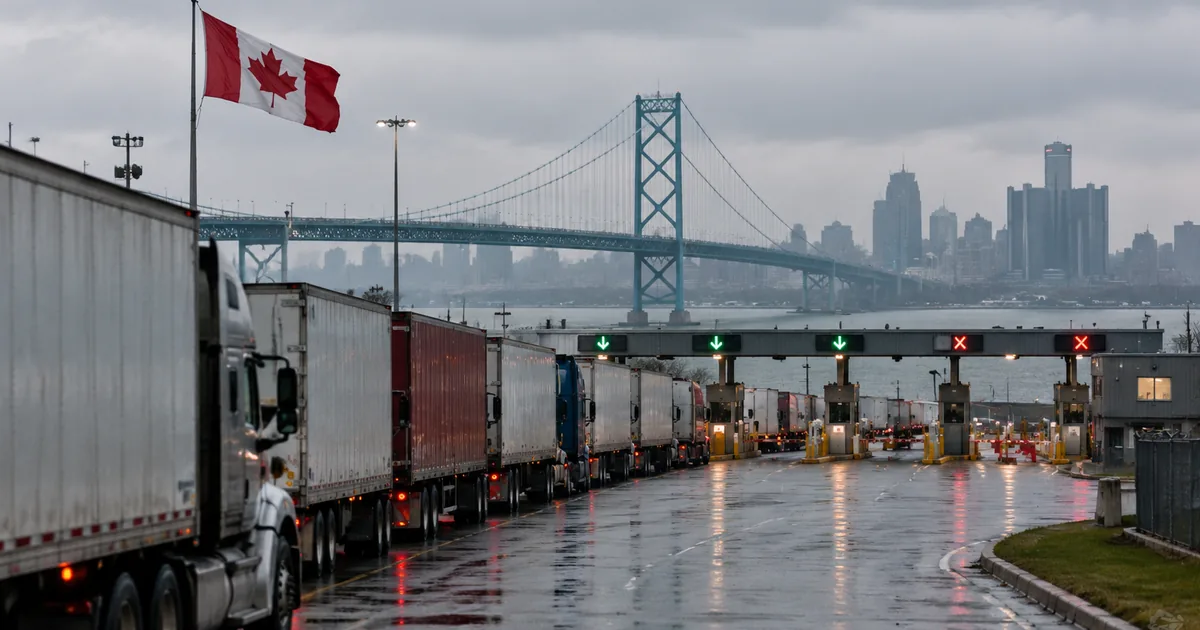
Just after midnight on Saturday, the United States began charging a 50 percent tariff on roughly $20 billion of Canadian goods, three days after President Donald Trump told the country those tariffs were off because Washington and Ottawa had reached a deal.
The distance between those two moments is the real story, and it is a more expensive problem for American trade policy than the tariff itself.
The sequence is worth laying out plainly, because it happened fast enough that the middle of it has already been forgotten. Late Tuesday, Trump said he had paused the 50 percent tariffs on the strength of a phone call with Prime Minister Mark Carney, writing that Canada and the United States, “subject to the finalization of documents, have a DEAL!” Trade officials then met in Washington on Wednesday and Thursday, as CTV News reported when the three-day delay was granted, and emerged both days without a finished agreement. On Friday night, minutes before the extension ran out, the whole thing came apart.
Two Accounts That Cannot Both Be True
United States Trade Representative Jamieson Greer put the blame on Ottawa in a call with reporters, saying that “Canada declined to finalise the trade deal under the terms agreed earlier this week” and that “new demands and walkbacks of other commitments by Canada have upended the careful balance reached in the past days.” His framing is that Washington had offered Canada the best treatment of any major exporter into the American market and Canada moved the goalposts at the end.
Carney’s office told the opposite story. The Prime Minister’s Office said last-minute changes in the American proposed terms were unfair, uneconomic, and called into question the reliability of any deal. Carney himself was more clinical, saying in a statement carried by CP24 as Canada suspended negotiations that “I have decided to suspend trade negotiations with the U.S. and have directed Canada’s negotiators to return to Ottawa.” Trade Minister Dominic LeBlanc and chief negotiator Janice Charette stayed in Washington through the deadline anyway, which tells you how late this fell apart.
Somebody moved. It is genuinely unclear who, and both governments have obvious reasons to say it was the other one. But the more interesting point is buried in Trump’s own announcement, and nobody has to take a side to see it.
Last-minute changes in the U.S. proposed terms were unfair, uneconomic, and called into question the reliability of any deal.
The operative words on Tuesday were “subject to the finalization of documents.” A deal announced before the documents exist is not an agreement, it is a claim about a future agreement. Announcing it anyway did two things at once: it let the White House bank a win in the news cycle on Tuesday, and it left three more days in which the terms were still genuinely open and both sides had every incentive to keep improving them. The pause was not a handshake. It was leverage wearing a handshake’s clothes, and it is difficult to negotiate the last five percent of anything when the other party has already told the press it is finished.
The Concession Ottawa Could Not Actually Make
There is a structural problem in this negotiation that most of the wire coverage has treated as a footnote, and it deserves better.
One of the American asks involved provincial bans on the sale of American alcohol, which Canadian provinces put in place in 2025 in retaliation for the earlier waves of Trump tariffs. Carney spent part of this week asking the premiers to put American booze back on the shelves. He cannot order them to do it. Liquor distribution in Canada runs through provincial boards, which is to say that a concession sitting inside the American ask was never Carney’s to hand over on a deadline, no matter how badly he wanted the deal.
The premiers were not quietly cooperating either. Manitoba Premier Wab Kinew said publicly this week that the federal government should fight Trump rather than accommodate him. So Carney was negotiating with a counterparty who wanted something he lacked the constitutional authority to deliver, while his own provincial leaders pushed him to stop trying. That is not a failure of nerve or of skill. It is federalism, and it does not respond to a midnight clock.
Nobody Agrees on How Big This Is
Here is a small detail that says something larger. Carney put the package at $20 billion in American dollars. The American statement referenced roughly $28 billion. CBC News reported the figure at close to $30 billion. Two governments that spent a week in a room together cannot produce a shared number for the thing they just failed to agree on.
Whatever the number, it is deliberately survivable. Al Jazeera put the affected goods at about 5 percent of Canadian exports to the United States, against the $880 billion in goods and services the two countries traded last year. This was engineered as pressure, not as amputation, and it sits on top of the tariffs already running on Canadian steel, aluminum, lumber and autos. It also fits a pattern already visible in this administration’s approach, which LNC covered in July when a set of expiring tariffs was made permanent under Section 301 across roughly 60 countries.
Read the target list and the political logic gets clearer. Electronics, industrial machinery, cement, plywood, electrical equipment and dairy are the serious entries. Hockey sticks and tongue depressors are on there too. That is not a list an economist assembles. It is a list assembled to be felt in specific places, by specific industries, in a specific country where hockey is not a metaphor.
The Bill Lands in American Checkout Lines
Tariffs are paid by the importer, which means the 50 percent is charged to American companies bringing Canadian goods across the border, and those companies will do what they always do with a new cost. Candace Laing, president and chief executive of the Canadian Chamber of Commerce, called the move a body blow to North American competitiveness and warned it would raise costs for Americans, not just Canadians.
The timing is not incidental. November midterms are close enough that a fresh round of consumer price increases is a live political risk for the party imposing them, which is part of why this particular package stayed relatively small. Ryan Majerus, a former United States trade official now at King & Spalding, offered the least partisan read available when he told Scripps News that consumers should brace for higher costs: Canada likely wanted more sector-specific relief than the United States was willing to offer, or Canada’s concessions did not go far enough.
Canada’s answer was immediate. Carney said Canada will match the tariffs dollar for dollar to protect its workers and businesses, with support measures for affected industries promised within days, and NPR reported the retaliation moving in step with the American duties rather than after a delay. Nobody is waiting to see whether the other side blinks.
What Actually Got Damaged
The $20 billion, or $28 billion, or $30 billion is recoverable. Tariffs come off as abruptly as they go on, and this administration has demonstrated repeatedly that it will reverse a levy in a morning if the politics turn.
The harder thing to repair is the one Carney’s office named. If the President of the United States can announce a completed deal on Tuesday night and preside over 50 percent tariffs by Saturday morning, then every government currently negotiating with Washington has to price in the possibility that an announced agreement is not an agreement. That is not a Canadian grievance. It is a discount that every future counterparty will now apply to every American commitment, and it does not show up in any tariff schedule.
Carney used the word reliability. He was describing a trade negotiation. He may have been describing something with a longer shelf life than this week’s package.