
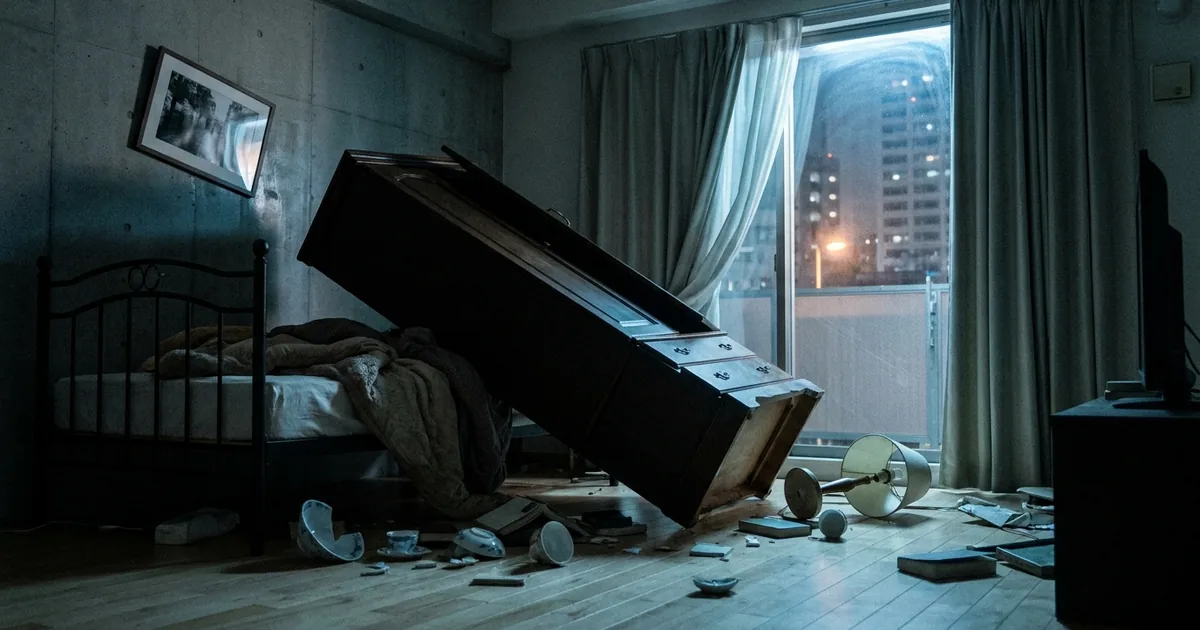
A magnitude 5.9 earthquake struck southern Ibaraki Prefecture early Sunday, shaking Tokyo hard enough to register lower 5 on Japan’s seven-point intensity scale and injuring at least 37 people across five prefectures.
Not one of those injuries came from a building failing, and that detail is the whole story.
What the Instruments Recorded
The quake hit at 2 a.m. local time, which turns out to matter more than anything else about it. The Japan Meteorological Agency put it at magnitude 5.9 with a focus roughly 70 kilometers down. The United States Geological Survey logged the same event slightly differently, at magnitude 5.8 and a depth of 61 kilometers, centered about four kilometers north of Toride. Small disagreements like that are normal between agencies using different networks and different magnitude formulas, and neither number changes what people felt.
What people felt was intensity, not magnitude, and those are not the same thing. Japan measures shaking on the shindo scale, which runs from 0 to 7 and describes what the ground actually did at a given spot rather than how much energy the fault released. Sunday’s quake hit lower 5 in Tokyo’s Adachi Ward and in Ibaraki, Saitama and Chiba prefectures, with a 4 across much of the rest of Tokyo plus Tochigi, Gunma and Kanagawa. Lower 5 is the threshold where unsecured objects start moving on their own: bookshelves walk, televisions slide, dishes come out of cabinets. There was no tsunami risk, because a quake this deep and this size does not displace enough seafloor to make one.
Thirty-Seven People, Five Prefectures, One Pattern
The casualty count climbed through the morning as prefectural fire departments reported in, which is why early wire copy said 23 and later counts said 37. As of 10 a.m. local time the breakdown ran across five prefectures:
- Tokyo: 15 injured
- Saitama: 9
- Kanagawa: 8
- Chiba: 4
- Ibaraki: 1
Read that list again and notice what is missing from it. There is no collapse, no entrapment, no search and rescue. The Associated Press reported, in coverage carried by the Boston Globe, that most of the injured were people who fell or struck themselves against furniture and doors after being woken by the shaking. Xinhua put the same finding more bluntly: they were caught off guard while asleep.
Infrastructure came through about as well. Roughly 460 households in Tokyo lost power and had it back before the morning was out. An underground water main split in Koto Ward and flooded a road until crews shut it off. Express trains toward Narita Airport ran late while inspection crews walked the track, and the Shinkansen never stopped at all. ABC News reported no tsunami advisory was issued at any point.
The Building Code Worked, Which Is the Uncomfortable Part
Here is the thing that should be said plainly instead of buried under the word “moderate.” A lower-5 quake directly under the largest metropolitan area on earth, home to something like 37 million people, produced zero structural failures and 37 bruises. That is not luck. That is the return on fifty years of compulsory seismic engineering, the 1981 code revision, the post-Kobe retrofit programs, and a regulatory culture that treats a building permit as a public safety instrument rather than a fee. Japan decided, at enormous public expense, that buildings would not kill people in ordinary earthquakes. On Sunday morning the buildings did not kill anybody.
And yet 37 people still got hurt, because the risk did not disappear. It moved.
Once you engineer the structure to a standard this high, the remaining injury surface in a moderate quake is almost entirely inside the room: the wardrobe that is not bolted to the stud, the television on an unsecured stand, the glass-front cabinet above the bed, the door that swings into you in the dark. Japan has a word for the countermeasure, and municipal governments across the Kanto region run subsidy and giveaway programs for the brackets and straps. But that last meter of earthquake safety is where the state’s power runs out. Nobody inspects your bedroom. Nobody issues a certificate of occupancy for your bookshelf.
Our read is that this is the structural reason the injury count looks the way it does, and it is a genuinely hard governance problem rather than a failure of will. Public safety spending scales beautifully when the target is a building, because a building has an owner, a permit, an engineer and an inspection regime. It scales terribly when the target is a household decision that costs about the price of a takeaway meal, takes twenty minutes, and produces no visible benefit for years or decades. Anchoring a dresser is the earthquake equivalent of a smoke alarm battery. Everyone agrees it matters. Compliance is voluntary, invisible, and therefore uneven.
There is a second-order version of this that we saw last month, when a magnitude 7.1 quake near Kumamoto tested Japan’s chip fabrication plants rather than its apartment blocks. Same lesson, different scale: the hardened thing holds, and the consequences relocate to whatever was not hardened.
Why the Aftershock Warning Sounds Different Now
The JMA did something on Sunday that would have been unusual a generation ago. Instead of a vague advisory, it told the public to expect shaking of comparable intensity, up to lower 5, for about a week, with the highest risk concentrated in the next two to three days.
That specificity is deliberate, and it is a direct inheritance of 2011. The Tohoku disaster did not just rewrite Japan’s tsunami defenses, it rewrote how the agency talks. Precise, time-bounded, probability-flavored warnings replaced institutional hedging, because hedging is what people ignore. The research legacy of that quake is still being worked through: it was powerful enough that scientists have spent years measuring how the 2011 event’s seismic waves moved through the planet’s core.
Southern Ibaraki sits where the Philippine Sea plate is grinding under the Kanto region, which is why this stretch of ground produces quakes of exactly this size on a schedule that feels almost routine to people who live there. Routine is the risk. A city that shrugs off a lower 5 is a city that has stopped rehearsing.
What This Says to Anyone Watching From California
The American version of this conversation is stuck at a much earlier stage, and it showed up in the same day’s search traffic: US readers spent Sunday looking up both the Tokyo quake and new findings about movement along the San Andreas Fault. The gap between the two countries is not scientific knowledge. It is enforcement, retrofit funding, and the political appetite to make an expensive rule mandatory and then keep it mandatory for four decades.
Japan’s Sunday morning is what the good outcome looks like, and it is worth being precise about how good it was: a major capital took a real jolt and produced no fatalities, no collapses, and a repair list that fit on one page. The 37 people who did get hurt are not evidence the system failed. They are a map of exactly where it ends, and of the one part of it that no building code can reach.