
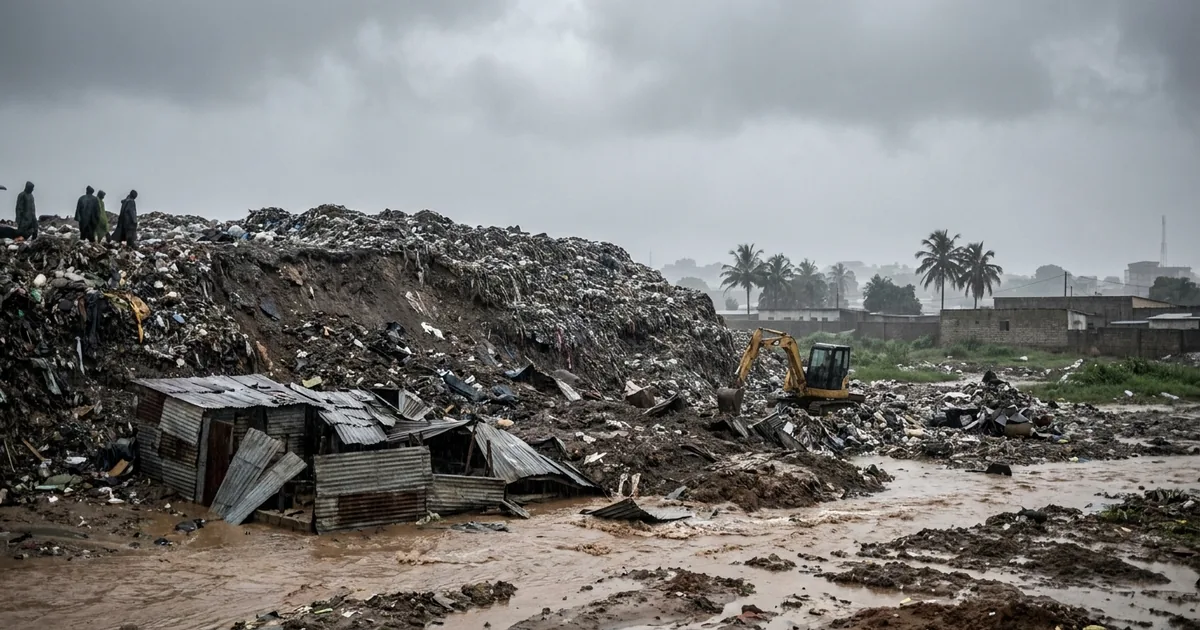
Guinea’s government had already concluded that the mountain of refuse at Dar-es-Salam was too dangerous to keep open, ordered the people living against it to leave, and fixed Sunday as the day the site would shut.
At around two in the morning on that Sunday, after heavy rain, the mountain came down on their homes and killed at least thirty of them.
The collapse hit the Dar-es-Salam neighbourhood of Conakry’s Bbessia district, on the outskirts of the Guinean capital. Al Jazeera reported that rain falling before dawn destabilised a slope of accumulated waste, which slid down onto the shacks built directly against it and buried people asleep inside. Six others were seriously injured. Djenabou Toure, Guinea’s minister for territorial administration, went to the site and said she would not give an official casualty figure until the search finished, which is the standard signal that a number is going up rather than down. Earlier wire counts put the dead at 22 before the government settled on 30.
A Closure Date That Arrived Second
Lieutenant Colonel Balde Mamadou Bailo, a sanitation officer with Guinea’s Military Engineering Battalion, told reporters the landfill had been designated for closure on Sunday. Not that quarter, not that month. Sunday. In the weeks beforehand the government had ordered people cleared from around the site and put safety measures in place, and it did so for one stated reason: it was afraid the waste would collapse.
So the state’s assessment was correct in every particular except the one that decided whether anyone lived. It identified the hazard. It named the mechanism, rain on an oversteepened slope. It picked a date. The hazard simply kept a schedule of its own, and beat the paperwork by a few hours.
We have pulled out 18 bodies that were taken to the morgue.
That was Lancine Sylla, who heads the Dar-es-Salam suburb, describing the recovery while excavators were still working the pile. The gap between his count and the government’s confirmed 30 is the part of this story that has not finished happening yet.
An Eviction Notice Is Not a Relocation Plan
This is where the story stops being about weather. Conakry’s rainy season is not a surprise, the physics of a saturated waste slope are not disputed, and the government demonstrably understood both. What failed was the assumption buried inside the eviction order, which is that telling people to leave a place is the same as giving them somewhere to go.
The households at Dar-es-Salam were not camped there by accident or by preference. A metropolitan landfill in a country with no formal recycling industry is a workplace, and the people who sort metal, plastic and food waste out of it live at the edge of the pile because the economics of the job collapse the moment you add a commute. Proximity is the business model. Removing people from the slope means removing them from their income, and an order that does the first without addressing the second is asking families to choose between a warned-about risk and a certain loss of everything they earn. People given that choice take the risk, and they take it consistently enough that it should be treated as a design input rather than a surprise. New York has watched the same arithmetic play out for years in the illegal basement apartments that keep flooding in Brooklyn and Queens, where the units are known to be lethal, known to the city, and still occupied, because the legal alternative does not exist at a price anybody can pay.
A warning issued without a place to move to is not a safety measure. It is a transfer of liability. It shifts the state from owning the hazard to having mentioned it, and it accomplishes this without moving a single person out of the way of the thing that kills them.
Kampala Ran This Exact Experiment Two Years Ago
The precedent is close enough in time and mechanism to be uncomfortable. In August 2024, two years and two weeks before Conakry, the Kiteezi landfill outside Kampala gave way after weeks of sustained rain and buried the homes built against it. PBS NewsHour covered the recovery as the toll climbed; Uganda’s Daily Monitor reported it reaching 23. Kiteezi was the only landfill serving a city of roughly four million people. Ugandan authorities had been discussing closing it and opening a replacement since 2016.
The overlap is not thematic. It is mechanical, item by item:
- A single saturated site absorbing an entire capital’s waste well past what it was built to hold
- A slope destabilised by sustained seasonal rain rather than by any sudden event
- Informal housing built directly against the working face, occupied by the people who make a living from the pile
- A closure and replacement plan that existed on paper and had not been executed
What happened after Kiteezi is the more useful warning. Uganda’s parliament demanded action and the government moved to decommission the site, yet a year later trucks were still delivering garbage to it. Compensation for the families reached them in December 2025, sixteen months after the slide, and only a fraction of the destroyed houses qualified for a formal settlement at all. Closing a landfill turns out to be much harder than announcing that you will, because the waste keeps arriving every single day whether or not the replacement is ready.
Guinea has now generated its own second data point. A rubbish dump collapse in Conakry in August 2017 buried people alive in almost identical circumstances, during the same month of the same season. Nine years later the city was still stacking waste on the same terrain and people were still sleeping underneath it.
The Country Is Not Short of Money
The uncomfortable context is that Guinea is in the first year of the largest financial windfall in its history. The Simandou iron ore project began shipping in late 2025, and Guinea’s EITI chapter estimates it will generate between 850 million and 1.7 billion dollars a year for the state before 2035, rising toward 2.7 billion after that. The IMF has said the project could lift Guinean GDP by more than a quarter by 2030, and Bloomberg reported this month that Guinea is negotiating a new IMF program built around the expected surge.
President Mamadi Doumbouya, who seized power in a 2021 coup and was inaugurated in January to a seven-year term after winning December’s election, has staked his legitimacy on turning that ore into something citizens can see. The closure of Dar-es-Salam was part of exactly that promise, a real, funded, scheduled piece of sanitation reform. The failure here was not that Guinea lacked a plan or the means to pay for it. The failure was sequencing. The government set a date to shut the hazard and never set a date to house the people standing on it, and when those two things are ordered wrongly the closing date becomes a death date.
Thirty is not the final number. Excavators are still working, the search was unfinished when the government issued its count, and the minister responsible has said as much. The question worth tracking is not the toll but the second half of the plan: whether the households that worked Dar-es-Salam get somewhere to live and something to earn before the next rainy season, or whether the site gets fenced, rehabilitated and photographed while the people who sorted it move to the next unregulated slope on the edge of the city. Kampala took sixteen months to answer that and did not reach everyone. Conakry is starting from the same place with considerably more money and one less excuse.