
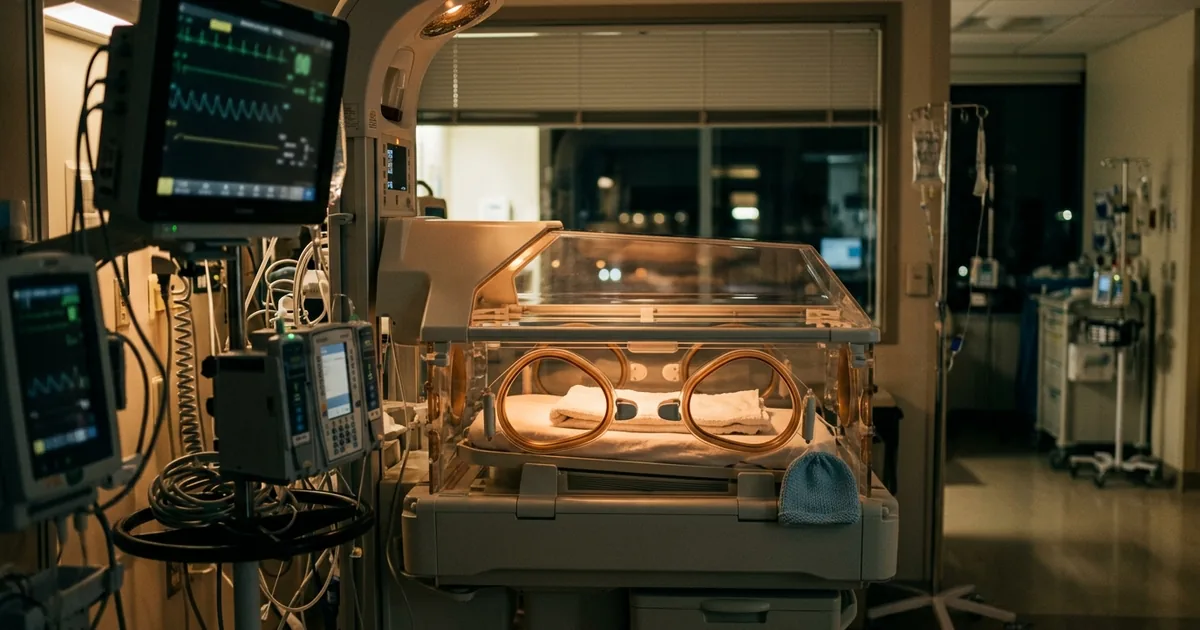
A judge in Dallas spent Tuesday deciding who is allowed to hold a two-week-old boy with half a working heart.
The people asking are his genetic parents, who call him Rumi, and the woman who carried and delivered him, who calls him Gabriel.
That naming split is not sentimentality. It is the cleanest possible summary of a case in which three state legal systems have each answered the same question and produced three different answers, and nobody in the story has done anything a court in their own state would call unlawful.
The Contract
McKenna West is a nurse in Alaska. In August 2025 she signed a gestational surrogacy agreement, arranged through Worldwide Surrogacy Specialists, with Nausheen Gilkar and Omar Ahmed, a California couple whose embryo she would carry. She would give birth at home in Alaska. The contract also included a clause that appears in a great many American surrogacy agreements and that almost nobody signs expecting to test: if a fetal abnormality was found and the intended parents asked her to terminate, she would.
In April, at roughly 20 weeks, the scan found hypoplastic left heart syndrome. The left side of the heart does not develop. It is survivable now, but survival means a staged reconstruction: one operation within days of birth, a second at four to six months, a third somewhere between eighteen months and five years old.
The intended parents asked her to end the pregnancy. She refused.
The Flight
What West did next is why this case exists. She left Alaska for Dallas County, Texas, a jurisdiction whose abortion law made continuing the pregnancy the legally protected default and made any pressure to end it something close to unenforceable.
American reproductive politics has spent four years assuming the migration runs the other way, from restrictive states to permissive ones. Here it ran toward Texas, deliberately, as a shield. The Texas Tribune, which has followed the case since before the birth, described a pregnant woman choosing a forum the way a litigant chooses one.
Texas Attorney General Ken Paxton then made it a state matter. He wrote to UT Southwestern and Children’s Medical Center of Dallas asking them to treat the baby and to prevent him from being taken out of state, declaring that Baby Gabriel deserved a chance at life and that he would not allow anyone to unlawfully deny medically necessary care. Paxton, who won a bruising Republican Senate primary against John Cornyn in May, is not a bystander in this story and has not tried to be one.
The Three Orders
Alaska ruled that West may make her own medical decisions, which is the ordinary answer anywhere for a competent adult who is pregnant.
California ruled that under the surrogacy contract West holds no legal or physical custody rights to the child, which is the ordinary answer in a state whose entire surrogacy framework exists to give intended parents certainty at birth.
Texas ordered that life-sustaining care be provided once the baby was born, and issued a temporary restraining order making Ahmed and Gilkar responsible for medical decisions while barring West from seeing, holding, transporting or deciding anything for him.
All three are defensible readings of their own state’s law. Together they are incoherent. CBS News laid the orders side by side and the incoherence is the finding: a woman who may make her own medical decisions in one state, has no rights at all in another, and is under a restraining order in a third.
What Actually Happened to the Baby
He was born in Dallas on August 12. He had the first operation, and CNN reported that the medical situation deteriorated afterward, with the newborn returned to a breathing tube as complications followed the procedure. The intended parents’ attorney says the child is in their physical custody and receiving expert care, and that their priority is his health.
Tuesday’s hearing, previewed by Houston Public Media, was about whether the restraining order keeping West away from him should stand.
The Clause Nobody Priced
Here is the structural cause, and it is not Texas and it is not California.
The American surrogacy industry runs on contracts drafted for a country that had one national abortion floor. Termination clauses were written as risk allocation, the same way a construction contract allocates delay. They assumed a background rule in which the pregnant woman could end a pregnancy anywhere and the contract merely specified who could ask. Once that floor disappeared, the same paragraph became a promise whose enforceability depends entirely on which state the carrier happens to be standing in, and the carrier is free to change states.
No agency repriced for that. No state legislature harmonized for it. The result is a document that says one thing in Sacramento, something weaker in Anchorage, and almost nothing in Dallas, signed by people who were told it was settled.
The Cost Is Being Paid by the Only Party Who Signed Nothing
There is no clean side here, which is why the case is so uncomfortable. Gilkar and Ahmed learned their child would need three heart surgeries and made a decision that thousands of parents make privately every year, and they are now being described nationally as people who tried to end their son’s life. West acted on a conviction she is entitled to hold, and in doing so moved a pregnancy across the country into the jurisdiction of an attorney general with an obvious political interest in the outcome. Both of those things are true at once.
The boy at the center has hypoplastic left heart syndrome, two more operations ahead of him, and two names. Whatever the Dallas court decided this week resolves custody for a few months. It resolves nothing about the next contract, which is being signed somewhere today with the same clause in it.