
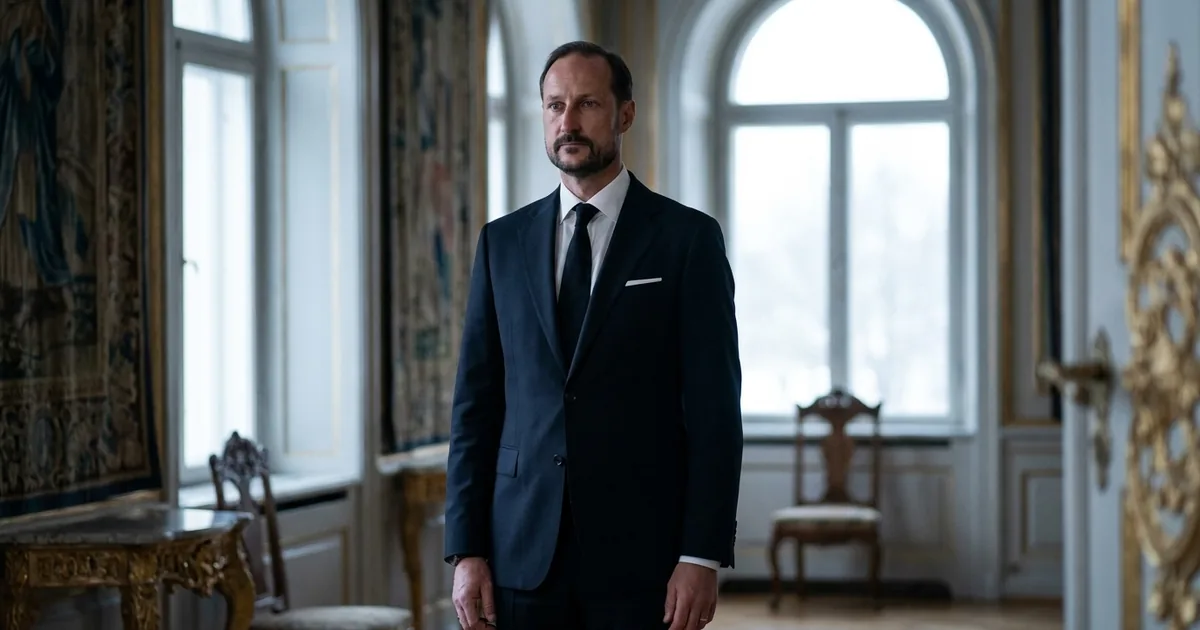
Norway’s King Harald V died at Oslo University Hospital early Friday morning at the age of 89, closing a 35-year reign that, as CNN noted in its account of his death, had made him Europe’s oldest sitting monarch.
His son became King Haakon VIII in the same instant, without a ceremony and without a choice, and that instant is the actual story.
Every obituary moving this morning is working from the same file, and it is a genuinely good file: the three-year-old who fled Nazi-occupied Norway for Sweden and then the United States, the crown prince who spent nine years wearing down his father’s objection to a businessman’s daughter, the monarch who made a stiff institution into something Norwegians actually liked. What none of that coverage does is the arithmetic. Harald spent his last decade publicly refusing to abdicate, and the cost of that refusal was never going to be paid by Harald. It is being paid, starting this morning, by a 53-year-old who takes the throne in the same calendar year that his wife apologized for her dealings with Jeffrey Epstein and his stepson was convicted of rape.
The Oath He Would Not Break
Harald was never coy about his reasoning. Pressed repeatedly on whether he would step aside as his health failed, he kept returning to the promise he made to parliament when he took the throne in January 1991, after the death of his father Olav V.
“It lasts for life.”
That was his position in January 2024, and he never moved off it. He treated the accession oath sworn before the Storting as a binding commitment rather than a job description with a natural end date, and there is something to admire in a head of state who declines to treat a constitutional vow as negotiable when it becomes personally inconvenient.
He also held that line through a long run of visible decline. He was fitted with a pacemaker, scaled back his official duties, and was admitted to hospital on 17 August, where Al Jazeera reported he was being treated for haemolytic anaemia, a condition in which red blood cells are destroyed faster than the body can replace them. The palace said he died peacefully at 6:35 on Friday morning. Prime Minister Jonas Gahr Støre said a whole nation was in mourning and that Norwegians were left with “a deep sense of gratitude for a long life in the service of Norway.” Both things are true. He was widely loved, and he stayed until his body decided the question for him.
What Haakon Actually Inherits
The throne passed automatically under Norwegian law. There will be no coronation, no crown, no anointing. As RTE explained in its guide to what happens next, Haakon will appear before members of parliament within days to swear that he will govern in accordance with the constitution and the laws, and that is the whole of it.
What he inherits along with it is a monarchy in the worst credibility stretch it has had in living memory, and both halves of the problem sit inside his own household.
His wife Mette-Marit, now queen at 53, was named several hundred times in the Epstein files, which included email exchanges and showed that she borrowed an Epstein-owned property in Palm Beach for several days in 2013 through a mutual friend. She has not been accused of any wrongdoing, and she had said back in 2019 that she regretted the contact. That did not settle it. She apologized publicly this year in unusually direct terms, saying some of the content of her messages with Epstein did not represent the person she wants to be, and adding that she was sorry for the situation she had put the royal family in, “especially the King and Queen.” She said she had been manipulated and deceived, and that Epstein had used the fact that they had a mutual friend, and that she is gullible.
Then there is Marius Borg Høiby, Mette-Marit’s son from an earlier relationship, who holds no royal title and never has. In June he was sentenced to four years in prison, convicted on two of four rape charges, acquitted on the other two, and convicted of assault and abuse in a close relationship among a wider set of counts. He is appealing.
Timing Is the Whole Argument
Here is where we part company with the reverent version of this story. Harald’s refusal to abdicate was principled, and it was also a decision with a price tag, and he was not the one holding the bill.
Spain’s Juan Carlos, the Netherlands’ Beatrix, Belgium’s Albert II and Denmark’s Margrethe II all stepped aside. Whatever mix of scandal, exhaustion and calculation drove each of those exits, they had one thing in common: the outgoing monarch chose the moment, which meant the incoming one got to start on a date that made sense. Harald reserved that choice and then declined to use it. So the handover lands not at a moment of institutional strength but in the middle of a rape conviction and an Epstein apology, because a hospital in Oslo picked the date instead.
The abdication debate is usually framed as tradition against modernity, and that framing is lazy. It is a question about timing, and timing is the one thing a hereditary system cannot schedule once the monarch decides his oath forbids him from scheduling it. A constitutional monarchy that cannot manage its own succession calendar is telling you something real about how much of its stability is structural and how much is luck.
The British case is instructive, and unflattering to nobody in Oslo: the Windsors spent years trying to cut Prince Andrew loose over his Epstein connections, and only formally stripped him of his titles in late 2025. Distance from a scandal is something a monarchy has to build deliberately, over time. Haakon has been handed the job with no runway at all.
The Heir Is Twenty-Two
The succession did not stop with him. Haakon’s eldest child, Ingrid Alexandra, is now crown princess and heir apparent at 22. If she reaches the throne she will be Norway’s first female monarch since Margrete I, who ruled Norway, Sweden and Denmark in the late fourteenth and early fifteenth centuries, and she will be the fifth sovereign since Norway dissolved its union with Sweden in 1905.
That is a genuinely significant thing to hang on a 22-year-old whose family spent this year in criminal court and in the Epstein files. Harald’s own answer to institutional strain was to absorb it personally and keep working, which was effective for him and is not a transferable strategy.
What Haakon does in the next few weeks matters more than the eulogies will suggest. He can run the accession as a restoration of dignity and hope the news cycle moves on, or he can use the one moment of maximum public attention a new monarch ever gets to say plainly what his household got wrong. Norwegians have already shown they will forgive a king they believe is being straight with them. They forgave Harald for nine years of arguing with his father about who he was allowed to marry, and they made him the most popular figure in the country.