
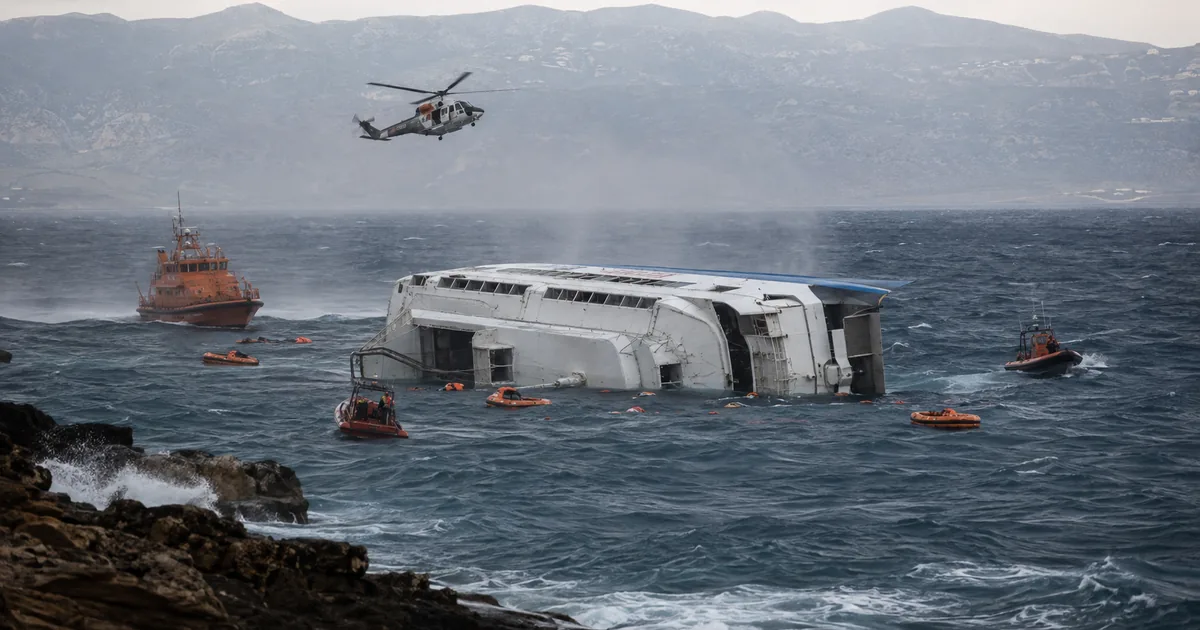
A 43-meter catamaran carrying 267 people went down about four nautical miles off Kyrenia on Sunday afternoon, and within hours the prime minister of northern Cyprus had blamed the weather while the territory’s own leader said conditions were not bad.
Both accounts have been printed side by side all day without anyone pointing out that they cannot both be true.
That contradiction is the story, and it matters more than the wire summaries suggest. The official weather explanation arrived before any investigation could possibly support it, it conflicts with what the territory’s leader said, it conflicts with what survivors describe, and it conflicts with the government’s own decision to detain the captain and seven crew members for questioning. When authorities genuinely believe a vessel was overwhelmed by the sea, they do not usually start the afternoon by taking its bridge crew into custody.
The Sailing Had Already Been Delayed Once, for Weather
Here is the detail that undercuts the official line hardest, and it has barely surfaced outside the maritime trade press. The crossing was not scheduled for Sunday. According to the shipping publication Shippax, which tracks ferry operations across the region, the sailing had been postponed from Saturday to Sunday specifically because of weather.
So weather was not an unknown variable that ambushed the Filo Jet. It was a known, actively managed one. Somebody looked at Saturday’s conditions, decided they were unsafe, held the vessel in port, looked at Sunday’s conditions, and decided they were acceptable. Turkish Cypriot leader Tufan Erhürman confirmed as much when he acknowledged Saturday’s storms but said Sunday’s conditions had been considered suitable for travel. As the Associated Press reported, he told reporters flatly that the weather “was not bad,” and urged people not to speculate about the cause.
Prime Minister Ünal Üstel told a different story on the same afternoon. He said the ferry faced adverse weather and began taking on water just 15 minutes after departure. Fifteen minutes. The Filo Jet left Kyrenia at 12:30 p.m. bound for Taşucu on Turkey’s southern coast, and it was in trouble before it had cleared the coastline, on a day the operator had already judged safe enough to sail after judging the previous day unsafe.
What a Survivor Describes Is Not a Squall
The passenger accounts point somewhere else entirely. Survivor Efe Multici gave Reuters a description, carried in the Jerusalem Post’s report, of a vessel behaving badly well before it foundered.
The vessel had been moving very badly. It was constantly lifting out of the water and slamming back down. It was shaking violently. The ferry leapt high into the air, then came crashing down. The front left side burst open and water started pouring in.
Read that carefully, because it is not a description of a boat being swamped by waves. It is a description of a fast catamaran repeatedly slamming into the sea until its hull opened up. On a two-hulled high-speed vessel, that sequence raises questions about speed and handling in the conditions and about the structural condition of the hull itself, and those questions belong to the operator and to whoever certified the ship, not to the sky.
Witnesses reported passengers jumping overboard as the ferry listed before it rolled near Diana Beach. It sank later in the afternoon, settling on the seabed at a depth of roughly 514 meters, which is deep enough that examining the wreck will be a serious undertaking rather than a routine survey.
Eight People in Custody Before the Day Was Out
Police detained eight people, including the captain, as part of the investigation. Transport Minister Erhan Arıklı, who traveled to Kyrenia with Üstel to oversee the response, said officials were examining the factors behind the accident. No charges have been reported, and detention for questioning is not a finding of fault.
But it is a signal. Governments do not detain the entire bridge crew of a ferry within hours when they think the answer is weather. They do it when they think the answer is on board. The prime minister’s statement and the police response are pulling in opposite directions, and only one of them involved handcuffs.
There is a further wrinkle worth naming. Northern Cyprus is recognized only by Turkey, so its shipping sits outside the European port state control regime that would ordinarily inspect a passenger vessel carrying hundreds of people in these waters. Filo Denizcilik is one of the territory’s main maritime operators, and the Filo Jet was its daytime fast service on a route thousands of people use. No build year, classification society, or inspection history for the vessel has been made public. That absence is not a minor gap in the coverage. It is the single most useful thing anyone could publish right now, and the inquiry should release it.
The Passenger Count, at Least, Reconciles
One thing has gone right in an otherwise grim afternoon, and it is worth flagging because it so often does not. The numbers add up. The manifest recorded 259 passengers and eight crew. As of Sunday evening, 237 people had been rescued, at least eight had died, and 22 were unaccounted for. That is 267, exactly the number the operator said was aboard.
Compare that with the search off Indonesia earlier this month, where the Mutiara Sentosa 2’s manifest turned out to be the central problem and rescuers could not establish how many people they were even looking for. Here, the searchers know their number. The figures moved through the day as they always do in the first hours, from seven dead and 23 missing to eight and 22, and they will move again. But the denominator is solid, and that is not nothing.
The response was substantial: four Turkish Cypriot coast guard vessels and a civilian passenger boat, five Turkish coast guard vessels, two helicopters, and Turkish divers. Kyrenia’s Victory Day commemorations were cancelled, the holiday that likely explains why a daytime fast ferry to Turkey was carrying 259 passengers on a Sunday in the first place.
What the Inquiry Actually Has to Answer
Our position is straightforward. The weather explanation was offered too early, by the wrong official, on a day the weather had already been assessed and cleared, and it should not be repeated as established fact by anyone covering this. Üstel got ahead of an investigation that had not begun. Erhürman, to his credit, urged people not to speculate about the cause, which was the correct instinct and which his own prime minister ignored within hours.
Three questions decide this case, and none of them is meteorological. What speed was the Filo Jet making in the conditions, and who set it? What was the hull’s certified condition, and when was it last inspected by anyone with the authority to keep it in port? And how many passengers was a 43-meter catamaran certified to carry on that run?
The wreck is 514 meters down and the crew are in custody. The records are not, and they can be published this week.