
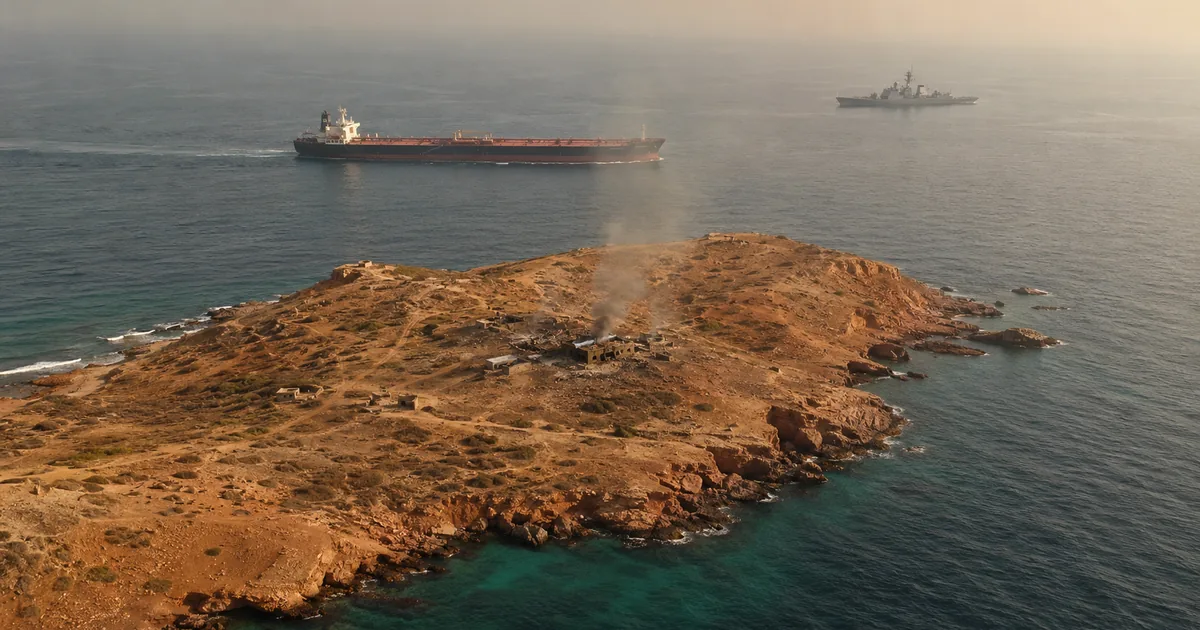
American forces struck two Iranian rocket launchers on Larak Island in the Strait of Hormuz on Sunday, the first known US attack on Iran in roughly a month.
The strike is being reported almost everywhere as a decision made on Sunday, and that is the one thing it almost certainly was not.
Five days earlier, on August 25, President Trump said Iran had been notified that any ship or boat placing new mines would be “immediately and systematically destroyed,” language he paired with a declared policy of “Zero Tolerance.” What happened on Larak reads as the first live execution of that order. The coverage published in the hours afterward handled the strike as a discrete event with a discrete rationale, which leaves out the detail that changes its meaning: the authorization existed before the target did.
What Hit Larak Island
A US official speaking on condition of anonymity said Islamic Revolutionary Guard Corps forces had been observed preparing to launch rockets carrying sea mines into the strait, and that American forces struck two launchers on the island. CNN, which first reported the strike, described it as the first American attack on Iran in about a month, after a lull that began in late July.
The casualty accounts do not agree, which is ordinary this early and better stated plainly than split down the middle. Iran’s semi-official Tasnim news agency reported that a drone carried out the strike and put the toll at two killed and two wounded. The IRGC, in a statement carried by Fars, said the attack killed and wounded several fighters and civilians without giving a number, blamed what it called the “US-Zionist enemy,” and said the strike would be “met with a retaliatory response.”
Larak sits inside the strait itself, the waterway that carries roughly a quarter of the world’s seaborne oil trade and that Iran closed after US and Israeli strikes in late February. Anything that happens there is a shipping story before it is a military one.
The Order Came First
The August 25 announcement was framed as a victory lap. The Navy had cleared the mines, the strait was open, and Tehran had been told what would happen if it laid more. The operative part was not the celebration. It was the conditional buried inside it: a specific Iranian action, identified publicly in advance, with a specific American response attached to it and no intervening decision described anywhere.
Five days later, Iranian forces were observed doing the identified thing. The identified response followed.
That sequence is the story, and it is the part nearly every account of Sunday leaves on the floor.
Three Claims About the Same Water
Sunday also demonstrated that the word “cleared” was carrying considerably more weight in the White House’s telling than in anyone else’s. Three statements were made about the Strait of Hormuz inside the same week, and they do not describe the same situation:
- Trump, August 25. The strait has been cleared of mines in international waters, with Zero Tolerance for any new ones.
- Admiral Brad Cooper of CENTCOM, August 27. US forces had “meticulously and quietly cleared them of sea mines using a combination of Navy divers, Navy SEALs, and U.S. air power from the Army, Navy, Air Force, and Marine Corps”, a claim scoped specifically to the internationally recognized Traffic Separation Scheme. That is the shipping lanes, not the strait.
- The Joint Maritime Information Center, the same days. Threat assessment held at SEVERE, with a warning of continued risk from drifting or uncharted mines, danger areas still active, and clearance operations still running.
Cooper described a cleared shipping lane. Trump described a solved problem. Those are not the same claim, and the space between them is exactly where Sunday’s strike happened: on forces preparing to put more mines into water the president had just declared safe. The administration announced a result, then had to shoot at the thing the result was supposed to have eliminated.
A Pause That Ended Because Nobody Had to Decide
Here is what we think this actually means.
The month-long lull did not hold because either government grew calmer. It held because every strike inside it required a human being to choose to order one. Trump called off a second round of strikes in early August for a deal Tehran never publicly confirmed. That is what a pause is made of: a sequence of decisions that could have gone the other way and did not.
A standing order is not restraint with a faster trigger. It is the removal of the step where somebody has to think about it.
For this particular scenario, that step is now gone, and it was removed deliberately. The White House will call that deterrence, and the argument is not a stupid one. Tehran now knows precisely which act produces an American strike, which is more than it knew in July. Clarity has value.
But deterrence only functions if the other party wants to avoid the outcome you are threatening. Iranian forces spent last week, by the Pentagon’s own account, preparing to put more mines into a waterway Iran has already closed once this year. That is not the behavior of a government hunting for an exit, and the ceasefire that collapsed in July collapsed over this same strait. What the administration has built here is not a brake. It is a tripwire, and it has been strung across the one stretch of water both sides have already proven they will fight over.
There is a second problem, and it belongs to Congress rather than to the Pentagon. A pre-authorized strike policy announced at a press availability is a commitment to future military action that no one voted on. Every previous round in this conflict at least produced a moment where somebody had to sign something. This one does not.
The Next One Will Be Faster
The real measure of a standing order is what happens the second time it is invoked. The IRGC has promised a response. If that response arrives at commercial shipping or at American forces in the Gulf, the American answer is likely to come on a similarly automatic footing, because automatic is the posture the last week established.
One version of the coming weeks is quiet. Nobody lays another mine, the order is never invoked again, and the deterrence argument turns out to have been right. That possibility is real and worth naming rather than waving away. The other version is that pre-authorization does what pre-authorization does, compressing the interval between an Iranian action and an American one down to the length of a surveillance feed. The second version requires nobody in Washington to decide to escalate. That is the entire appeal of it, and it is also the reason it should worry people.