
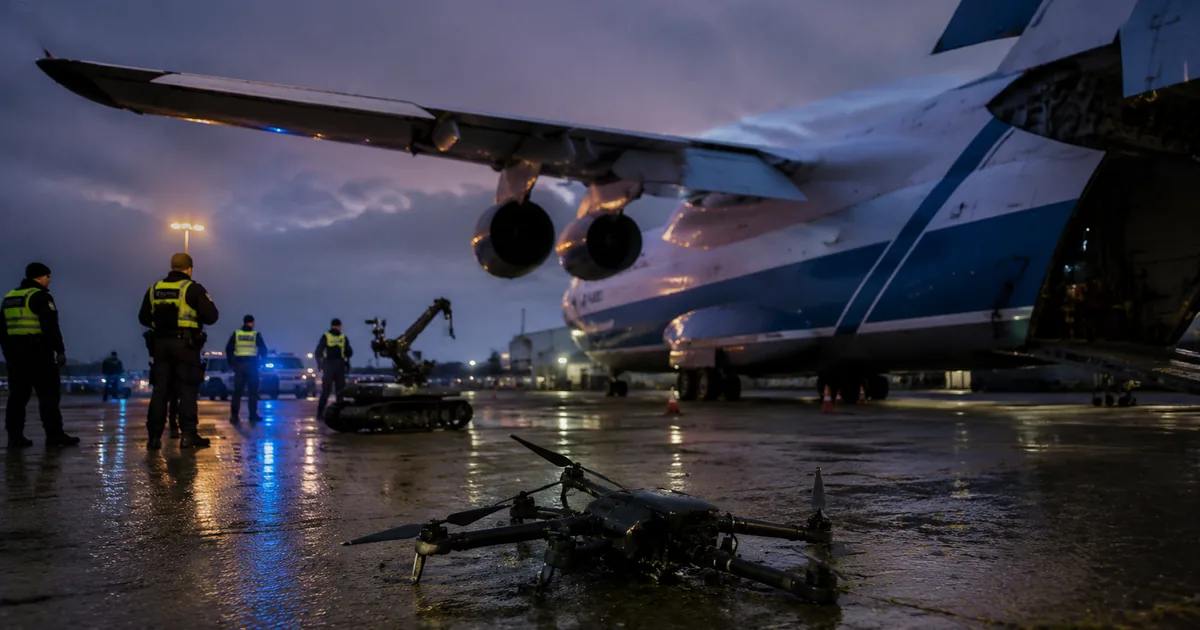
A drone carrying roughly 800 grams of military explosive struck the wing of a Ukrainian cargo jet at Leipzig/Halle Airport on the evening of August 4.
It was found about four hours later by an airport bus driver, not by any air defense system.
Foreign Minister Johann Wadephul and Interior Minister Alexander Dobrindt stood up in Berlin on Tuesday and put Russia’s name on that device, which the BBC reported as Germany’s first formal attribution of the attack. Almost every account of the announcement is running it as a diplomatic story: Berlin accuses, Moscow denies, sanctions may follow. That framing misses what the target actually was. Leipzig/Halle is not a generic German airport. It is the airfield NATO uses to move armaments and ammunition east, and it is the base Ukraine’s Antonov Airlines relocated to after Russia destroyed its last one. This was an attempt to cut the physical supply line to Ukraine from inside NATO territory, and the only reason it failed is that the bomb did not work.
What Was Actually Sitting on the Apron
The device was a quadcopter roughly the size of a microwave oven, fitted with a detonator and a charge initially identified as PETN and later described as Semtex. It struck an Antonov An-124 near the wing’s fuel tank at about 7:30 p.m. and dropped to the ground without going off. German reporting has attributed that failure to the triggering mechanism, with investigators indicating that a malfunction is all that stood between the airfield and a fuel fire on the apron. The aircraft itself was empty at the time.
The build was not improvised. The drone carried a 5G router and two SIM cards, an arrangement that allows an operator to fly it from anywhere on earth, and it had no navigation lights. Investigators recovered an antenna from a tree near the perimeter, consistent with a relay station. Police destroyed the device in a controlled detonation using a bomb disposal robot, closing the north runway for about two hours.
Three separate drones ended up in the file:
- August 4: the explosive quadcopter that hit the An-124 and failed to detonate.
- August 5: a second drone struck a DHL-operated Boeing 757 freighter at roughly 400 metres as it went around. The crew declared a mayday, climbed to 10,000 feet and diverted to Hannover with minor damage to the nose. Investigators suspect it carried a camera to film the attack.
- August 14: a third drone, recovered from a field west of the airport, holding about 50 grams of RDX.
Antonov Is at Leipzig Because Russia Already Destroyed Its Home Base
This is the detail that turns the story from a sabotage curiosity into something colder. Antonov Airlines flies out of Leipzig/Halle because Russian forces wrecked its home field at Hostomel outside Kyiv in the opening days of the 2022 invasion, taking the An-225 with it. The airline moved its surviving heavy-lift fleet west into Germany, and Al Jazeera has reported that Leipzig has served as its base ever since.
So a charge turned up on an An-124 at the airfield Antonov fled to. Those aircraft are among the very few in the world that can carry outsized military cargo, production ended long ago, and a burned one cannot be replaced on any useful timeline. US officials have assessed that the airport had already been the target of multiple suspected Russian sabotage operations, and investigators believe this drone was meant to disable parked aircraft in order to slow deliveries to Ukraine and to make a point to Berlin.
Read that way, the intent is not mysterious. Destroying strategic airlift where it parks is cheaper than intercepting what it carries, and it works whether or not anyone ever admits to it.
Germany Spent Four Weeks Saying It Quietly
Dobrindt called the incident a new quality of danger within a day, and told reporters the work was done by professionals, probably on behalf of foreign powers. He did not name the power. CNN and NPR both carried the same careful non-naming through early August.
The name arrived from Washington instead. On August 7, US intelligence officials told the Wall Street Journal they believed Russia was responsible and that the explosive bore the marks of Russian military intelligence. Germany’s own government took another three and a half weeks to say it out loud, and only after Politico and Welt had already reported that the attribution and a sanctions package were coming. Chancellor Friedrich Merz, for his part, had promised in late August that those behind hybrid attacks on Germany would pay.
There is no overreaction on our part, but there is a response when we are attacked.
That is Wadephul, speaking before the Berlin news conference. It is a careful sentence, and the care is the point. Russia’s foreign intelligence service has already dismissed the German conclusion as premature, which is the response Moscow gives every time and costs it nothing.
The Response Is a Sanctions Package, and That Is the Uncomfortable Part
Here is where we will say plainly what the wire copy will not. Russia attempted to blow up an aircraft on NATO soil, and the measure Berlin is preparing is a sanctions list assembled alongside a package already moving through Brussels. Sanctions are not nothing. They are also not a defense, and they will not stop the next drone, because nothing stopped this one.
That is the failure Germany can actually fix and has not. No sensor caught a quadcopter crossing the perimeter of the country’s most strategically important cargo airfield. Nothing engaged it. The charge was defeated by its own trigger, and the wreckage was found by a man driving a bus. Dobrindt’s answer in August was a drone research centre at Cochstedt, 150 new officers and four drone defense bases, which is a serious program on a multi year clock against a threat that showed up in August with a 5G router and a SIM card.
Germany is also making this decision from a weaker position than it was a year ago, having watched Washington pull 5,000 troops out of the country in May as a rebuke over Iran policy. And Berlin has been here before: it spent years on the Nord Stream investigation before filing its first criminal charges over that sabotage in July. The pattern is consistent. Germany investigates thoroughly, attributes late, and answers with legal and economic instruments because the alternatives all escalate.
Moscow can read that pattern as easily as anyone. The lesson available from Leipzig is that you can put a bomb on a NATO airfield, have it found by a bus driver, and absorb a sanctions listing four weeks later.
What to Watch Now
The measures themselves are the first test, specifically whether Berlin’s list is narrow and symbolic or reaches the people and entities actually running these operations. The second test is quieter and matters more: whether the shoot down authority German police have been asking for actually arrives, and whether anything at Leipzig/Halle can detect a small drone before it touches an airplane. The attribution was the easy part. Germany has now told the world who did it, which leaves the harder question of what happens the next time somebody flies one in and the detonator works.