
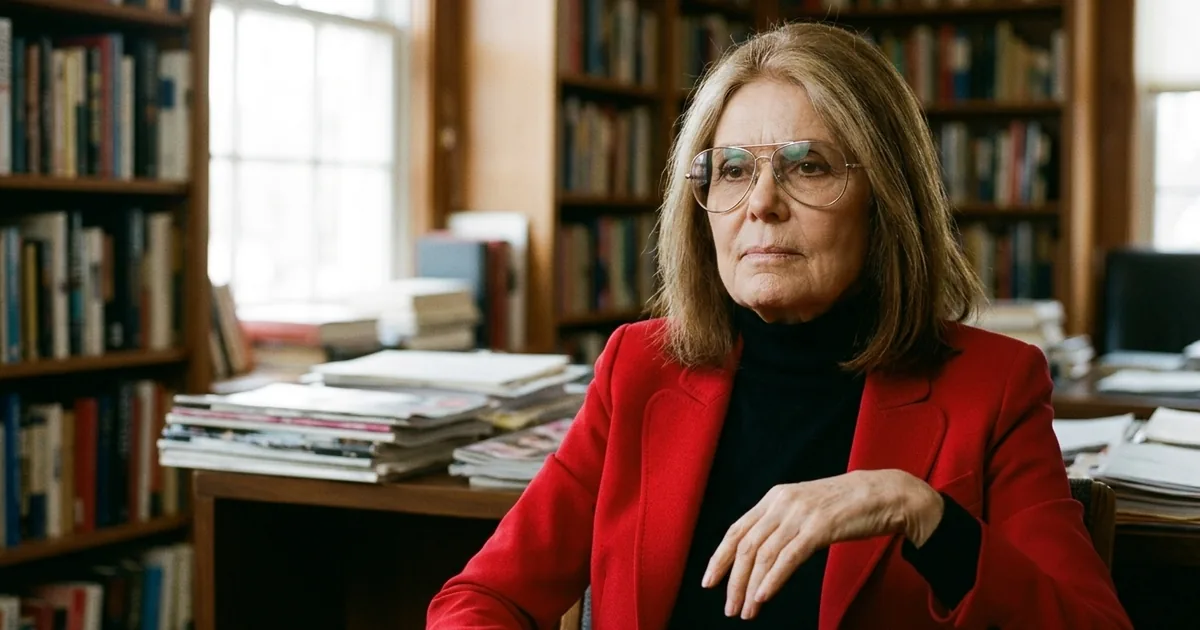
Gloria Steinem died on Wednesday at her home in New York City, at the age of 92.
The obituaries that went up overnight are all writing the same woman, the Toledo childhood and the Playboy Bunny assignment and the aviator glasses and the founding of Ms., and what almost none of them is doing is reading the ledger she actually left behind.
So here is the ledger. Steinem spent half a century organizing around two legal guarantees for American women, and on the day she died she had neither one. The Equal Rights Amendment has now been ratified by 38 states and is still not in the Constitution. Roe v. Wade was decided when she was 38 and overturned when she was 88, a reversal that arrived first as a leaked draft opinion in the spring of 2022. That combination makes her close to unique among American reformers: she lived long enough to see a constitutional right won, and then long enough to watch it taken back.
Her family announced the death on her official Instagram account on Thursday morning. NBC News reported that she died peacefully at home, surrounded by people who loved her, and no cause was given. The statement said her “near-century on earth were years well-lived, and she continued working for equality until the very end.” That last clause is the part worth sitting with, because it is not a figure of speech. The work was genuinely unfinished, and it was unfinished for reasons that have nothing to do with public opinion.
The Deadline That Outlived Her
The Equal Rights Amendment is not stalled because Americans rejected it. It is stalled on a procedural technicality about a clock.
Alice Paul wrote the first version in 1923 and introduced it in Congress the same year. Congress finally passed it and sent it to the states on March 22, 1972, attaching a seven-year ratification deadline that was later stretched to 1982. Thirty-five states ratified inside that window, three short. Then Nevada ratified in 2017, Illinois in 2018, and Virginia became the 38th state on January 27, 2020, clearing the three-quarters threshold the Constitution actually specifies.
It has not been certified. The National Archives stated flatly in December 2024 that the amendment “cannot be certified as part of the Constitution due to established legal, judicial, and procedural decisions,” pointing to Justice Department legal opinions from 2020 and 2022 holding that the congressional deadline is valid and enforceable. That position has not moved since, and the Feminist Majority Foundation, which now publishes Ms., has argued that the path to certification runs through Congress rather than through the Archivist’s office at all.
We think the deadline argument is indefensible, and it is worth saying so plainly rather than presenting it as a live controversy with two respectable sides. The deadline was never in the text of the amendment that the states voted on. It sat in the preamble of the resolution that transmitted it. Article V of the Constitution says nothing about Congress setting expiry dates on ratification, and the 27th Amendment was ratified in 1992 after sitting unresolved for 202 years, which rather undercuts the idea that constitutional amendments go stale. The Brennan Center’s explainer lays out how thin the ground is here. Thirty-eight states have voted yes. The remedy sits with Congress, which could resolve it with a simple resolution and has declined to for six years.
She Said It Herself, Six Years Ago
Gloria’s near-century on earth were years well-lived, and she continued working for equality until the very end.
What She Built Instead
If the legal scoreboard reads badly, the institutional one does not, and this is the part the retrospectives tend to compress into a single line about founding a magazine.
Steinem was an organization builder more than she was a symbol, and she was better at it than her public image suggests. Ms. launched as an insert inside New York magazine in late 1971, went standalone in 1972, and put domestic violence on a national cover in 1976 when no general-interest publication would touch it. She co-founded the National Women’s Political Caucus in 1971 to get women into legislatures. In 1973 she started the Ms. Foundation for Women with Patricia Carbine, Letty Cottin Pogrebin and Marlo Thomas. In 2005 she founded the Women’s Media Center with Jane Fonda and Robin Morgan.
All four still exist. Ms. is still publishing, owned since 2001 by the Feminist Majority Foundation, which is a more durable outcome than most magazines founded in 1972 can claim. The Women’s Media Center still runs. That is the actual inheritance: not a ruling that a later court could withdraw, but a set of organizations with staff, budgets and mailing lists.
There is a lesson in the asymmetry. The things Steinem won through the courts proved reversible by other courts. The things she built by putting an entity on paper and funding it are still standing, three and five decades on.
The Playbook Did Not Die With Her
Watch what has actually worked since Roe fell, and it looks a great deal like her method rather than the litigation strategy that replaced it.
When the Supreme Court removed the federal right in 2022, the response that moved was not a lawsuit. It was ballot organizing. Kansas voters, in a state Donald Trump carried twice, rejected an anti-abortion amendment that August. Ohio voters turned down Issue 1 the following year and then wrote abortion rights into their state constitution. Both were won the way Steinem spent sixty years telling people things get won, which is by counting votes in rooms and church basements rather than by waiting for nine people in Washington.
She was clear-eyed about this near the end. At the 2017 Women’s March in Washington, where she served as an honorary co-chair, she told a crowd of several hundred thousand, “I have met the people, and you are not them,” and then, “We are the people.” It reads now less like a rally line than like an instruction to people who were going to have to do it again without her.
The Equal Rights Amendment sits at 38 states, one congressional resolution away from the Constitution, and Congress is the body that has to act. Steinem did not live to see it. Whether anyone does is now a question about whether the institutions she left behind are as good at this as she was.