
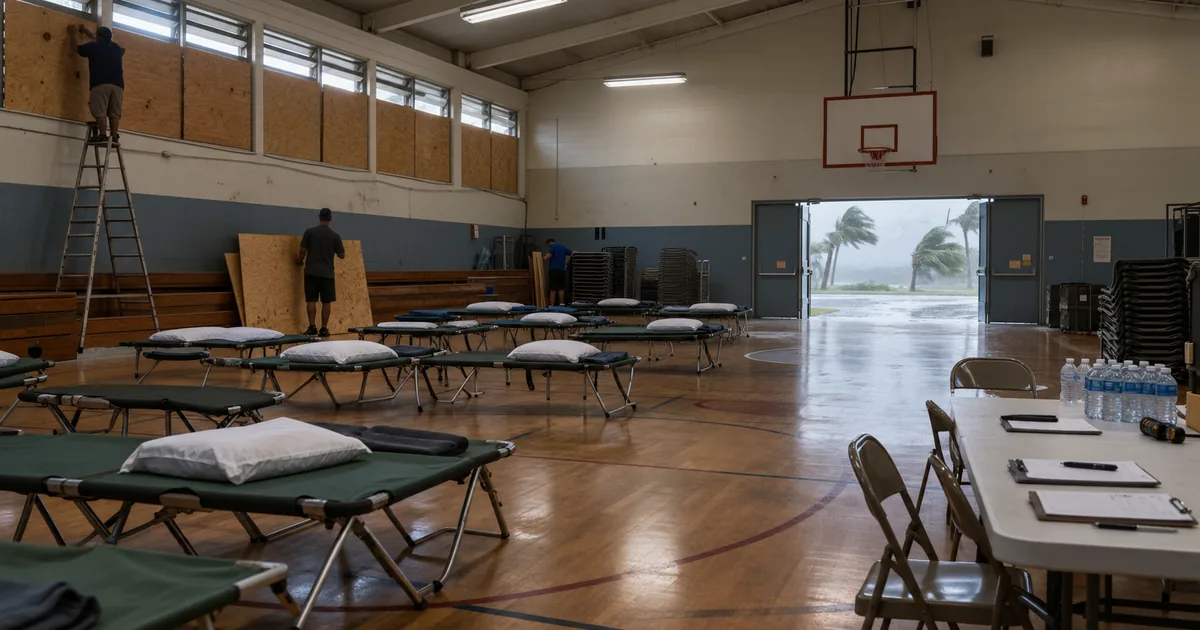
Kauai County went under a Hurricane Warning late Sunday night, and the five places the island tells residents to go if their homes will not hold are, by the county’s own written admission, not hurricane shelters.
They are refuge areas. The distinction is not bureaucratic hair-splitting. It is the whole story.
The Central Pacific Hurricane Center upgraded Kauai and Niihau from a watch to a warning in its 11 p.m. advisory, with Lowell holding at 115 miles an hour, a Category 3, roughly 455 miles southwest of Lihue and turning north-northeast. The forecast track carries the center just west of the main islands Monday night, and forecasters expect it to still be a hurricane when it gets there. Six to ten inches of rain on Kauai with 14 possible, storm surge of one to three feet, tornadoes in play Monday afternoon into the night, and hurricane-force winds reaching 60 miles out from a center that is not going to pass far from Niihau at all.
All of that is in the coverage, on every station, with the cone graphic. What is not in the coverage is what happens if a family on Kauai reads it and decides their house will not do.
Refuge Area Is a Term of Art
Kauai’s Emergency Management Agency published its updated refuge-area list on May 27, ahead of the June 1 start of hurricane season. The document names the facilities and then says something most emergency bulletins do not say out loud: the buildings flagged as offering the best available protection “were not originally designed to meet hurricane ‘shelter’ standards.” The agency describes refuge areas as an option of last resort and recommends sheltering in place where a home is sound and outside the flood and surge zones.
The facilities on the current list, for an island of roughly 73,000 people, are these:
- Kilauea Neighborhood Center, Kilauea
- Kapaa Middle School, Kapaa
- Kauai High School gym, Lihue
- Kalaheo Neighborhood Center, Kalaheo
- Waimea Canyon Middle School, Waimea
Five buildings. No food, no water, no bedding, no medication, no medical staff, no caregivers. Bring your own kit. That is not a criticism of KEMA, which has been unusually straight with the public about exactly what it can and cannot offer, and whose administrator Elton Ushio has spent the spring telling people to work out their plan before a storm forces the decision. It is a description of what the state has actually built.
The State Already Said This in May, on the Record
None of this is new information that a hurricane just revealed. Four months ago the Honolulu Star-Advertiser ran a survey of the state’s shelter stock, republished on Kauai by The Garden Island, and the findings were blunt. Three buildings in the entire state have completed hurricane retrofitting under the state program: the Waialua High School gym on Oahu, the Molokai High School gym, and a band room at a charter school in Laupahoehoe on Hawaii island. Not one of them is on Kauai. On Oahu, 20 of 25 designated refuge areas are hardened to withstand Category 1 winds, which top out at 94 miles an hour. No agency contacted could confirm that any shelter in the state would hold beyond Category 1.
James Barros, who runs the Hawaii Emergency Management Agency, put it on the record in that reporting: hurricane shelters throughout the state “are not at the levels of readiness that we require.” The state climatologist, Pao-Shin Chu, offered the other half of the sentence. It is all just a matter of time.
Lowell is currently a Category 3.
Three Weeks Ago, the Same Islands, the Same Problem
Hawaii is not being surprised by this. On August 15, Lala became the first hurricane to make a direct hit on the Big Island since an unnamed storm in 1871. More than 100 homes were damaged or destroyed. Statewide, over 220,000 customers lost power. We covered it here as the rarest storm threat the islands face, and three weeks later the rarest storm threat is back, aimed at a different island, and the shelter inventory in between has not changed by a single building.
There is a grim anniversary sitting under this one. Iniki came ashore on Kauai on September 11, 1992, a Category 4 with 145-mile-an-hour winds. It damaged or destroyed about 70 percent of the homes and businesses on the island and killed six people. Lowell makes its closest approach four days shy of the 34th anniversary, from more or less the same direction. Much of the island was rebuilt afterward to tougher standards, which is the genuinely good news here and the reason sheltering in place is sensible advice for a lot of Kauai families. It does not help anyone in an older house, a rental in a flood zone, or a structure the surge reaches.
Say the Quiet Part
Our view is that Hawaii’s shelter posture is a policy failure, not a resourcing accident, and the responsible parties are the legislature and successive governors rather than the emergency managers now working around the clock on Kauai. Hardening school gyms is unglamorous capital spending with no ribbon to cut, so it has lost the budget fight for three decades running while the state carried a hurricane relief fund, a tourism marketing budget and a rail project. The result is that the official advice to an island facing a Category 3 has been reduced, correctly and honestly, to “your house is probably safer than ours.”
That advice is right. It is also an admission, and it should be treated as one when the legislature returns in January rather than filed with the after-action reports. Hardening the school gyms already sitting on the counties’ refuge rosters is a knowable cost on a knowable timeline. Nobody in Honolulu has been willing to put a number on it in public, which is usually what happens when the number is affordable and the political payoff is zero.
For anyone on Kauai reading this on Monday morning, the practical advice has not changed: county officials have outlined their plan, the state’s Lowell updates page is current, conditions arrive Monday afternoon or evening, and if you are going to move you move now rather than in the wind. The harder question is for everyone who watches this from the mainland and assumes there is a gym with a generator waiting somewhere. On Kauai tonight, there is a middle school.