
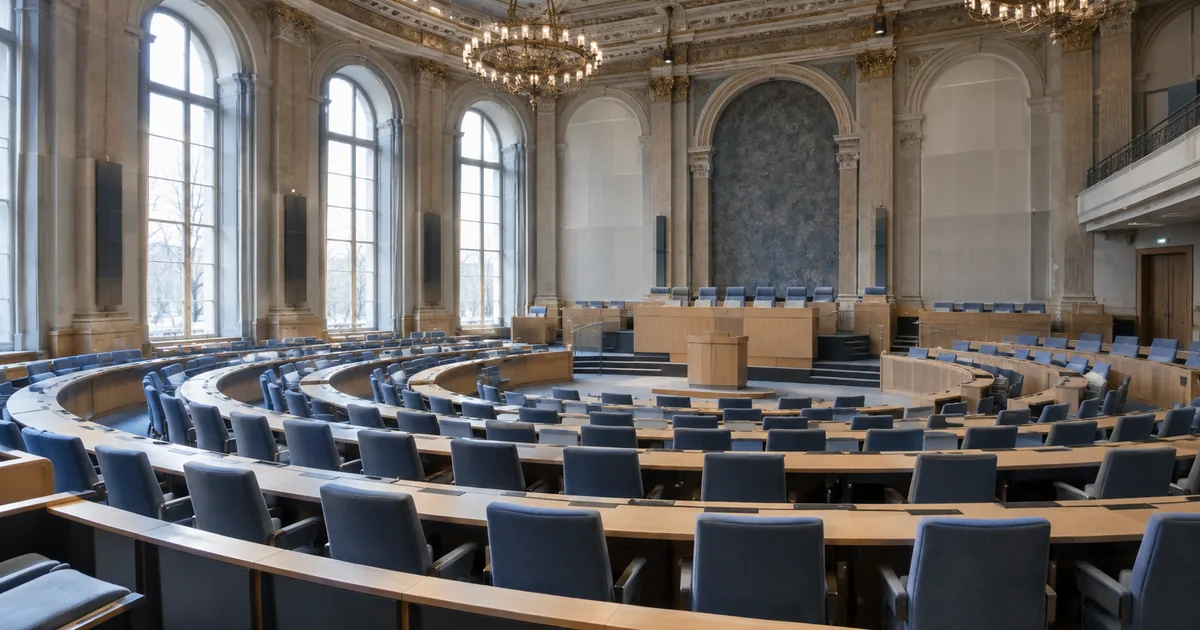
Alternative for Germany took 43.8 percent of the vote in Saxony-Anhalt on Sunday and 39 of the state parliament’s 83 seats, the strongest showing a far-right party has recorded in a German state since the Federal Republic was founded.
Almost every account of that result closed on the same reassuring clause, that the AfD fell short of a majority, and almost none of them did the subtraction the clause invites.
So here is the subtraction. A majority in the Magdeburg Landtag is 42 seats. The AfD holds 39. Every other party in the chamber holds 44 between them. A government that excludes the AfD therefore has to keep 42 of those 44 votes together, and precisely one combination gets there: the Christian Democrats, the Social Democrats, the Greens, Die Linke and the Sahra Wagenknecht Alliance, all five at once, with two seats of slack.
That arrangement has a name in German politics, and the name is not “firewall.” It is the entire rest of the political spectrum fused into a single bloc to keep one party out, and it can be broken by any two of its members on any given afternoon.
The Arithmetic Nobody Ran
Run every option and the picture gets narrower, not wider:
- All five non-AfD parties: 44 seats. A working majority, barely.
- Everyone except Die Linke: 36 seats. Six short.
- Everyone except the Wagenknecht alliance: 39 seats. Three short, and exactly level with the AfD.
- Neither Die Linke nor the Wagenknecht alliance: 31 seats. Not in the conversation.
The Christian Democrats finished on 17.2 percent and 15 seats, as Al Jazeera reported from Magdeburg on Sunday night, a loss of 25 seats and less than half the AfD’s total. The Social Democrats, Greens and Die Linke took eight seats apiece on 9.3, 8.9 and 8.6 percent. The Wagenknecht alliance cleared the threshold for the first time with 5.3 percent and five seats. The Free Democrats, on 2.6 percent, were wiped out entirely.
Which means the arithmetic runs through Die Linke. There is no majority in Saxony-Anhalt that excludes both the AfD and the party Friedrich Merz has spent two years insisting is equally unthinkable.
Merz Ruled Out the Only Coalition That Adds Up
The chancellor’s position going into Sunday was that neither the AfD nor Die Linke could be a partner in government. He restated it days before the vote and, as PBS NewsHour reported ahead of the ballot, pointed to Saxony and Thuringia as examples of a Christian Democrat minority government functioning without formally taking Die Linke into the tent. That was presented as principle. On Monday morning it reads as a workaround being staged in advance, because Merz can count, and he knew what Sunday was likely to produce.
A minority government is where this is heading, and it deserves to be described accurately rather than filed under continuity. A Christian Democrat administration governing from 15 seats in an 83-seat chamber does not pass legislation. It negotiates for every bill, every budget line and every appointment, against a bloc of 39 votes that has no incentive to hand it a win and every incentive to make ungovernability the argument for the next election.
“The ‘firewall’ has been definitively rejected by the voters today.”
That was AfD national co-leader Tino Chrupalla on Sunday evening, and on the specific question of Saxony-Anhalt he is closer to right than the people insisting otherwise. Ulrich Siegmund, the 35-year-old who led the state campaign, told reporters his party had “made history in this state” and said voters “want that change to happen with us.” Sven Schulze, the Christian Democrat who took over as minister-president when Reiner Haseloff retired in January, ruled out cooperating with the AfD and conceded the obvious: “We’re going to have to live with this result.” By Monday the winners had sharpened the demand into a principle, telling the BBC that democracy itself now requires the other parties to deal with them.
Turnout Removes the Usual Excuse
The reflex explanation for a far-right surge is that the mainstream stayed home. It does not survive contact with this result. Turnout was 77.8 percent, up 17.5 points from the 60.3 percent recorded in 2021, a level NPR noted was the highest in the state in decades. More people voted, and the AfD’s share went up 16 seats.
This matters because it forecloses the comforting read. An apathy result can be reversed by mobilization. A high-turnout result cannot, because the mobilization already happened and it broke the other way. The party that Saxony-Anhalt’s own domestic intelligence office classifies as a confirmed right-wing extremist organization, a designation the AfD rejects as politically motivated, just won a plurality of an electorate that showed up in numbers not seen since reunification-era votes.
Europe Has Tried This, and the Mechanism Was Different
The obvious precedent is France in 2024, when the mainstream blocked the National Rally from power after a first-round shock and the far right’s advance forced Macron into a scramble that ended with a hung parliament rather than an RN government. That worked. It is worth being precise about why, because the reason does not transfer.
France has two rounds. The republican front functioned by having third-placed candidates withdraw between them, concentrating the anti-RN vote seat by seat. It was a coordination device operating before the seats were allocated. Saxony-Anhalt allocates its seats proportionally in one pass. By the time anyone starts coordinating, the 39 seats already exist and cannot be negotiated away. Germany’s firewall is a promise about what politicians will do after an election. France’s was a machine that changed the election. Those are not the same instrument, and only one of them has ever actually held back a far-right plurality.
Our Position
Calling the firewall intact in Saxony-Anhalt is not neutral reporting. It is a description that has stopped matching the object it describes, and repeating it is how a party at 43.8 percent gets normalized: not through a coalition deal, but through months of coverage assuring readers the wall held while the state is governed by whatever the AfD permits.
The Christian Democrats now have to do one of two things they have promised not to do. They can govern with Die Linke, formally or by durable arrangement, which means Merz abandons an equivalence he has built his leadership on. Or they can run a minority government that survives on AfD forbearance, which hands the party an effective veto without the inconvenience of ministerial responsibility. The first is a broken promise. The second is the firewall’s collapse dressed as its defense, and it is plainly the worse outcome, because a party that can block everything and be blamed for nothing is in a stronger position than a party in office.
The honest thing for the CDU to say this week is which one it has chosen. The honest thing for everyone covering it to say is that “fell short of a majority” was the beginning of the story, not the end of it.
Saxony-Anhalt sends 83 members to a parliament that now has to elect a minister-president. The first vote will tell you more about the next German general election than any polling released between now and then.