
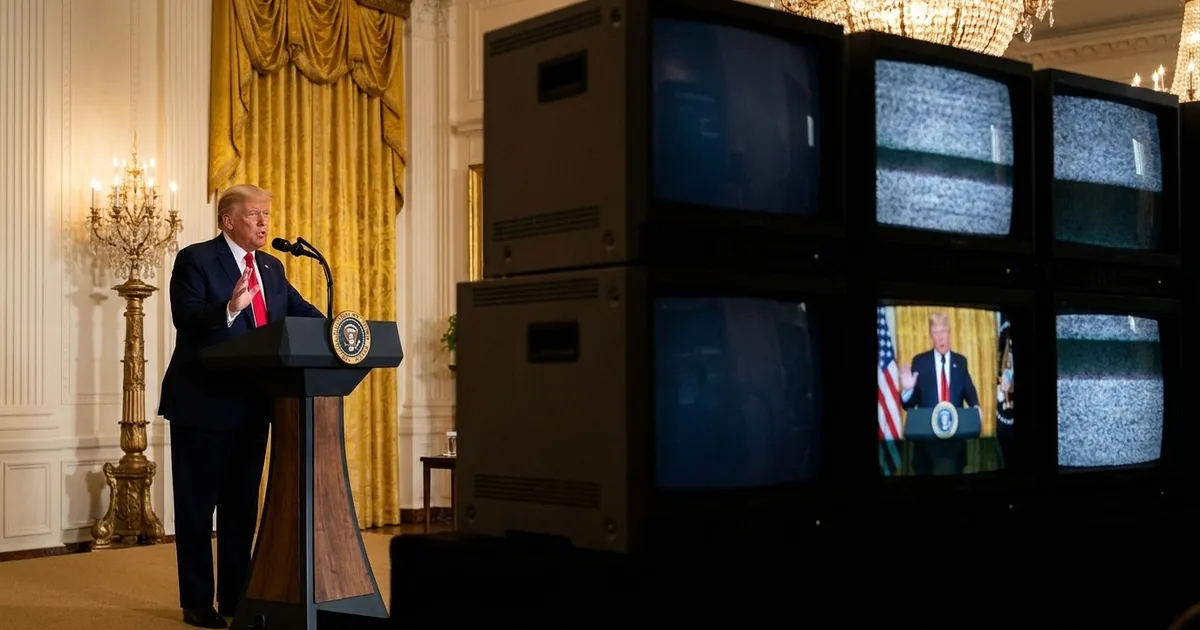
Donald Trump took the East Room podium Thursday night to deliver a primetime address on “free and fair elections” that two of the four major broadcast networks declined to put on television and that Republicans in Congress spent the week pleading with him to abandon.
Before the president said a single word, the speech had already made history for the worst possible reason: an American president announced he had something urgent to tell the country about its elections, and much of the country’s media and most of his own party decided the safest response was not to listen.
The Blackout Is the Story
ABC and NBC confirmed they would not carry the address on their broadcast networks, and CNN kept it off its main channel, a break from the near-automatic airtime presidents have commanded for decades, as Deadline reported Thursday. Axios reported that the networks weighed the news value of the address against the risk of amplifying false claims about elections in real time, and most of them chose not to hand over the airwaves.
The loudest silence came from Fox News. The network that built a business on carrying every Trump appearance would not say whether it planned to air this one, declining repeated inquiries all day. It did not need to explain why. Fox paid $787 million in 2023 to settle Dominion Voting Systems’ defamation suit over the last round of stolen-election claims it broadcast. When the president’s most reliable megaphone goes quiet rather than repeat his election material, that is not a scheduling decision. That is a legal department doing math.
His Own Party Begged Him to Stop
The Republican resistance to this speech was not whispered. The Hill reported that House and Senate Republicans saw little benefit in relitigating the 2020 election with competitive midterms four months away, and that lawmakers had pressed the president to talk about affordability, the issue actually moving voters, instead. Aides have reportedly stripped election-fraud passages out of speech drafts only to watch Trump ad-lib them back in. One former adviser has described telling Trump he lost in 2020 as a pointless exercise. The people closest to him gave up on changing his mind and settled for bracing themselves.
That fixation has a documented history. CNN reported as far back as February 2025 that aides describe Joe Biden as the rival Trump never beat at the ballot box and cannot stop talking about. Six years after the 2020 election, with control of both chambers on the line in November, the president of the United States pre-empted primetime to argue about it again.
Claims That Arrived Pre-Debunked
The White House teased “shocking” findings. What surfaced in advance looked more like a rerun. CBS News reported that Trump planned to allege previously unreported Chinese meddling, including a claim that Beijing compromised American voter data and that the CIA knew and concealed it from him during his first term. The intelligence community has already assessed with high confidence that China did not attempt to influence the outcome of the 2020 election. The voting-machine material fares no better: CNBC noted that official reviews of election equipment found vulnerabilities worth patching but no evidence any system was hacked to change results.
That gap matters more than the individual claims. A vulnerability is not a hack, and a hack is not a changed outcome, but a primetime address is designed to blur exactly those distinctions for tens of millions of people at once. The claims do not need to survive scrutiny. They need to survive until November.
What He Actually Said
The speech itself, delivered to that reduced audience, leaned on one marquee number. Trump alleged that China acquired 220 million American voter files between 2020 and 2023, describing it as the largest compromise of election data in history and citing newly declassified documents, according to CBS News’ live coverage of the address. He called the episode “an unprecedented election security nightmare,” accused deep-state officials of hiding the intelligence from him and the public, and repeated his stolen-election claims about 2020.
Set the number against what it actually describes and it deflates on contact. Voter registration files are substantially public records in the United States. Campaigns, data brokers, and academics buy and sell them every cycle, and some states simply post them online. Acquiring voter rolls is not touching a vote. The National Intelligence Council’s own assessment found no indications that any foreign actor tampered with voter registrations, ballot casting, or vote counting in 2020, and even the one intelligence officer who dissented on China’s intentions agreed that Beijing never went near election processes.
And there is the piece of the timeline the speech worked hardest to skip: Donald Trump was running the government while all of it allegedly happened. The compromise he dates to the 2020 election cycle unfolded under his own presidency, his own Department of Homeland Security, and his own intelligence agencies, staffed by people he appointed. His own election security agency declared in a joint statement in November 2020 that the election was “the most secure in American history,” with no evidence that any voting system changed, deleted, or lost votes. Trump responded by firing the official who stood behind it, CISA director Chris Krebs, by tweet. So Thursday night asked the country to hold two ideas at once: that the government failed catastrophically to protect the 2020 election, and that the man who ran that government bears no responsibility for it. That is not an election security case. It is an alibi with a scapegoat attached.
Notice what else was missing from the podium. For all the buildup, Trump never claimed a single result was changed. He produced no evidence that any vote was altered, anywhere, ever, and he announced no new action to match the alleged emergency. The Christian Science Monitor reported that states have spent years hardening their election systems and are resisting the expanded federal role Trump keeps reaching for. Six years of searching and a primetime slot produced a data-acquisition claim about mostly public records. That is the tell. The falsehood is not any single number; it is the frame that stolen data means stolen elections, asserted to millions of people with not one changed vote behind it, because the doubt is the product and the midterms are the market.
Sowing Doubt Is the Point
Strip away the staging and the structural logic is plain. As we argued in our preview of tonight’s address as a midterm power play, this speech is not an attempt to win an argument about 2020. It is infrastructure for 2026. A president trailing into the midterms is building the predicate now: if the elections are compromised by China, by the machines, by a CIA cover-up, then any Republican loss in November arrives pre-explained and any adverse result becomes contestable. Senate Minority Leader Chuck Schumer said the quiet part plainly this week, arguing the speech has everything to do with a president who fears losing in 2026 and wants to change the subject.
Democracies do not usually collapse in one dramatic night. They erode through exactly this: a leader normalizing the idea that elections he loses are illegitimate, institutions deciding one at a time whether to amplify or resist, and a party concluding that objecting privately is the same as objecting. On Thursday night the networks resisted, his party flinched, and the president went ahead anyway.
The real audience for this speech was never Thursday’s viewers. It is the county clerks, secretaries of state, and courts who will spend the next four months fielding challenges built on tonight’s claims, and the voters who will be told in November that any result they dislike was stolen in advance. The question worth holding onto is not what Trump alleged tonight. It is which institutions still say no the next time, when the ask is bigger than airtime.