

A new survey from the National Institute on Retirement Security shows that many Americans still do not trust cryptocurrency as a retirement investment. At the same time, officials in Washington are making it easier for these assets to become part of 401(k) portfolios.
The study, Retirement Insecurity 2026: Americans’ Views of Retirement, was conducted by Greenwald Research for NIRS. It surveyed 1,203 adults in the U.S. (aged 25 or older) between October 24 and November 15, 2025. The results were released on August 26, 2026.
Most respondents treated crypto as a poor fit for workplace retirement accounts. 77% view it as a risky asset in employer plans, including 46% who consider it very risky. Just 12% said the risk is minimal.
When people were asked about adding a crypto option to a 401(k), a majority (53%) opposed the idea. 33% said they were strongly against it, while 26% said they were in favor.
The fact that there is a 24-point difference between the percentage of people who perceive the risk as high (77%) and those who outright oppose it (53%) is worth pointing out. It suggests that perceiving crypto as risky does not necessarily mean rejecting its availability as an investment option.
Familiarity may be part of the picture. 9% of those questioned say they own cryptocurrency, and only 15% describe themselves as very familiar with digital assets, while 47% state that they have heard of crypto without actually knowing much about it.
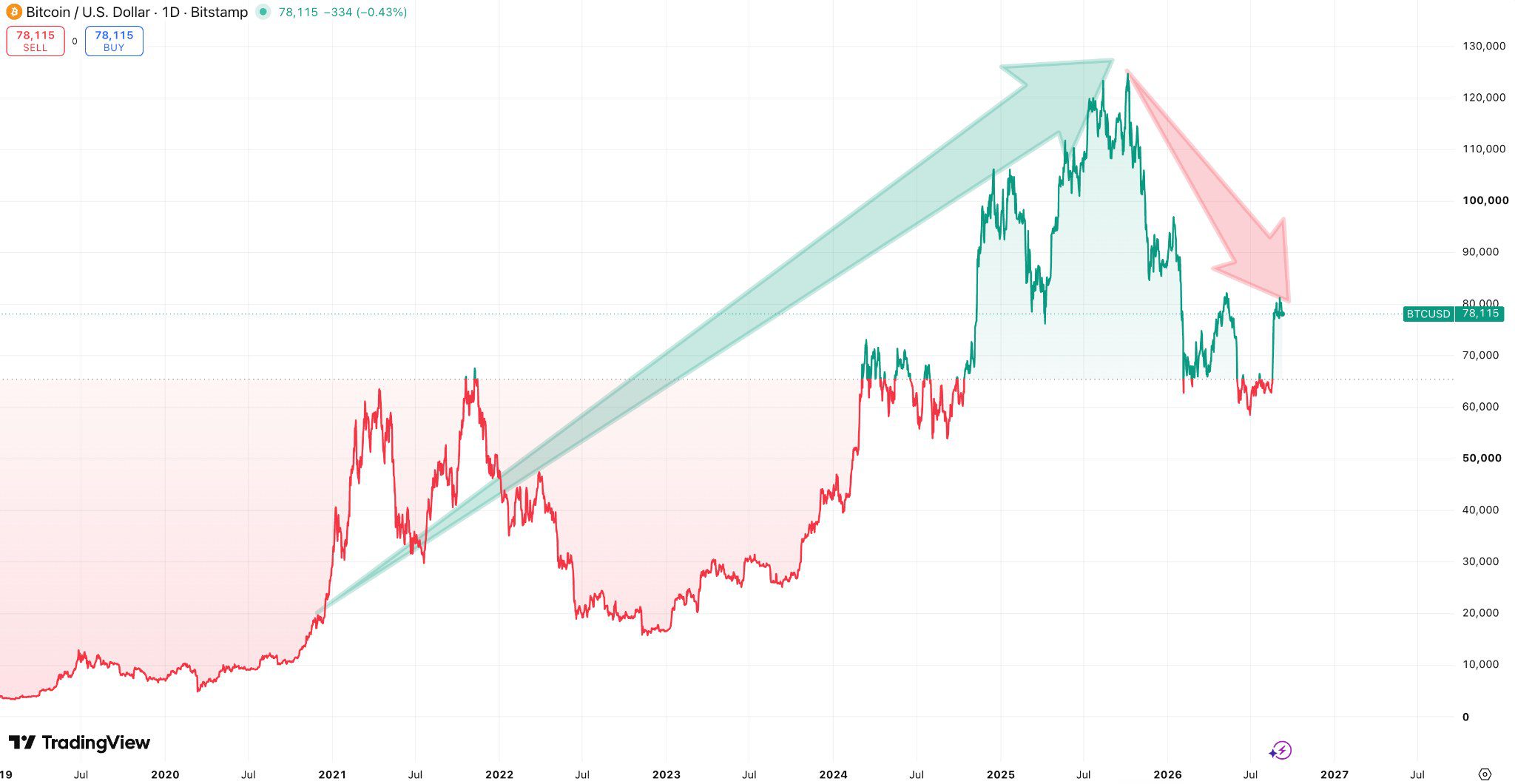
After BTCUSD hit all-time highs and then suffered a dramatic decline, it’s understandable that not everyone is excited about investing their retirement savings in it.
That caution sits within a much broader anxiety about life after work. Today, 80% of Americans think that the nation is facing a retirement crisis (up from 67% in 2020), while 61% say they are concerned that they will not achieve financial security in retirement.
Almost half have managed to save less than $100,000. Another 18% have saved nothing. Seven in ten worry about inflation. About 62% are nervous about swings in the stock market, a concern that looks particularly relevant today amid renewed volatility following U.S.-Iran tensions, also reflected in S&P 500 futures. And 76% fear that Social Security benefits could be cut if Congress does not act.
Dan Doonan, Executive Director of NIRS, pointed to a broader affordability problem: the rising costs of housing, health care and debt are already undermining retirement savings, even before crypto and AI are taken into account.
While the survey points to considerable public skepticism about crypto in retirement plans, federal policy has been moving toward giving plan fiduciaries more flexibility over alternative assets. In May 2025, the Department of Labor cancelled the 2022 guidance, which had advised 401(k) fiduciaries to exercise “extreme care” when adding crypto to the plans they offer, and instead adopted a neutral position.
In August 2025, President Trump signed Executive Order 14330, “Democratizing Access to Alternative Assets,” directing regulators to facilitate access to alternative assets, including certain investments in digital assets, within defined-contribution plans.
In March 2026, the Labor Department proposed a rule establishing a process-based fiduciary safe harbor around six evaluation criteria: performance, fees, liquidity, valuation, benchmarking, and complexity.
The proposal doesn’t require 401(k) plans to include crypto or other alternative assets; rather, it aims to remove regulatory obstacles to their inclusion. However, it has faced opposition because Senators Bernie Sanders and Elizabeth Warren, together with Representative Bobby Scott, asked the Labor Department in June 2026 to withdraw the rule, citing the volatility of crypto and the lack of investor protections.
That leaves an unusual gap between policy and public sentiment: regulators are moving to lower some of the barriers surrounding alternative assets in retirement plans at a time when crypto ownership remains low and many Americans still view the asset class as risky. Given limited adoption and understanding, the upcoming debate will not be one of “crypto or not” but will center on who is responsible for fiduciary liability if a crypto option within a 401(k) proves to be problematic.