
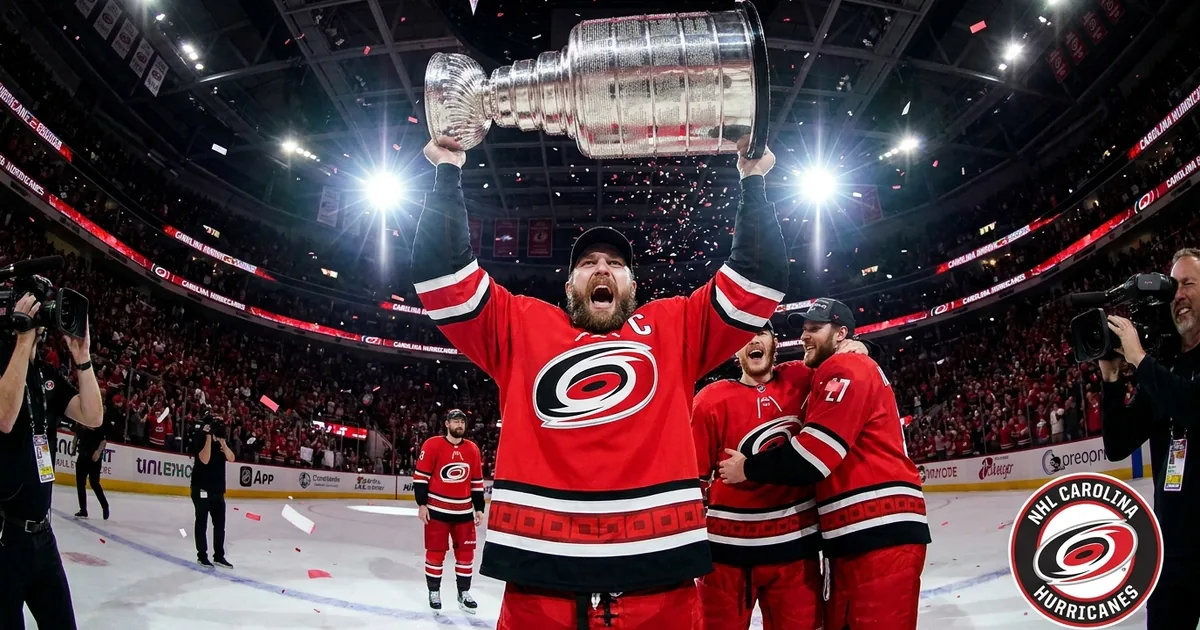
The Carolina Hurricanes are Stanley Cup champions for the first time in twenty years, closing out the Vegas Golden Knights 3-0 in Las Vegas on Saturday to take the Final in six games. It is a vindication for a franchise that spent most of a decade as one of the league’s best regular-season teams and its most reliable playoff disappointment, and the title arrived behind a 37-year-old captain and a rookie goaltender almost nobody outside Raleigh had penciled in.
A Twenty-Year Wait, Settled in Six
Carolina last lifted the Cup in 2006. Everything since has been a study in almost: deep playoff runs, conference finals, a regular-season machine that piled up points and then ran into a hotter goalie or a thinner bench when it mattered most. The futures markets reflected exactly that reputation, treating the Hurricanes for years as a team you respected in October and faded in May. That pattern is now broken.
The clinching game followed the script Carolina has run all spring. Taylor Hall opened the scoring less than four minutes in, Jackson Blake doubled the lead in the second period, and a late insurance goal made it 3-0. According to the NHL’s official recap, the Hurricanes finished the postseason 16-3, one of the most dominant playoff records of the salary-cap era. This was not a team that backed into a championship. It steamrolled toward one.
Jordan Staal, the Oldest Conn Smythe Winner Ever
The Conn Smythe Trophy, awarded to the most valuable player of the playoffs, went to captain Jordan Staal, who at 37 became the oldest player ever to win it. That is the headline number, but the choice says something larger about how this team is built. Staal is not the flashiest name on the roster, and he has never been a points machine. He is a defensive center, a faceoff specialist, a penalty killer, the kind of player whose value shows up in the spaces between the highlights.
Handing him the trophy was a statement about identity. Carolina did not buy a championship through one franchise-altering superstar contract the way Vegas tried to. It won by being relentless in the parts of the game that do not trend on social media. As CBS Sports laid out in its Game 6 coverage, Staal anchored a forward group that smothered the Golden Knights’ transition game for most of the series. The award is a recognition that role players, deployed with conviction, can decide a Final.
Brandon Bussi and the Goaltending Gamble That Paid Off
The riskiest decision of Carolina’s run was in net. Rather than lean exclusively on veteran Frederik Andersen, the Hurricanes rode rookie Brandon Bussi into the biggest game of the season, and he answered with a 22-save shutout. First-year goaltenders are not supposed to post clean sheets in Cup-clinching games. Bussi became only the third in league history to do it.
There is a broader lesson here for how contenders think about the position. Goaltending has long been the great variable in playoff hockey, the place where the best-laid plan goes to die. Carolina’s front office spent years trying to solve it through acquisition and trade. In the end the answer was developmental patience and a coaching staff willing to trust a young player when the stakes were highest. Teams that have spent every deadline chasing veteran netminders, the moves that tend to reshape the league’s playoff futures, might take a different lesson from this run than the one they expected.
Rod Brind’Amour Comes Full Circle
The most resonant story of the night belongs to the bench. Rod Brind’Amour captained the Hurricanes to their 2006 championship. On Saturday he won another one as their head coach, completing a loop that almost never closes in professional sports. Players retire, move into front offices, or drift out of the game entirely. Very few come back to the same building and win it all from behind the bench.
His teams have always been defined by structure and effort over individual brilliance, which is precisely why the 2026 group reflects him so cleanly. The criticism leveled at Brind’Amour for years was that his system produced great regular seasons and brittle playoffs. That criticism is now retired along with the drought. A coach gets remembered for what he wins, not for the seasons that fell short on the way, and Brind’Amour now owns the result that reframes everything that came before it.
What a Cup Means for Carolina
For a franchise that has long operated in the shadow of bigger markets, this changes the conversation. A championship is bargaining power. It helps in free agency, where players weigh whether a destination can actually win. It helps at the gate in a region the league has spent two decades trying to convert into a hockey market. And it settles, at least for now, the question that hung over every Carolina spring: whether a team built on system and depth rather than star power could finish the job.
The harder question is what comes next. Staal is 37 and the championship core is not getting any younger. Bussi’s emergence buys the front office room, but a title also raises the cost of everything, from contract renewals to the expectations of a fan base that now knows exactly what the end of the road feels like. The Hurricanes spent twenty years learning how to lose in the playoffs. The interesting part is whether they have learned how to stay at the top now that they have finally gotten there.