
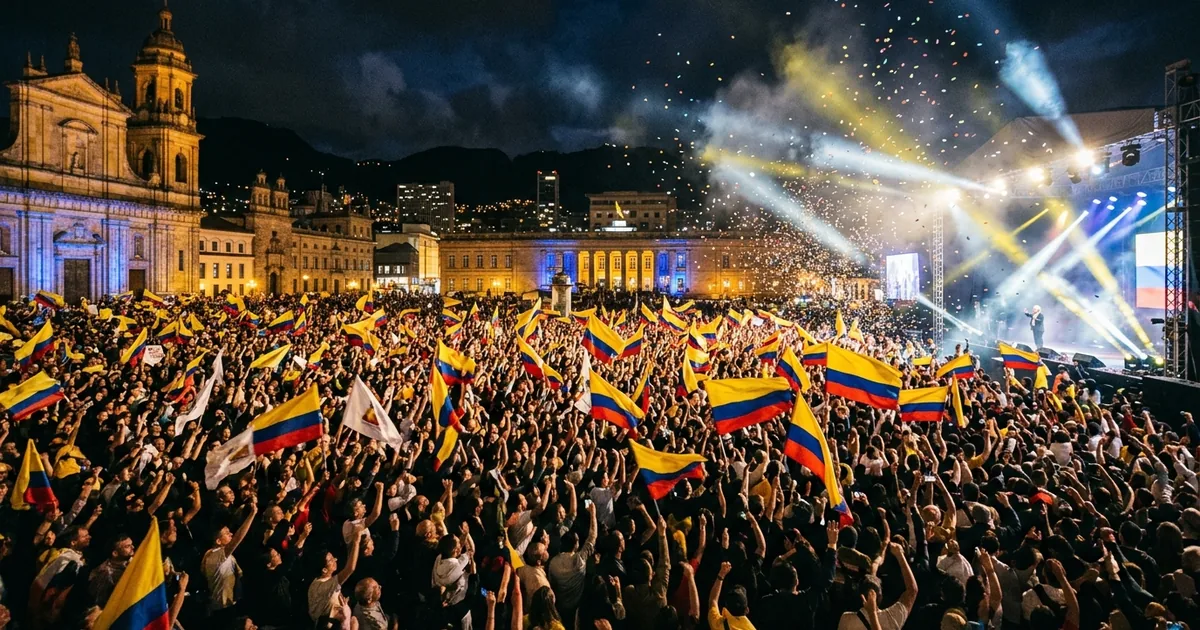
Colombia just made the sharpest rightward turn in its modern political history, and the rest of Latin America should be paying attention. Abelardo de la Espriella, the millionaire criminal defense attorney who calls himself “El Tigre,” won Sunday’s presidential runoff by less than one percentage point over left-wing senator Ivan Cepeda, according to Colombia’s national electoral authority. With over 99% of the preliminary tally counted, de la Espriella pulled 49.65% to Cepeda’s 48.70%, making this the tightest presidential race Colombia has seen in decades.
A Political Outsider With a Strongman Playbook
De la Espriella is not a career politician. He built his name as one of Bogota’s most prominent defense lawyers before launching his Defenders of the Motherland movement, a populist vehicle that blended law-and-order rhetoric with Trump-style showmanship. The U.S. president endorsed him personally, CNN reported, and the parallels are hard to miss: the brash outsider, the nationalist branding, the promises of decisive military action.
His platform reads like a security-first manifesto. He has pledged a sweeping military offensive against guerrilla groups on day one, vowed to bomb camps holding what he calls “narco-terrorists,” and promised the construction of ten “mega prisons.” He also plans to reverse outgoing President Gustavo Petro’s moratorium on fracking and new hydrocarbon contracts, a move that will thrill energy markets and alarm climate advocates in equal measure.
What Petro’s Exit Means for the Peace Process
The bigger question hanging over Bogota is what happens to the fragile peace architecture Petro spent his term trying to build. The 2016 peace accord with FARC was already fraying under implementation challenges, and Petro’s “total peace” strategy of simultaneous negotiations with multiple armed groups produced mixed results at best.
De la Espriella has made no secret of his skepticism toward those talks. His promise to intensify military operations against drug-smuggling operations and guerrilla holdouts suggests a fundamental reorientation from negotiation to confrontation. For the estimated 7.7 million internally displaced Colombians and the rural communities caught between armed factions, the stakes could not be higher.
Regional Ripple Effects
Colombia’s shift does not happen in a vacuum. With Argentina’s Javier Milei already reshaping economic policy from the right, and Ecuador’s Daniel Noboa pursuing a militarized anti-gang strategy, de la Espriella’s victory extends a conservative wave that has been rolling through Latin America since 2023.
The 12.9 million votes de la Espriella secured made him the most-voted presidential candidate in Colombian history, reflecting both the depth of frustration with Petro’s governance and the mobilizing power of security-first messaging in a region still grappling with cartel violence, migration pressures, and economic uncertainty.
The Road to August
De la Espriella will not be sworn in until August 7, the traditional Battle of Boyaca memorial date. That gives Petro’s government roughly six weeks to finalize any remaining peace agreements and lock in policy commitments before the transition. It also gives Colombia’s international partners, particularly Washington, time to calibrate their expectations for a relationship that will look very different under El Tigre than it did under the leftist Petro.
With turnout at roughly 63% and a margin of less than one point, de la Espriella inherits a deeply divided electorate. Whether he governs for all of Colombia or only for the half that chose him will determine whether this election marks a course correction or the beginning of a new chapter of polarization.