
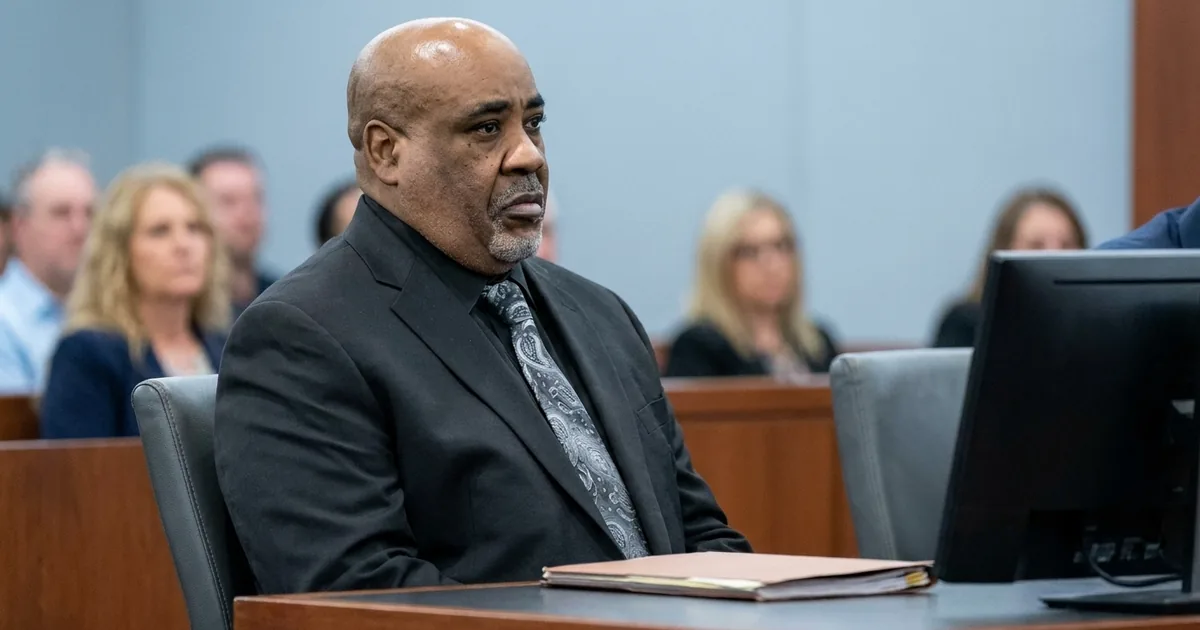
A Las Vegas jury found Duane “Keffe D” Davis guilty of first-degree murder on Monday afternoon in the 1996 killing of Tupac Shakur, closing a case that sat unsolved for nearly thirty years. It took them under three hours, and nearly everything they used to do it had come out of Davis’s own mouth.
Most of the coverage of that verdict reports the outcome and the sentencing date. Very little of it sits with the strangest fact of this trial: the state won a first-degree murder conviction on a record that held no forensic evidence tying Davis to the shooting, no phone records, and no surveillance placing him in Las Vegas on the night of September 7, 1996. What it had instead was a memoir, a cable docuseries, and a police interview Davis gave in the belief that it could never be charged against him. He talked, for leverage and then for money, until the talking became the case.
What the Jury Actually Had
Prosecutors never claimed Davis pulled the trigger. Chief Deputy District Attorney Binu Palal told jurors that Davis acquired a gun and then went hunting for Shakur and Marion “Suge” Knight, retaliation for the beating Davis’s nephew Orlando “Baby Lane” Anderson had taken in the MGM Grand lobby hours earlier, after that night’s Mike Tyson fight. CBS News reported that the theory placed Davis in the white Cadillac that pulled alongside Knight’s BMW on Flamingo Road. Shakur was shot multiple times and died six days later, at 25.
The evidence for that theory was Davis describing it. He put himself in that car in his 2019 memoir, Compton Street Legend. He described it again in a BET docuseries. He had already done it a decade earlier, in a December 2008 interview with Los Angeles police, and jurors heard those recordings played in court. Across nine days the state called twenty-four witnesses, among them a gang expert who described Davis as a shot caller in the South Side Compton Crips. The defense called three.
Defense attorney Michael Sanft spent his closing daring jurors to find anything beyond Davis’s own statements that put his client in Las Vegas that night. He was right that there is nothing: no ballistics match, no cell-site record, no camera. His case was that Davis is a braggart who bought himself a role in the most famous unsolved murder in American music because the role was worth something, first as leverage with police, later as book sales and a television check. The jury heard it and rejected it in less than three hours.
The Enhancement the State Dropped on Its Way to Winning
One detail from Monday deserves more attention than it has drawn. Before the case reached the jury, prosecutors abandoned the gang enhancement attached to the murder count. The reason Palal gave was not evidentiary. It was scheduling. A former officer would have testified for ten or fifteen minutes, and in Palal’s account there were logistical issues on the state’s end that prevented it.
That enhancement was the piece of the charge that formally tied the killing to the South Side Compton Crips as an organization, which is the theory the district attorney had been building since Davis was indicted in 2023. Dropping it cost the prosecution nothing on Monday, because first-degree murder with the use of a deadly weapon already carries up to life. Still, it is a strange way to close a thirty-year case. The gang framing was load-bearing in the narrative and disposable in the charging document.
The Promise That Came Apart
The appeal Davis announced from the defense table on Monday, moments after asking the judge for his belongings back, will not be about the drive-by. It will be about a promise made in Corona, California, in December 2008.
LAPD detectives Greg Kading and Daryn Dupree approached Davis at his home while he was exposed on federal drug allegations, and brought him into what lawyers call a queen-for-a-day session. Kading’s assurance to him was direct.
Nothing you say can be used against you.
That was true, and far narrower than it sounds. A proffer agreement bars the government from using your statements against you. It does not bar the government from building a case out of evidence gathered elsewhere, and it does not survive you repeating the same account into a microphone for pay. That is exactly what Las Vegas prosecutors argued: Davis voided whatever protection he had the moment he retold it in his book and on television. We covered the immunity question the jury was left holding hours before the verdict came back, and it is now the whole appellate case.
Testimony in the trial’s final days added something that will outlive this verdict. A former officer told the court he had been instructed to stand down on arresting Davis. Set that beside the twenty-seven years between the shooting and the indictment, and the state’s triumphant framing gets harder to hold.
The Verdict Is Probably Right. The Route to It Should Still Bother People.
Our read is that the jury got the outcome right and the path there is not something Clark County should be celebrating.
Davis confessed repeatedly, in detail, across two decades and several formats, with the core specifics holding their shape each time. Juries are entitled to believe confessions, and a man who narrates his own part in a murder for money has forfeited any serious claim to being misunderstood. Convicting him is defensible, and our earlier reporting on how the case was built almost entirely out of Davis himself does not change that.
What is not defensible is the twenty-seven years. The record now shows police had Davis describing his own role in 2008, that at least one officer was told to stand down, and that the case only moved once Davis had made himself impossible to ignore by publishing. Prosecutors are entitled to call Monday a win. They are not entitled to call it diligence. If the district attorney’s office wants credit for closing this case, it should explain on the record, and before October 13, why that 2008 interview sat for fifteen years and who issued the stand-down instruction.
What Happens on October 13
Judge Carli Kierny set sentencing for October 13 and ordered Davis held without bond. He is 63, and first-degree murder with a deadly weapon in Nevada means he will most likely die in custody whatever number is attached to it. That makes the appeal less about his freedom than about the rule it would set. If a proffer promise can be voided by the defendant’s own book deal, that is a workable doctrine and probably a correct one. It also means the most reliable way for police to get an admission they can use is to wait for the suspect to sell it.
Tupac Shakur has been dead for thirty years. The institution that took this long to put a name to it has just been taught that waiting works, and that is the part worth watching as the next cold case comes up for review.