
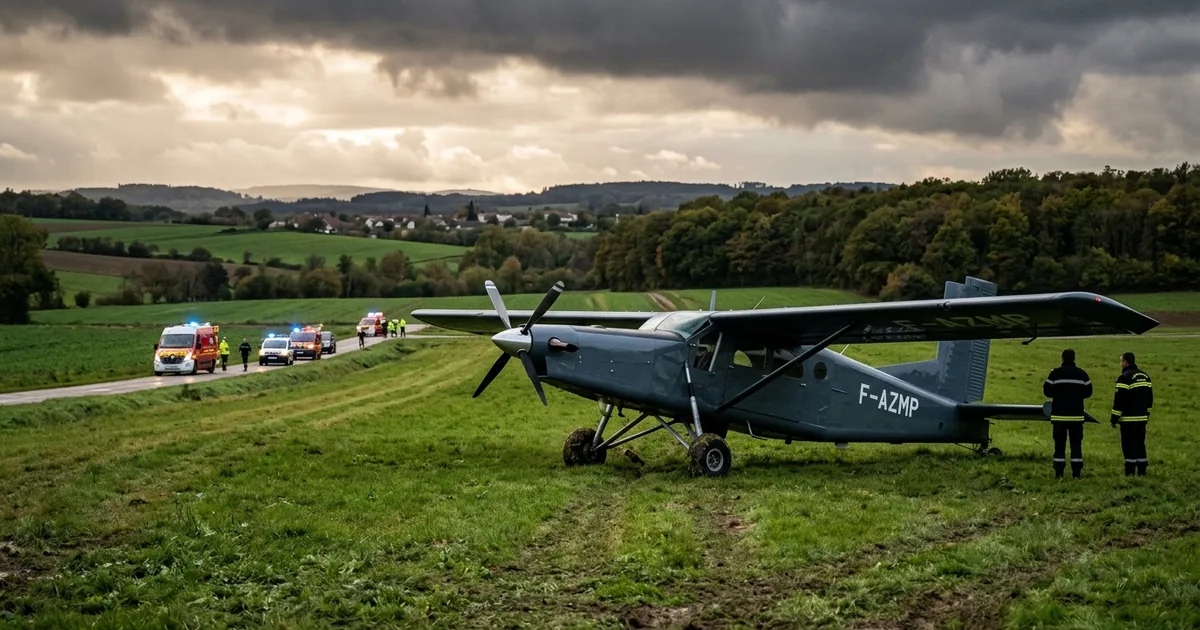
A civilian aircraft carrying skydivers slammed into the ground moments after takeoff from a regional airport in northeastern France on Sunday morning, killing all 11 people aboard.
The crash, which occurred in the town of Tomblaine just outside Nancy, is the deadliest aviation disaster in France in years and has sent shockwaves through the country’s recreational aviation community.
What We Know So Far
The aircraft, a Pilatus PC-6/B2-H4 Turbo Porter registered in Germany under the tail number D-FIPS, departed Nancy-Essey Airport shortly before 11:00 a.m. local time carrying a pilot, five skydiving instructors, and five students participating in their first tandem parachute jump. Al Jazeera confirmed that none of the 11 survived. The operator, Tandemotion Parachutisme, a local skydiving school, has not issued a public statement as of early Sunday afternoon.
The Pilatus PC-6 Turbo Porter is a single-engine turboprop workhorse widely used by skydiving operations across Europe and the United States. It is considered one of the most reliable short-takeoff aircraft in the world, which makes the catastrophic failure immediately after departure all the more alarming for investigators. The plane’s German registration suggests it may have been leased or operated cross-border, a common arrangement in European recreational aviation.
The Scene in Tomblaine
Emergency services, including firefighters and medical teams, flooded the crash site within minutes. Yves Seguy, the prefect of the Meurthe-et-Moselle department, confirmed the death toll and said authorities were collecting witness statements at the scene. Police urged the public to stay away from the area to allow first responders unrestricted access.
French Interior Minister Laurent Nunez announced he was traveling to Tomblaine, signaling the gravity with which the national government is treating the disaster. Euronews reported that the crash site is in a semi-urban area near the airport, raising questions about the flight path and whether debris posed risks to people on the ground.
A Grim Pattern in Recreational Aviation
France has one of Europe’s largest general aviation sectors, with thousands of recreational flights operating weekly from small regional airports. But the industry has faced recurring scrutiny over safety standards, particularly for parachute and skydiving operations where aircraft routinely fly at high load capacities with rapid turnaround times. A crash during a first-jump training session, where five of the victims were complete beginners trusting the operation with their lives, will amplify those questions considerably.
Skydiving operations across Europe have historically relied on aging fleets of rugged utility aircraft like the Pilatus Porter, Cessna Caravan, and de Havilland Twin Otter. These planes are built to handle short, repetitive flights under demanding conditions: steep climbs to altitude, frequent door-open operations at 13,000 feet, rapid descents, and back-to-back sorties on busy weekends. The maintenance demands are intense, and the economic margins for small drop-zone operators are razor-thin. Sunday’s crash will inevitably refocus attention on whether regulatory oversight of these operations matches the risks involved.
The Investigation Ahead
The probe will likely focus on several key areas: mechanical failure in the engine or airframe, weight and balance calculations for the fully loaded aircraft, weather conditions at the time of departure, and pilot qualifications and fatigue. The French Bureau of Enquiry and Analysis for Civil Aviation Safety (BEA), the country’s equivalent of the NTSB, is expected to lead the investigation. Given the aircraft’s German registration, German aviation authorities under the European Union Aviation Safety Agency (EASA) framework may also participate. Cross-border registration is common in European general aviation but can sometimes create jurisdictional complexity around maintenance records and oversight responsibility.
One factor investigators will examine closely is the timing of the crash. A failure immediately after takeoff, when an aircraft is at maximum weight, low altitude, and low airspeed, leaves almost no room for recovery. Pilots in this phase of flight have minimal options: there is no altitude to trade for speed, no runway to return to, and no time to troubleshoot a mechanical problem. It is, statistically, the most dangerous phase of any flight.
Why This Resonates Beyond France
This is a tragedy that will resonate well beyond Tomblaine. The deadly crash of an Air Canada jet at LaGuardia Airport earlier this year underscored how quickly routine flights can turn fatal, and Sunday’s disaster is a reminder that recreational aviation, often perceived as a weekend thrill, operates with real and sometimes unforgiving risks. Eleven people boarded a small turboprop for what was supposed to be the experience of a lifetime. For five of them, it was their very first jump. That gap between expectation and outcome is what makes this story so devastating.
What Comes Next
The BEA will secure the wreckage and begin recovering flight data. France’s civil aviation authority, the DGAC, may issue temporary restrictions on similar operations while the investigation proceeds. For the families of the 11 victims, five of whom showed up at a small regional airport expecting the adventure of a lifetime, the questions about what went wrong will take far longer to answer.
This is a developing story. We will update as French authorities release additional details.