
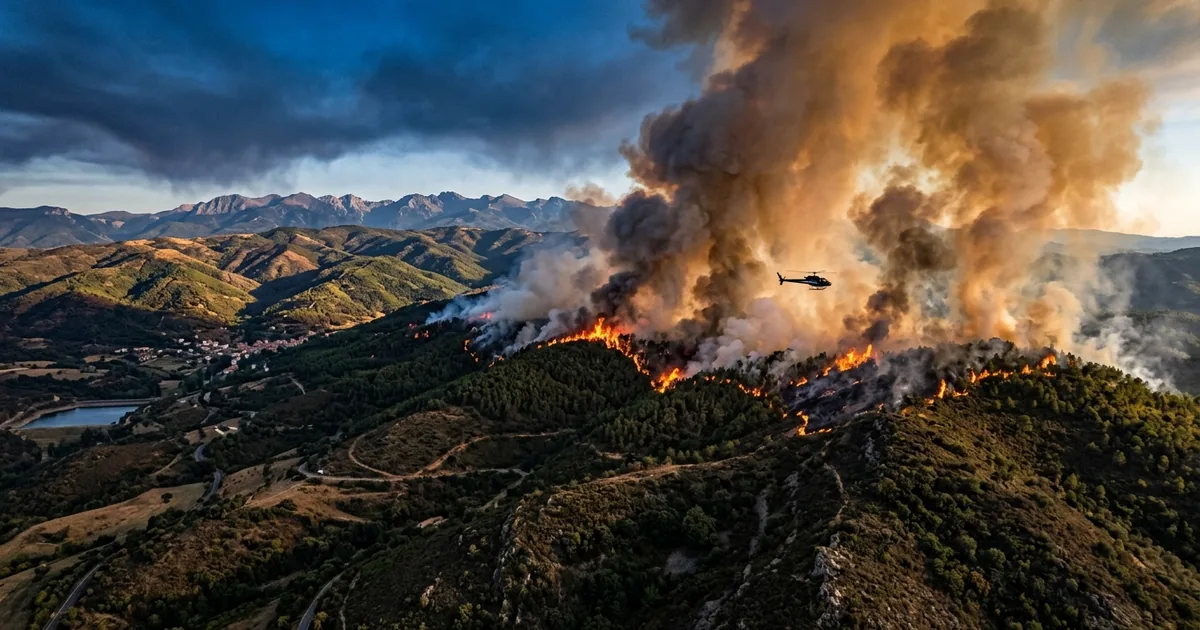
A wildfire tearing through the Pyrenees-Orientales department of southern France has burned more than 4,600 hectares and forced the evacuation of over 10,000 people from more than a dozen towns near the Spanish border, turning a summer heatwave into a full-blown crisis that is now disrupting one of the world’s most-watched sporting events.
The blaze, which originated near the village of Trevillach and spread rapidly toward Ille-sur-Tet in the foothills of the French Pyrenees, has put 700 firefighters and aerial units into the field against what officials describe as a “gigantic” fire burning through remote, hard-to-reach terrain. No deaths have been reported, but two people, a firefighter and a local resident, are in critical condition.
The Fire Is a Product of the Heatwave, Not an Accident of Timing
The structural cause here is not mysterious: a punishing early-summer heatwave that has baked southern Europe for weeks created the conditions for exactly this kind of catastrophe. Prolonged drought, record temperatures, and strong winds combined to turn the densely forested Pyrenean foothills into a tinderbox. France is not new to summer wildfires, but the pattern is accelerating. The same heatwave that set record temperatures across France and drove drowning deaths just days ago is now feeding a fire that has consumed an area roughly the size of 6,500 football fields.
This is what the climate science community has been warning about for years: the Mediterranean basin is drying out faster than infrastructure and emergency response can adapt. Southern France, Greece, Portugal, and Spain are all seeing wildfire seasons that start earlier, burn hotter, and overwhelm firefighting capacity. The Pyrenees-Orientales fire is not an outlier. It is the new baseline.
Tour de France Caught in the Fire Zone
The wildfire has forced emergency measures around Stage 3 of the 2026 Tour de France, which was scheduled to pass through sections of the Pyrenean corridor between Granollers and Les Angles. U.S. News reported that officials banned all public spectator access along affected stretches of the route to keep roads clear for emergency vehicles and reduce crowd safety risks.
The race is proceeding under strict emergency conditions, but the optics are jarring: the world’s premier cycling event threading through a landscape that is actively on fire, with smoke plumes visible from the route. For a race that sells itself on the beauty of the French countryside, the imagery tells a story the organizers would rather not broadcast.
What the Response Looks Like on the Ground
Seven hundred firefighters, backed by water-dropping aircraft, are working to contain a blaze that has proven difficult to control because of the terrain. The fire zone sits in a remote, mountainous area near Perpignan, close to the border with Spain, where steep slopes and dense vegetation make ground access treacherous.
Al Jazeera reported that more than 10,000 residents were ordered to leave their homes across over a dozen small towns and villages in the foothills. Emergency shelters have been established in Perpignan and surrounding communities. The evacuation is among the largest wildfire-driven displacements in France in recent years.
CBC News confirmed the scale of the operation, noting that thousands of evacuees were relocated from homes in the southwest of the country as the fire continued to spread.
The Bigger Pattern Across Southern Europe
France is not alone. Massive wildfires are burning across southern Europe, driven by the same heatwave conditions. The Mediterranean fire season is now a months-long emergency rather than a few bad weeks in August, and the policy response across the continent has not kept pace.
The core problem is one of chronic underinvestment in prevention. Fire breaks, controlled burns, forest thinning, and early-detection infrastructure remain underfunded relative to the growing risk. Instead, countries rely on reactive suppression, deploying hundreds of firefighters and aircraft after the fire starts, rather than investing in the landscape management that would reduce ignition risk in the first place. The result is a cycle: every year the fires get worse, every year the response is heroic but insufficient, every year the season starts a little earlier.
For the 10,000 displaced residents of the Pyrenees-Orientales, the immediate question is when they can go home. The bigger question is whether France and its neighbors will treat the wildfire crisis as the structural infrastructure problem it is, or continue to treat each blaze as a one-off emergency to be managed and forgotten until the next one ignites.