
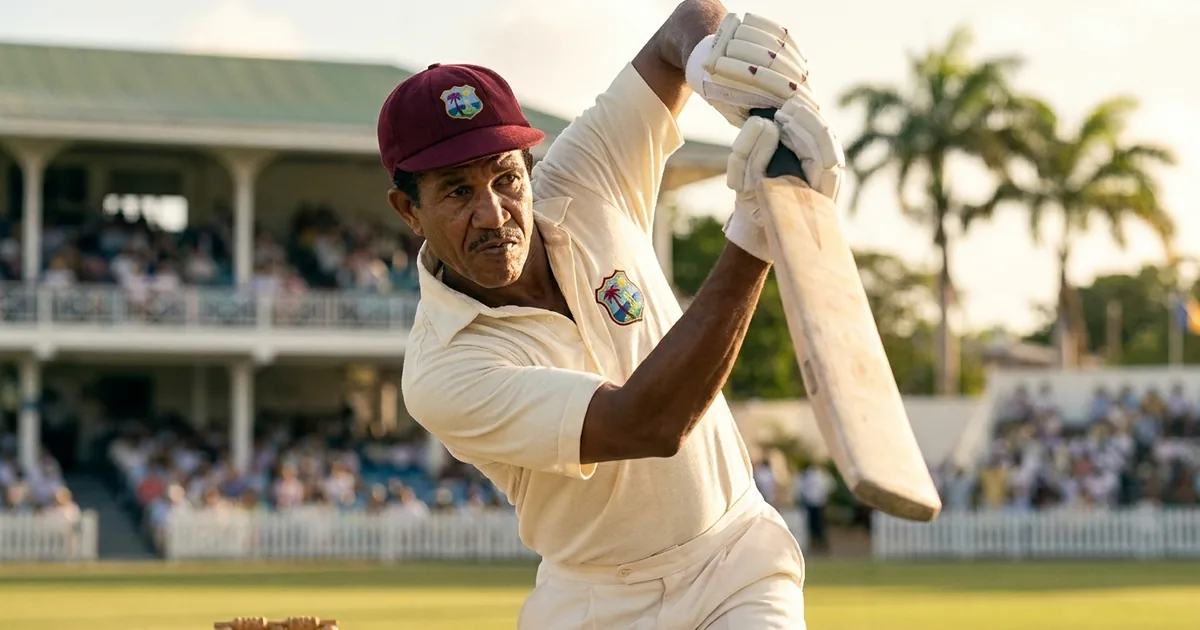
Sir Garfield Sobers, the West Indies all-rounder whom the sport itself long ago stopped debating and simply crowned its greatest, died Friday at 89, two weeks short of his 90th birthday. BBC Sport reported the death of the Barbadian legend, and the loss lands not just on cricket but on the small-island Caribbean nations whose post-colonial confidence he did as much as any politician to build.
The Numbers Were Never the Whole Story, but They Are Staggering
Start with the record, because the record is absurd. Across 93 Tests for the West Indies between 1954 and 1974, Sobers scored 8,032 runs at an average of 57.78 and took 235 wickets at 34.03. No one else in the sport’s history has combined batting of that class with genuine frontline bowling in three different styles: fast-medium seam, orthodox left-arm spin, and wrist spin. Modern all-rounders get compared to him the way modern basketball players get compared to Michael Jordan, which is to say the comparison flatters them and settles nothing.
Two feats bracket the legend. In 1958, at 21 years old, he batted for days against Pakistan in Kingston and finished 365 not out, a world record for the highest individual Test score that stood for 36 years until his fellow West Indian left-hander Brian Lara passed it with 375 in 1994. And in 1968, playing county cricket for Nottinghamshire against Glamorgan, he became the first man to hit six sixes in a single six-ball over, off the unfortunate Malcolm Nash, a piece of film that still circulates every time a batter threatens the feat.
Wisden, the sport’s publication of record, named him one of its five Cricketers of the Century in 2000, alongside Don Bradman. The Almanack’s tribute called on the game’s heavyweight writers because ordinary praise was not going to cover it.
Why Sobers Mattered Beyond the Boundary
Here is the part an American reader should not miss, because it is the actual why of this story. Sobers’s career ran in near-perfect parallel with the Caribbean’s decolonization. He debuted for the West Indies in 1954, when the islands were still British colonies and the team’s leadership was reserved, by custom if not by rule, for white players. He was captaining the side by the mid-1960s, the era when Barbados itself won independence in 1966. A Black man from a modest Bridgetown neighborhood was, by then, the best cricketer on earth and the leader of a team that routinely beat England at the game England invented.
That was not just sport. For the newly independent nations of the English-speaking Caribbean, the West Indies team was the one institution that outperformed the former colonial power on the former colonial power’s own terms, and Sobers was its face. Queen Elizabeth II knighted him in 1975. Barbados went further: in 1999 the government named him one of the country’s ten national heroes, an honor that comes with a public holiday, and the island’s premier sporting venue, the Sir Garfield Sobers Sports Complex, has carried his name since 1992. In 1998 the region’s governments collectively awarded him the Order of the Caribbean Community, an honor reserved for figures whose contribution transcends any single island.
The pattern is worth naming plainly. Nations tend to mint national heroes out of generals and independence leaders. Barbados minted one out of a cricketer, because in the years when the country was deciding what it was, he was the proof of concept.
A Death the Cricket World Saw Coming and Still Cannot Absorb
Sobers had lived quietly in Barbados in recent years, an elder statesman wheeled out for anniversaries and hall-of-fame ceremonies, his profile maintained in the International Cricket Council’s Hall of Fame as the benchmark against which the sport still measures completeness. Outlook India noted in its report of his death that he passed just weeks short of his 90th birthday, which falls on July 28.
The timing gives the obituaries a bitter edge. Cricket had been quietly preparing a global celebration of his 90th year. It will now get a global mourning instead, and the difference between those two events is two weeks.
Expect the tributes to be led from the Caribbean and to spread through every cricketing capital: London, where he conquered county cricket; Mumbai and Karachi, where his 1958 record was chased for a generation; Melbourne and Sydney, where his seasons with South Australia are still spoken of with reverence. The formal machinery will follow, likely a state funeral in Barbados befitting a national hero, though arrangements had not been announced as of Friday afternoon.
The Last of a Category
Sports produce great players constantly and complete players almost never. The modern game, with its franchise leagues and specialist roles, has made the Sobers template functionally extinct: no one is developing a batter who averages nearly 58 while also serving as three bowlers in one. The economics of the sport now push talent toward narrower excellence, which is precisely why his numbers have only grown stranger with age.
In a week when the sporting world’s attention is fixed on Saturday’s World Cup final between Spain and Argentina at MetLife Stadium, the death of cricket’s greatest player is a reminder that the games that command the biggest audiences are not always the ones that produce the largest figures. Sobers was, by broad consensus rather than partisan argument, the most complete practitioner his sport has ever seen. The question his death leaves open is not who replaces him. It is whether the structure of modern cricket can ever again produce someone eligible for the comparison.