
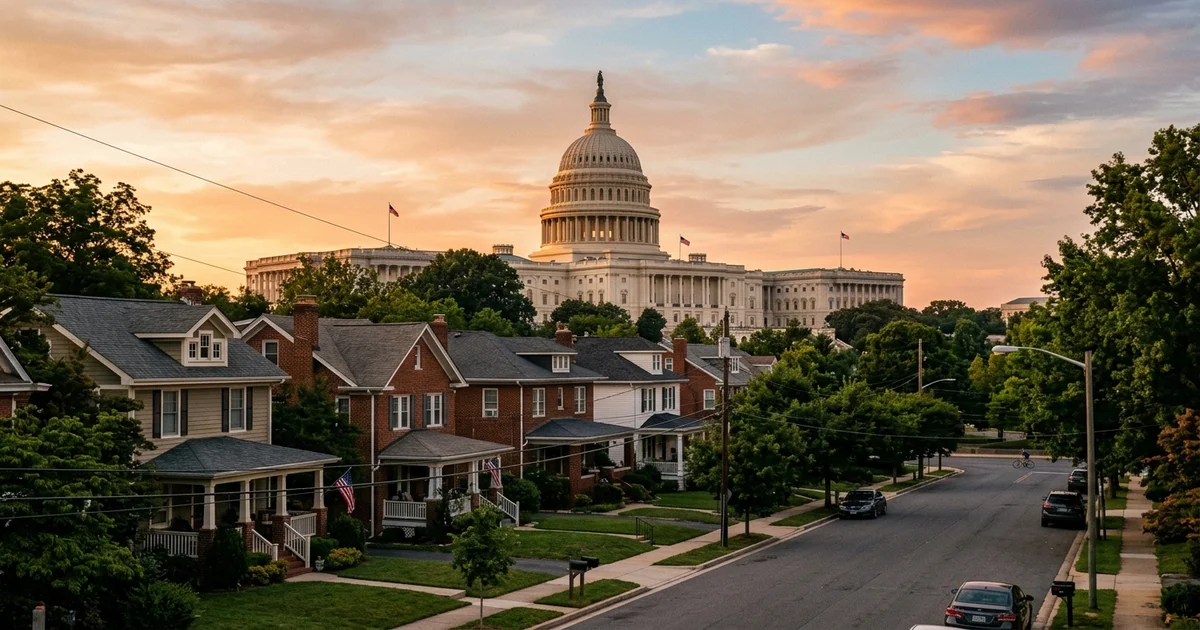
The 21st Century ROAD to Housing Act officially became law on Thursday after President Donald Trump let the 10-day signing window expire, making it the most significant housing legislation in decades and a rare bipartisan rebuke of a president who tried to use the bill as a bargaining chip for an unrelated voter ID measure.
The bill passed Congress with veto-proof margins, 85-5 in the Senate and 358-32 in the House, and Trump’s refusal to sign it did nothing to stop it from taking effect. What it did reveal is a president willing to hold millions of Americans’ housing prospects hostage to extract concessions on his SAVE America Act, the controversial bill that would require proof of citizenship and photo identification to vote in federal elections. That is not dealmaking. That is extortion with extra steps.
What the ROAD to Housing Act Actually Does
The legislation attacks the housing crisis from multiple angles, and the corporate investor restrictions alone make it worth the fight. Large institutional investors controlling 350 or more single-family homes are now barred from purchasing additional ones, with civil penalties reaching $1 million per violation or three times the purchase price. NPR reported Thursday that the provision directly targets the private equity firms that have been snapping up starter homes across Sun Belt cities and converting them to permanent rentals, a practice that has priced out first-time buyers in markets from Phoenix to Charlotte.
The bill also eliminates the permanent chassis requirement for manufactured homes, a decades-old regulatory quirk that kept factory-built housing trapped in a regulatory gray zone between real property and personal property. That distinction matters because it determined whether buyers could access conventional mortgages or were stuck with higher-rate chattel loans. Removing it opens the manufactured housing market to a financing system that actually works for buyers.
Community Development Block Grant funding can now be used for new affordable housing construction, not just rehabilitation. And the cap on bank investments in community development projects rises from 15% to 20%, unlocking billions in potential affordable housing financing.
Why Trump Refused to Sign
Less than 24 hours before a planned bill signing ceremony, the president pulled out, demanding that Congress first pass his SAVE America Act. Time reported that the abrupt reversal blindsided even Republican leadership, who had spent weeks coordinating the bipartisan rollout.
The calculation was transparent: use the one piece of legislation that had genuine bipartisan support, the kind of bill that helps people in every congressional district, as pressure on Democrats to accept a voter ID bill that voting rights advocates have called the most restrictive proposed change to federal election law in half a century.
It did not work. The margins were so overwhelming that a veto would have been overridden anyway, and Trump apparently decided that a pocket veto fight was worse optics than simply letting the clock run out.
The Corporate Landlord Problem This Law Targets
The institutional investor provision is the headline, and for good reason. Between 2020 and 2025, large corporate investors purchased an estimated 400,000 single-family homes across the United States, according to data compiled by the National League of Cities. In some metropolitan areas, corporate buyers accounted for more than 25% of all single-family transactions, competing directly with families who were already struggling with mortgage rates above 6%.
The new law does not force corporate owners to dump their existing portfolios overnight, but it does require divestiture to individual buyers within seven years and establishes a HUD complaint hotline for renters of institutionally owned properties. The enforcement mechanism has real teeth: those per-violation penalties are large enough to make continued acquisition economically irrational for all but the most brazen operators.
This is the policy response that housing advocates have been demanding since the post-pandemic buying spree turned entire neighborhoods into corporate rental portfolios. When LNC covered the bill’s passage through Congress last month, the question was whether Trump would sign it. He chose not to. It became law anyway.
What Comes Next
Implementation timelines vary by provision. The corporate investor restrictions take effect in 180 days, giving HUD time to establish enforcement protocols and the complaint system. The manufactured housing reforms require a rulemaking process that could take 12 to 18 months. The CDBG and bank investment cap changes are effective immediately.
The political takeaway is starker. This is the third time in Trump’s second term that legislation has become law without his signature, a mechanism that sits somewhere between a veto and an endorsement, sending a signal that the president opposes the bill in principle but lacks the political capital to stop it. For a president who has built his brand on dominance, letting housing reform happen to him rather than shaping it is a quiet admission that even his own party’s members have limits on how far they will follow his lead when their constituents’ daily lives are at stake.
The housing crisis will not be solved by one bill. But for the first time in a generation, there is now a federal framework that treats housing as infrastructure, restricts the financialization of the family home, and modernizes the rules governing affordable alternatives. That it happened despite the president rather than because of him says as much about where American politics is headed as the law itself.