
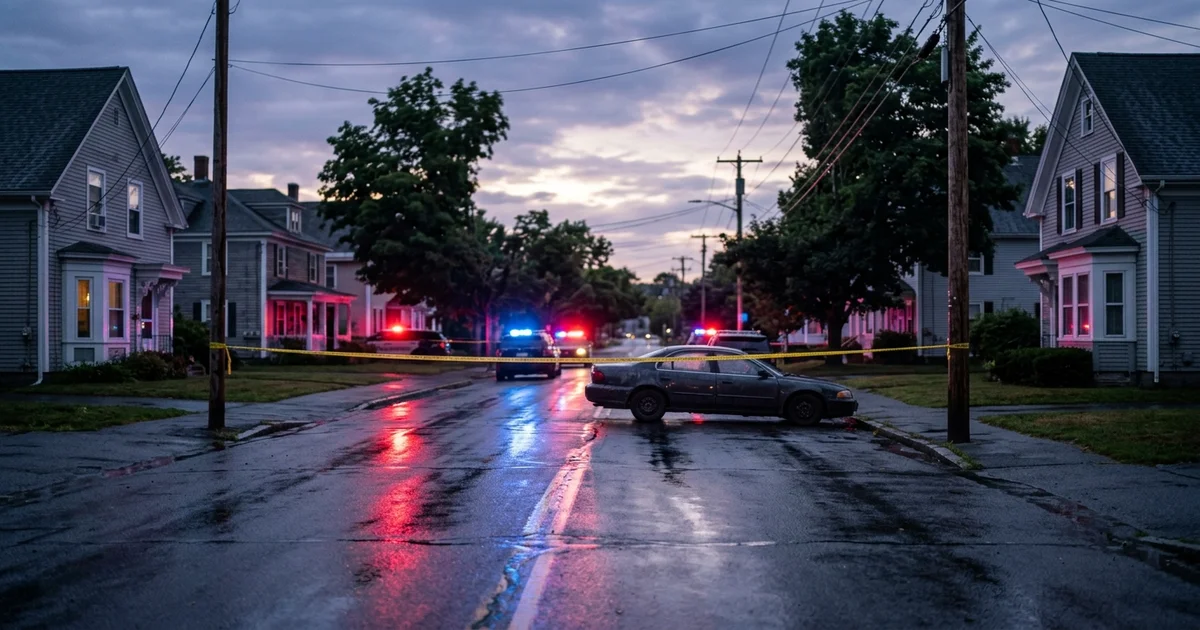
A 26-year-old Colombian man who was authorized to work in the United States, held a Social Security number, and had a 3-year-old daughter was shot dead by an ICE agent in Biddeford, Maine on Monday.
He was not the person federal agents were looking for.
That fact alone should stop every American in their tracks. Johan Sebastian Duran Guerrero was, by every available account, exactly the kind of immigrant the system is supposed to protect: documented, employed, raising a family. And now he is dead because an ICE officer discharged a firearm during what the Department of Homeland Security described as a “vehicle stop” after the car “attempted to flee.”
What DHS Says Happened
The official version is thin on detail and heavy on justification. According to DHS, agents were conducting surveillance on the last known address of an undocumented immigrant with a final order of removal. Someone departed the residence, and ICE attempted a vehicle stop. The agency says the vehicle tried to flee, and an officer fired “fearing for public safety.”
But here is the critical detail that DHS initially took hours to disclose: Duran Guerrero was not the person named on the warrant, as NBC News first confirmed. He was a bystander to an operation that was never about him.
His father told reporters that Johan had legal authorization to be in the country. Neighbors in Biddeford described him as a cleaner and food delivery driver who kept a quiet life with his partner and their young daughter. None of that mattered when the bullet left the chamber.
A Pattern, Not an Anomaly
This is not an isolated incident. It is the second time in a single week that ICE agents used deadly force. On July 7, plainclothes agents in unmarked vehicles pursued and killed 52-year-old Lorenzo Salgado Araujo in Houston. PBS News reported that the Maine shooting marks the ninth death linked to ICE operations since President Trump launched his expanded immigration enforcement campaign.
The throughline connecting these cases is operational recklessness. Unmarked vehicles, plainclothes agents, high-speed pursuits in residential areas, weapons drawn on people who may not even understand they are being stopped by law enforcement. This is not the careful, targeted enforcement the administration describes in press conferences. It is a pattern of escalation that treats every encounter as a potential combat scenario.
The Accountability Gap
New York City Public Advocate Jumaane Williams and other officials have called for an independent investigation, but the structural barriers to accountability here are enormous. ICE agents operate under federal authority, which insulates them from most local oversight. The DHS inspector general’s office is investigating, but the agency’s track record on internal accountability does not inspire confidence.
Maine’s congressional delegation has demanded answers. Senator Angus King called the shooting “deeply troubling,” and the state’s political landscape is already shifting in response to federal overreach in the region. But demands for transparency from Congress have historically produced little more than strongly worded letters and delayed reports.
The deeper question is structural. When federal law enforcement agents can fatally shoot someone who had every legal right to be in this country, someone who was not even the subject of their operation, and the initial public response is hours of silence followed by a vague statement about “public safety,” the system is not functioning as designed. It is functioning as protected.
What Comes Next
The political fallout will play out predictably. Immigration hardliners will focus on the “fled the vehicle stop” detail. Critics will point to the dead man’s legal status and the fact that he was not the warrant target. Cable news will move on within a week.
But Johan Sebastian Duran Guerrero’s 3-year-old daughter will not move on. His partner will not move on. And the fundamental question at the center of this story will outlast every news cycle: at what point does aggressive immigration enforcement become indistinguishable from the lawlessness it claims to combat?
The answer, for at least nine families now, arrived too late to matter.