
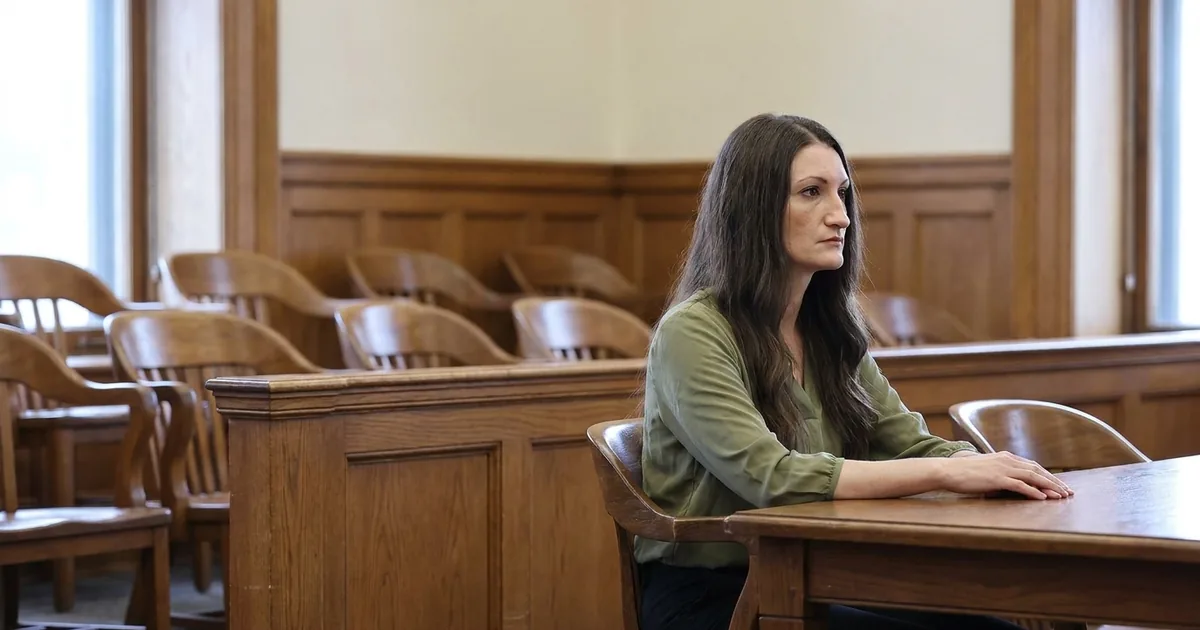
Judge William Sullivan declared a mistrial in Lindsay Clancy’s triple murder trial at 11:25 on Friday morning, then paused his own ruling for one hour so her lawyer could run to the state’s highest court. Almost every account of that hour has tracked the mechanics, the stay, the petition, the clock, and skipped the part the courtroom record makes plain: this jury did not reject the postpartum psychosis defense. It came apart over a single juror who, by the foreperson’s own account, would not do what Massachusetts law asks a juror to do.
That reading is not a guess about what happened behind a closed door. It is what you get by watching who asked for what. Clancy’s attorney, Kevin Reddington, spent Friday morning trying to get a juror thrown off the panel. Assistant District Attorney Jennifer Sprague fought to keep that juror seated. Defense lawyers do not move to eject jurors who are helping them, and prosecutors do not go to the mat for a juror who is about to acquit.
What the Note From the Jury Room Actually Said
The foreperson told Sullivan that one juror had made statements acknowledging doubt but was refusing to apply that doubt to the verdict as the law requires. Read past the procedural language and that sentence describes something specific and, in this case, decisive.
Massachusetts does not make a defendant prove insanity. Once a lack of criminal responsibility is properly in play the burden runs the other way, as WBUR laid out three days before the deadlock broke the trial: the Commonwealth must prove beyond a reasonable doubt both that the defendant committed the acts and that she was criminally responsible when she did. The mechanics matter here more than they usually do. A juror who holds reasonable doubt about criminal responsibility and votes to convict anyway is not being tough. That juror is declining to apply the standard.
A juror who acknowledges doubt and votes to convict anyway is not being tough on crime. That is a juror refusing to apply the burden of proof.
So the deadlock reported by NBC News on Friday, after roughly 36 hours of deliberation across seven days and a trial that ran close to six weeks with 85 witnesses, is being written up as a null result. It is not a null result. A jury that spent seven days on it, and whose foreperson reported a lone member holding out against the instructions rather than against the evidence, tells you the psychosis testimony landed with most of the room.
Why Reddington Ran to the Supreme Judicial Court
The maneuver that bought Clancy an extra hour is unusual and worth naming precisely. Reddington asked to file a petition under chapter 211, section 3, which lets a single justice of the Massachusetts Supreme Judicial Court reach into a live case when there is no other adequate remedy. His claim is structural error: that Sullivan’s refusal to examine or remove the juror tainted the whole proceeding.
Reddington did not soften it. He told the court there was one person refusing to apply the law to the facts, and went further, accusing that juror of having made a false statement under oath. That is an extraordinary thing to say out loud about a sitting juror, and it is a measure of how close he believed the defense was.
Sullivan Was Right Not to Touch That Juror
Here is the uncomfortable part, and it is why this case is going to be argued about for years. Sullivan almost certainly made the correct ruling, and the correct ruling is what cost Clancy a verdict.
As NBC Boston reported from the courtroom, he declined to interview or remove the juror, saying he saw no need for the inquiry and that the note did not indicate a person refusing to follow the law. He added that he did not think it proper for him to side with one side or the other of the deliberations. Sprague’s position was the same: nothing in the record showed a lack of impartiality or an inability to deliberate.
That is the right instinct, and any other one is worse. A judge who starts pulling jurors off a panel because the foreperson reports how they are leaning has converted deliberation into something a court supervises. The holdout juror problem has no clean fix, because the only tool that reliably removes a stubborn juror also lets a judge steer a verdict. Sullivan chose the failure mode that protects the institution. Clancy paid for that choice.
Timothy Cruz Should Not Retry This Case
The decision now belongs to Plymouth County District Attorney Timothy Cruz, and because no verdict was returned, double jeopardy does not stop him from starting over. He should not.
Weigh what a second trial actually buys. It puts a woman whose severe mental illness was documented at length in front of a new jury on the same evidence, with the state carrying the same burden it just failed to meet in front of twelve people over seven days. It drags Patrick Clancy, who lost all three of his children and who asked the public to forgive Lindsay four days after they died, through the whole thing again. And it does all this on a record where the sole reported obstacle to a verdict was one juror the foreperson described as refusing to apply the standard, not a jury unpersuaded by the defense.
Prosecutors retry hung cases all the time and are usually entitled to. This one is different in a way that ought to matter: the deadlock did not signal a close question the jury could not resolve, it signaled a jury that mostly resolved it and could not get unanimity. Cruz has the discretion to accept that. He should use it, and if he will not, he should be made to explain in public why a second jury is likely to do anything the first one did not.
Our own view is straightforward. Postpartum psychosis is a real and recognized illness, the defense put it in front of a jury that took seven days with it, and a criminal justice system that cannot metabolize that outcome without a second bite is not being rigorous. It is being stubborn.
What Happens Next
If the single justice denies Reddington’s petition, Sullivan’s mistrial becomes formal and the case resets. If the justice grants it, the same deadlocked jury goes back into a room it has already spent seven days in, which would settle nothing for anyone. When this trial seated its jury back in July, the open question was whether twelve people could hear the worst facts imaginable and still apply a standard built to protect the mentally ill. Most of them could. The system has not yet decided what to do about that.