
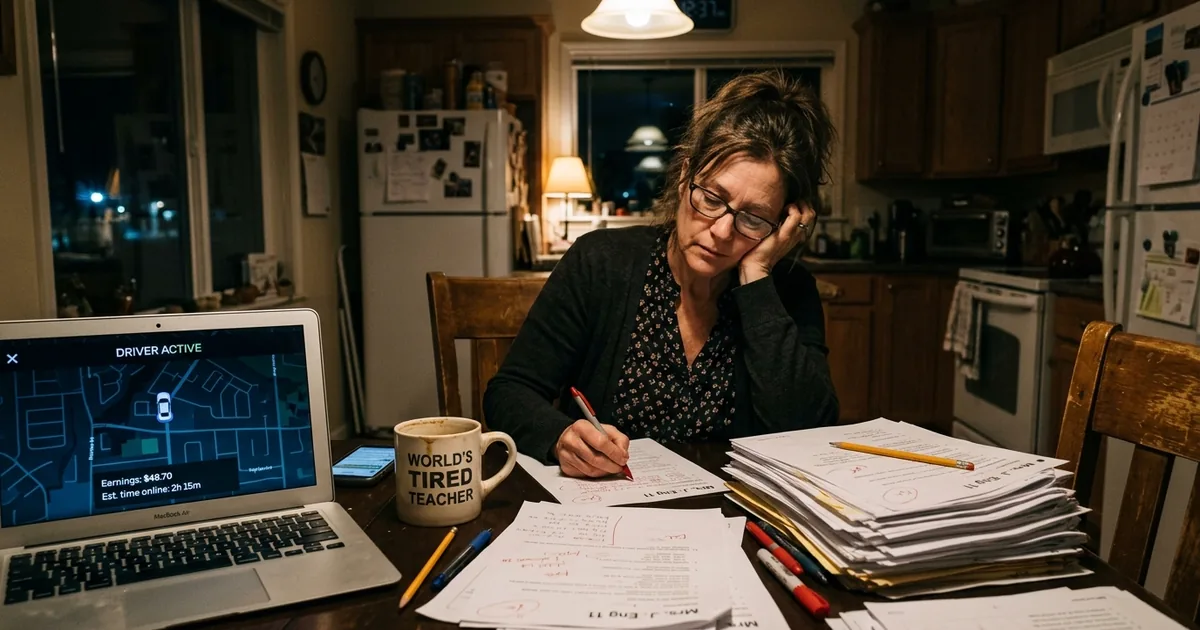
The numbers are staggering, but they shouldn’t be surprising. A new national survey from the Walton Family Foundation and Gallup finds that nearly three out of four American public school teachers hold at least one job beyond their classroom role. The “Teaching for Tomorrow” study, conducted in partnership with the Bipartisan Policy Center, surveyed 2,012 public K-12 teachers between October and November 2025, and what it reveals is less a snapshot of individual financial struggle than a portrait of institutional failure.
Let’s be precise about what 71% means. It means that in a profession we routinely call essential, the majority of practitioners cannot sustain themselves on the salary that profession provides. It means the person teaching your kid long division may have been driving for Uber until midnight. It means we have, as a society, decided that educating children is important enough to mandate but not important enough to fund.
The Side Hustle Breakdown
The survey draws a critical distinction between two types of second jobs, and both tell a damning story.
Sixty-two percent of teachers with additional work hold positions related to education: coaching, tutoring, mentoring, running after-school programs. These roles keep educators in their lane but stretch their hours and energy far beyond what any single salary is compensating. The remaining 31% hold jobs entirely unrelated to teaching, including food delivery, bartending, waiting tables, and rideshare driving. Fortune has reported that roughly one in three teachers now take on gig-economy side hustles.
Here is the detail that should alarm anyone who cares about classroom quality: 85% of teachers with side jobs work them during the school year, not just over summer break. This isn’t seasonal supplementation. This is year-round survival.
What “Getting By” Actually Looks Like
The financial picture the Gallup data paints is bleak in its ordinariness. More than half of surveyed teachers, 52%, describe their financial situation as merely “getting by.” Twenty-eight percent say they are “living comfortably.” And one in five, a full 21%, report that it is outright “difficult to get by.”
The average teacher salary in the United States sits at roughly $72,000. That figure sounds reasonable until you account for two realities. First, it varies enormously by state and district; teachers in rural Mississippi and teachers in suburban Connecticut exist in different economic universes. Second, $72,000 in 2026 does not buy what it bought a decade ago. Housing costs have surged. Grocery bills have climbed. Childcare, the cruel irony for people who spend their days caring for other people’s children, remains punishingly expensive.
When Gallup reports that one in five K-12 teachers struggle financially, that is not an abstraction. That is a teacher choosing between a copay and a full tank of gas. That is a teacher whose lesson planning happens at 11 p.m. because the hours between school dismissal and bedtime were spent earning enough to cover rent.
The Classroom Cost
The most consequential finding in the survey may be this: 34% of teachers who hold non-education side jobs say the additional work negatively affects their teaching.
Think about what that means at scale. If roughly a third of moonlighting teachers acknowledge diminished classroom performance, the downstream effects touch millions of students. Lesson plans get less creative. Grading gets delayed. The emotional bandwidth that great teaching demands, the patience, the attentiveness, the ability to notice when a kid is struggling, shrinks when the person providing it is exhausted from a second shift.
This is not a problem of lazy teachers or poor time management. This is what happens when you pay professionals below what their local cost of living requires and then act surprised when they optimize for survival.
A Systemic Design, Not a Personal Failing
The framing matters here. Every few years, a survey like this surfaces and the public conversation briefly flares with sympathy before settling back into inertia. Teachers are lauded as heroes. Politicians promise reform. And then state legislatures pass budgets that allocate more per prisoner than per pupil.
The structural reality is straightforward: teacher compensation in most states has not kept pace with inflation, housing costs, or the credentialing requirements the profession demands. Many teachers hold master’s degrees and carry the student loan debt to prove it. The gap between what we ask of educators and what we pay them is not an accident; it is a policy choice made repeatedly at every level of government.
The Walton Family Foundation-Gallup study, to its credit, does not frame this as a feel-good resilience narrative. The data makes clear that second jobs are not a charming quirk of the teaching profession. They are a structural symptom of chronic underfunding.
What Would Change Look Like
Serious reform would require more than token raises. It would mean rethinking how schools are funded, moving away from property-tax models that guarantee inequality between wealthy and poor districts. It would mean treating teacher compensation the way we treat compensation for other professionals whose work we consider essential: competitively, with benefits that reflect the actual cost of living in the communities where they serve.
It would also mean confronting an uncomfortable truth about American priorities. We spend lavishly on systems we value, from defense budgets to corporate tax incentives. The fact that the people responsible for educating 50 million public school students cannot make ends meet on their teaching salary alone is not a mystery. It is a mirror.
For anyone tracking how these pressures intersect with broader economic trends, our latest news coverage continues to follow the policy and labor dynamics shaping American households.
The Bottom Line
Seventy-one percent is not a statistic that should prompt sympathy alone. It should prompt structural accountability. The teachers surveyed by Gallup are not asking for luxury. They are asking for the basic dignity of a single salary that covers a single life. Until the systems that fund public education treat that as a baseline rather than an aspiration, the side hustle will remain the silent subsidy that keeps American classrooms running.