
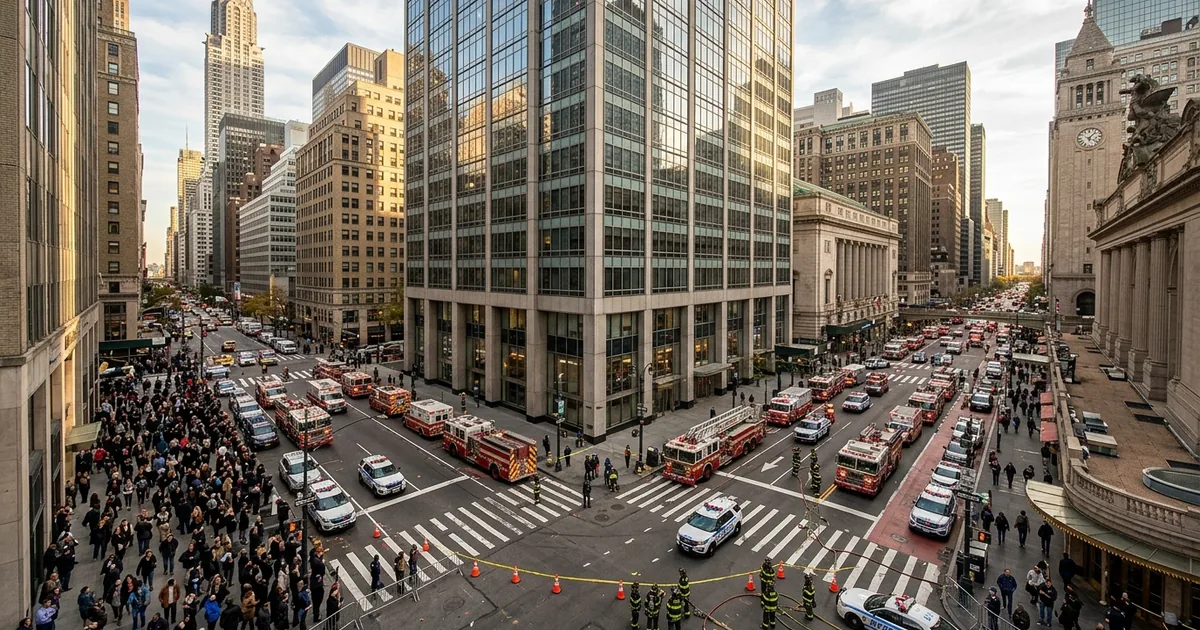
A 37-story Midtown Manhattan tower that once housed Pfizer’s global headquarters began buckling from within on Tuesday morning, forcing the evacuation of at least nine surrounding buildings and shutting down three city blocks in one of the most dramatic structural emergencies New York has seen in years.
The building is not old or neglected; it is in the middle of what was supposed to be the largest office-to-residential conversion in the city’s history, and the developer’s own founder now says the weight his company added to the top of the structure likely caused the failure.
What Happened Inside 235 East 42nd Street
Construction crews working on 235 East 42nd Street, a concrete-frame tower two blocks from Grand Central Terminal, called the fire department at 7:57 a.m. after noticing falling bricks and visibly deforming structural supports. Firefighters arriving on scene found two load-bearing columns on the 21st and 22nd floors had buckled, and multiple floors between the 21st and 26th stories were sagging downward under their own weight.
By mid-morning, 150 fire and EMS personnel with more than 50 units had established a frozen zone around the site. A nearby school housing roughly 400 students was evacuated. The Israeli consulate, located in an adjacent building, was also emptied. No injuries have been reported, and all construction workers have been accounted for.
The Building Is Still Moving
At an afternoon press conference, FDNY Chief of Department John Esposito delivered a blunt assessment. The building, he said, is showing “continual movement.” It is “not yet stable,” and the situation remains “very serious and dangerous,” he told reporters.
Mayor Zohran Mamdani confirmed that the structure “remains unstable,” though a small team of six engineers was able to enter the building Tuesday evening to begin staging shoring equipment. By nightfall, prep work was complete and contractors were cleared to begin installing temporary steel supports, with the stabilization effort expected to continue through the night and into the coming days.
One evacuated building at 222 East 44th Street was cleared for residents to return, but the frozen zone around 235 East 42nd remained in place.
The Why: a Developer Bet That Overloaded the Structure
This is not a story about an aging building finally giving out. It is a story about what happens when a developer pushes a mid-century office tower past its structural limits in pursuit of the biggest residential conversion New York has ever attempted.
MetroLoft, the firm behind the project, was adding more than a dozen new stories on top of the existing 37-floor structure to create over 1,600 rental apartments. Nathan Berman, MetroLoft’s managing principal and founder, told the Wall Street Journal he believes the additional weight from the new construction on the roof caused the columns to buckle. That is the developer himself pointing to the conversion’s scope as the cause of the failure.
The project had been billed as a landmark of New York’s push to convert underused commercial real estate into desperately needed housing, a policy initiative that both city and state officials have championed as a solution to the affordability crisis. Tuesday’s structural failure lands directly on that policy promise. If the city’s flagship conversion project is buckling under its own ambition, it raises uncomfortable questions about the engineering review and permitting process that approved it.
A City Already Tested This Week
The timing compounds the optics. Just hours before the building emergency, New York was still dealing with flash floods that turned Brooklyn and Queens into rivers, exposing the same infrastructure vulnerabilities that surface every time a major storm hits. Two emergencies in one day, both rooted in the gap between what the city’s physical systems can handle and what gets built, approved, and left to weather the consequences.
What Comes Next
The immediate priority is the shoring operation. If the temporary supports hold and the building stabilizes, the Department of Buildings will need to conduct a full structural assessment before any decision about the conversion’s future. MetroLoft will face scrutiny from city regulators, and the broader office-to-residential conversion pipeline will face questions about whether the engineering standards are adequate for projects of this scale.
For the hundreds of residents and workers displaced Tuesday, the more immediate question is simpler: when can they go home? For some, the answer came by evening. For those closest to 235 East 42nd, it may be days.
The building that was supposed to prove New York could reinvent its skyline is, for now, proving the opposite: that the gap between ambition and structural reality has physical consequences, and they landed in the middle of Midtown on a Tuesday morning.