
Marjane Satrapi, the Franco-Iranian artist whose graphic memoir “Persepolis” gave millions of readers a visceral, deeply personal window into life under the Islamic Republic, has died in Paris at the age of 56.
Her publisher confirmed the news on Wednesday morning, and the French cultural world responded with an outpouring of tributes that underscored just how thoroughly Satrapi had reshaped the way the West understood Iran.
A Life Drawn in Black and White
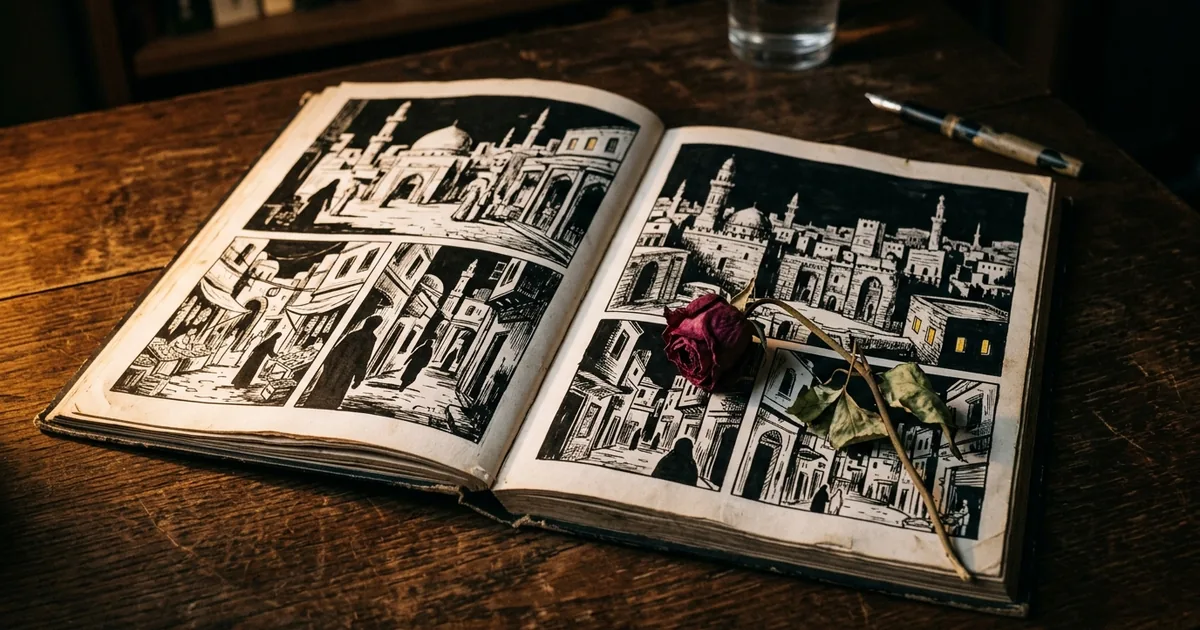
Born in Rasht, Iran, in 1969 and raised in Tehran, Satrapi grew up in a family of progressive intellectuals who watched the 1979 revolution and its aftermath destroy the open society they knew. “Persepolis,” published in four volumes between 2000 and 2003, told that story with a deceptive simplicity that was its genius: stark black-and-white panels, no shading, no color, just the unvarnished geometry of a child trying to make sense of a world that had gone mad.
The book became a global phenomenon. It was translated into dozens of languages, sold millions of copies, and was adapted into an animated film in 2007 that earned an Academy Award nomination for Best Animated Feature. Satrapi co-directed the film herself, insisting on preserving the hand-drawn aesthetic that made the source material so immediate.
The Exile Who Refused to Be Quiet
Satrapi arrived in France in 1994 and became a French citizen in 2006, but she never stopped engaging publicly with the politics of the country she left behind. She was a vocal critic of Iran’s theocratic government, and as France 24 noted, that criticism put her on a collision course with Iranian authorities who banned her work and attempted to discredit her legacy.
What made Satrapi different from many exile voices was the medium. Graphic novels were not, at the time she published, a respected vehicle for serious political memoir. She changed that. “Persepolis” demonstrated that comics could carry the weight of history, trauma, and political argument with a force that traditional prose sometimes struggled to match. It was not a simplification of the story. It was a distillation.
A Death Attributed to Grief
Friends and colleagues told multiple outlets that Satrapi had struggled profoundly since the death of her husband, Swedish producer and actor Mattias Ripa, who died on April 8, 2025. “She died of sadness,” one close friend told French media, a description that carries both the poetry and the tragedy of a life spent converting pain into art.
Beyond “Persepolis,” Satrapi directed the live-action films “Chicken with Plums” (2011) and “The Voices” (2014), wrote several other graphic novels, and remained a sharp commentator on censorship, exile, and the politics of storytelling across cultures. She was, in the fullest sense, an artist who used every tool available to insist that the world pay attention.
What She Leaves Behind
“Persepolis” will endure. It is one of those rare works that functions simultaneously as memoir, history, political argument, and art object. It is taught in high schools and universities worldwide. It has introduced more Westerners to modern Iranian life than any diplomatic communique or news report ever could.
Satrapi would probably have appreciated that irony. A woman who left Iran because the regime could not tolerate her ended up explaining Iran to the world more effectively than anyone the regime ever produced. She was 56, and the world is smaller without her.