
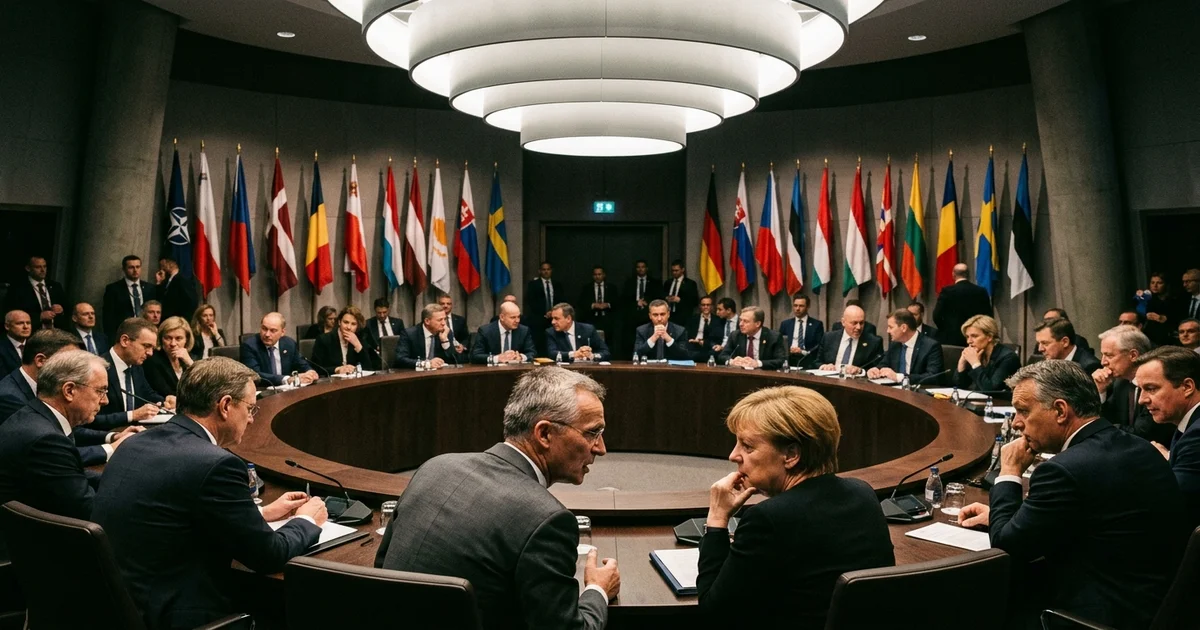
NATO’s 32 member nations convened in Ankara on Tuesday for a two-day summit that was supposed to project unity and strength. Instead, the gathering is dominated by a single question: whether President Trump’s demand that every ally spend 5% of GDP on defense will fracture the alliance he claims to be strengthening.
The number itself is staggering. When Trump first pressured allies to meet the existing 2% target during his first term, most of Europe balked. At last year’s summit, he pushed that number to 5%, and NATO members made vague pledges to work toward it over the next decade. Now Trump wants timelines, commitments, and consequences. “President Trump fully expects that all allies will step up immediately and get on the path to 5% and do it with urgency,” U.S. Ambassador to NATO Matt Whitaker told reporters, as NPR reported ahead of the summit.
The Math Does Not Work for Most Allies
Here is the problem with the 5% demand: only a handful of NATO members currently meet even the 2% benchmark, and most of those only crossed that line in the past two years under intense American pressure. Jumping to 5% would require countries like Germany, Canada, and Spain to roughly triple their defense budgets, which would mean either massive tax increases, deep cuts to social programs, or both. For most European democracies, that is not a policy adjustment. It is a political impossibility.
Trump’s calculation appears to be that fear of American disengagement will override domestic politics. He has said publicly that it is “ridiculous” for the United States to maintain current NATO support levels while allies free-ride on American military spending. The implicit threat, that the U.S. might scale back its security guarantee, is the leverage that makes the 5% demand more than rhetorical.
Zelensky Meeting Carries the Summit’s Highest Stakes
Ukrainian President Volodymyr Zelensky arrived in Ankara as a non-alliance head of state, but his Wednesday meeting with Trump may be the most consequential bilateral of the entire summit. The encounter comes as Russia has intensified drone and missile attacks on Ukrainian infrastructure, and Trump’s pressure campaign on spending is directly linked to his argument that Europe, not the U.S., should bear more of the cost of supporting Ukraine.
A senior U.S. official told reporters that Trump feels “a sense of urgency” to bring the war to an end and will speak with Zelensky about how to do so. In diplomatic language, “urgency” paired with a spending ultimatum typically means the U.S. is preparing to condition future Ukraine aid on European financial commitments. Zelensky’s challenge is to keep American support locked in while the spending debate plays out.
Trump also plans to call Russian President Vladimir Putin after the Zelensky meeting, a sequencing choice that sends its own signal about where the administration sees the endgame.
Turkey as Host Adds a Layer of Complexity
Ankara is not a neutral venue. Turkey sits at the intersection of every tension line running through the alliance: it borders Syria, where explosions rattled Damascus during Macron’s visit just hours before the summit opened. It has been a difficult NATO partner for years, blocking Sweden’s membership bid until 2024 and purchasing Russian S-400 missile systems in defiance of allied consensus.
President Erdogan, who meets Trump on Tuesday, has positioned himself as a mediator between Russia and the West on Ukraine, a role NATO’s European members view with suspicion. Hosting the summit gives Turkey visibility and legitimacy at a moment when Erdogan badly needs both.
What the Summit Will Actually Produce
NATO Secretary General Mark Rutte has outlined three priorities: accelerate defense investment, boost transatlantic defense-industrial production, and sustain Ukraine support. The final communique will likely include stronger spending language than last year’s, but actual enforcement mechanisms remain elusive. NATO has no way to force sovereign nations to spend, which is precisely the structural gap that frustrates Trump and gives his spending demands their coercive edge.
The real outcome will be measured not in the text of a communique but in what happens in the bilateral meetings. If Trump and Zelensky leave their Wednesday session with a concrete framework for burden-sharing on Ukraine, the summit will have justified its existence. If Trump uses the Ankara stage primarily to publicly shame allies over spending, the alliance leaves weaker than it arrived, which would be a gift to the one capital not represented at the table: Moscow.